

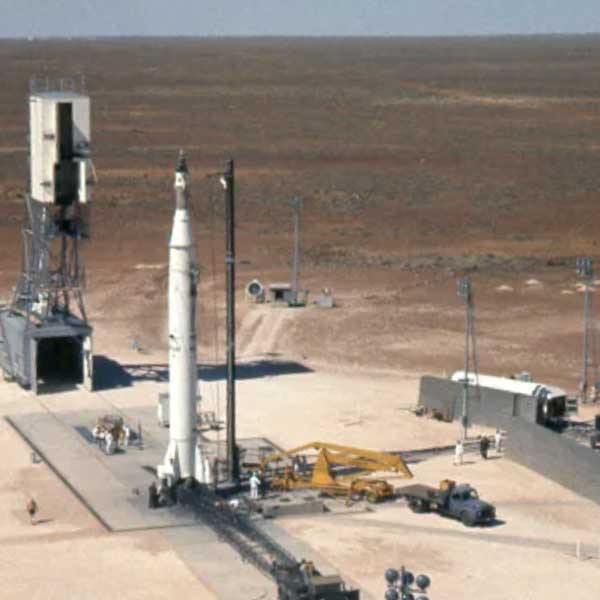
The Second World War had demonstrated, with devastating clarity, what Germany had achieved with its V-2 programme. Britain emerged from the war determined to develop its own long-range guided weapons capability. The problem was self-evident: Britain was small, densely populated, and surrounded by sea lanes and the territory of allies and neutrals. There was nowhere to test anything that moved at the velocities these weapons required. Australia, by contrast, was enormous, sparsely inhabited, and enthusiastically cooperative. The Anglo-Australian Joint Project, established in 1946, formalised an arrangement that suited both parties: Australia provided the land, the facilities, and most of the funding; Britain provided the scientific equipment, most of the personnel, and the weapons being tested.
The site identified became Woomera, named for the Aboriginal spear-throwing device, the short hooked stick that allowed a hunter to extend their arm and hurl a spear with considerably greater force than the arm alone could provide. Construction of the range began in 1947, and it required workers. Britain and Australia recruited them partly from the displaced persons camps of post-war Europe, men and women who had survived the war in countries that no longer wanted them or that no longer existed in the form they had left, who had been offered passage to Australia in exchange for two years of labour.
They arrived to find themselves in canvas tents in a desert, building a secret weapons facility in the interior of a continent most of them had never imagined visiting. The heat was extraordinary. The isolation was absolute. The work was physically brutal. Many of them stayed in Australia when their contracts ended. Woomera was, among other things, a waystation for people in transit from difficult pasts toward new lives, which gave the place, from its earliest days, a human texture more complicated than a defence establishment’s official history tends to capture.
By the mid-1960s, at the height of the Cold War, the village population reached around 7,000. Scientists, engineers, military personnel, and their families, living in a purpose-built town in the middle of the South Australian desert. It had its own school, hospital, cinema, swimming pool, bowling alley, radio station, supermarket, and football club. The Fourth of July was celebrated there, because American influence was significant enough. NASA ran a Deep Space Station at Woomera, DSS-41, one of only three in the world, which tracked the Mercury and Gemini programmes and the early Ranger and Mariner missions. Residents describe it now as a place where every nationality imaginable lived side by side, united primarily by the peculiarity of their shared location and the secrecy of their shared purpose.
The range itself was vast. At its peak the complex covered 270,000 square kilometres, larger than the United Kingdom, roughly the size of the state of New Mexico. Around the station homesteads within the range, rocket pieces stood like garden gnomes. Each of the pastoral stations within the Woomera Prohibited Area had its own bomb shelter, though most were rarely used. At its Cold War peak, Woomera had the highest quantity and rate of rocket launches in the world after NASA’s facilities at Cape Canaveral. Over the full operational period, more than 518 launches were recorded. It was the busiest piece of sky outside of Florida, and almost nobody outside the fence knew it.
Black Knight and the Art of Coming Back
The first large rocket to fly from Woomera was the Black Knight, not a satellite launcher but a research vehicle, designed to answer a question that Britain’s nuclear deterrent programme urgently needed answered: what actually happened to a warhead when it came back through the atmosphere at ballistic missile speeds? The physics of atmospheric reentry was, in the mid-1950s, poorly understood. There were genuine fears that a warhead might simply burn up like a meteor, rendering the entire concept of a land-based nuclear missile unworkable.
The rocket was 11.6 metres tall, burning kerosene and high-test hydrogen peroxide in a Gamma engine. Its engines were tested on the Isle of Wight before the completed vehicles were shipped to Australia. The journey from the Isle of Wight to the South Australian desert, by sea, then rail, then road, took weeks. Each rocket represented months of precision manufacturing and was handled with corresponding care across thousands of miles of transport before being stood up on the pad at Launch Area 5A or 5B and fired into the desert sky.
Between 1958 and 1965, a total of 22 launch vehicles were fired, none of which suffered any major failures. The early flights carried plain copper spheres, silica spheres, and cones, lofted to altitudes of up to 800 kilometres before plunging back at velocities simulating ICBM reentry. All the reentry firings took place on clear, moonless nights, deliberately scheduled so that the luminous wake of the descending vehicle could be observed and photographed against the dark sky. Scientists at ground stations across the range tracked the glowing trails and built up an empirical picture of what materials survived reentry and what didn’t. The answer: a cone-shaped head, reentry pointed-end first, clad in a composite asbestos-based material called Durestos became the template for subsequent British and allied missile warhead designs.
When Blue Streak was cancelled as a weapon in 1960, the justification for Black Knight’s existence technically evaporated. In practice, the Americans had noticed how reliable the vehicle was and paid to use it for their own tests. Under programmes codenamed Gaslight and Dazzle, Black Knight was used to study the radar signatures of reentry vehicles and their plasma trails — data critical to the development of early warning systems and anti-ballistic missile defences. To reach the higher reentry speeds of an ICBM, a small solid Cuckoo second stage was added, mounted inverted to accelerate the reentry vehicle shape downward into the atmosphere rather than upward into space. The resulting flights reached apogees of over 800 kilometres and reentry velocities that no other British vehicle could generate. Black Knight made its final flight on 25 November 1965, having achieved its objectives with a reliability rate that no other British rocket programme has equalled before or since.

Black Knight
Black Knight
1st launch attempt: 7 September 1958
Launch Site: LA-5a, Woomera Rocket Range, SA, Australia
Orbital Type: Sub-orbital
Country of Origin: United Kingdom

Woomera LA-5a
Woomera LA-5a
1st launch attempt:
Launch Site:
Orbital Type:
Country of Origin:
Blue Streak: The Missile That Became a Rocket That Became a Political Problem
Blue Streak was Britain’s attempt to build an independent nuclear deterrent on a ballistic missile. Its design, begun in 1955, was based substantially on the American Atlas — itself a marvel of thin-walled pressure-stabilised structure — with Rolls-Royce developing new RZ-2 engines burning liquid oxygen and kerosene for the British version. The missile would have been stored in underground silos and fired at targets in the Soviet Union. It was, by the standards of the mid-1950s, a coherent and technically serious programme.
Doubts arose however as the cost escalated from the first tentative figure of £50 million submitted to the Treasury in early 1955, to £300 million in late 1959. The silos were judged dangerously vulnerable to a Soviet first strike — a Blue Streak missile required hours of liquid oxygen loading before it could be fired, during which time it sat in its silo waiting. American Skybolt missiles, carried under RAF aircraft already in the air, promised a more survivable deterrent. The project was unexpectedly cancelled in April 1960. The problem was what to do with everything that had already been built and paid for. The rocket was too expensive to abandon entirely. It was proposed that it could be repurposed as the first stage of a satellite launcher, its military embarrassment laundered into European respectability through a new name and a multinational programme. This became ELDO and the Europa rocket.
When the Commonwealth Government agreed in 1956 to allow Blue Streak to be tested in Australia, it led to a huge development programme to open up the full length of Woomera Range for use, because the trial flights were planned to cover well over a thousand miles, travelling north-west from Lake Hart almost to the Indian Ocean. Blue Streak’s launch site was at the edge of Lake Hart, a dry salt lake whose white surface provided a striking visual contrast to the red desert. The rocket stood 21 metres tall and 3 metres in diameter — the largest vehicle Woomera had ever hosted. From Lake Hart, tracking, measuring and recording instruments had to be installed across the deserts of central Australia all the way to the Talgarno impact area in Western Australia. They even built a small town at Talgarno to house the researchers who would examine each missile when it impacted at the end of its test flight.
The infrastructure required to fire one rocket in a remote desert — tracking stations strung across hundreds of kilometres of outback, a purpose-built township in the Western Australian desert to examine impact sites, roads and communications links across country that had previously had none — was itself an engineering achievement. The launches, when they finally happened, were simultaneously impressive and anticlimactic. The Blue Streak first stage performed well on every test.

Blue Streak
Blue Streak
1st launch attempt: 5 June 1964
Launch Site: LA-6, Woomera Rocket Range, SA, Australia
Orbital Type: Sub-orbital
Country of Origin: United Kingdom

Woomera LA-6
Woomera LA-6
1st launch attempt:
Launch Site:
Orbital Type:
Country of Origin:
Skylark and the Flock of Australian Rockets
While Black Knight and Blue Streak were pursuing their respective military objectives, a parallel scientific programme was building Woomera’s most enduring legacy — a body of atmospheric and astronomical research conducted over nearly two decades by a flock of British and Australian sounding rockets that gave the range its most consistent scientific productivity. Britain’s Skylark sounding rocket programme became the longest-operating space project at Woomera, launching British, Australian, European and American scientific instrument packages.
First fired from the range on 13 February 1957, Skylark was a simple unguided rocket — a solid propellant motor with a payload section, no guidance system, and a trajectory determined entirely by the angle at which it left the launch rail. Each vehicle was flown from Britain and assembled at the range’s workshops, transported 270 kilometres to the launch site, prepared across two weeks, and mounted on its inclined launch rail two days before firing. The launch itself was observed from an underground control room at the edge of the concrete apron. By 1967, over 157 Skylark launches had been conducted from Woomera alone, carrying in excess of 300 scientific experiments.
Alongside Skylark, the Weapons Research Establishment inaugurated its own sounding rocket programme with the first successful Australian-built sounding rocket, Long Tom, developed from surplus British motors. Long Tom was 8.2 metres tall and was, by any technical standard, modest — originally an instrumentation test vehicle adapted for carrying equipment used for research into atmospheric conditions, first fired in October 1957, only ten weeks after the decision had been taken to make the rocket. Long Tom’s propellants came from surplus British Gosling motors; its structure and instruments were Australian. It worked. Long Tom was the first of what became a distinctively Australian menagerie, each vehicle named for a native bird or creature.
Kookaburra was a two-stage vehicle using Lupus 1A and Musca cast composite propellant motors, replacing the earlier HAT programme that measured atmospheric temperature profiles by releasing instrumented packages at altitude. Kookaburra was used in an international experiment in March 1970 when a group of firings was carried out simultaneously with Britain and India in order to obtain a comparative assessment of atmospheric temperature and ozone levels — a moment of multinational scientific cooperation conducted from an outback launch pad and a pair of overseas sites simultaneously, coordinated by telegram and telephone across three continents.
Cockatoo was larger — a two-stage vehicle using a Gosling I first stage and a Lupus 1 second stage — and became the primary vehicle for “falling sphere” experiments, in which a lightweight sphere was released at altitude and its aerodynamic deceleration used to measure atmospheric density with great precision. More than 60 Cockatoo launches were conducted between 1968 and 1973.
Jabiru was a different animal entirely, a hypersonic research vehicle rather than an atmospheric sounder, its flights aimed at studying aerodynamic heating and control at very high velocities, reaching altitudes of around 250 kilometres and serving the Royal Aerospace Establishment’s research into reentry vehicle behaviour.
Aero High, the largest locally designed sounding rocket, was used for releasing chemical clouds at altitude, aluminised grenade payloads that produced artificial glow clouds observable from the ground, used to trace wind patterns in the upper mesosphere.
Between 1960 and 1976, more than 400 sounding rockets were fired from Woomera. The scientific output of this programme, atmospheric density profiles, ozone measurements, X-ray astronomy surveys, ultraviolet stellar observations fed directly into the understanding of Australia’s meteorology, the structure of the upper atmosphere, and the nature of the X-ray sky that no ground-based telescope could observe. It also built the engineering culture and instrument expertise that made WRESAT possible. The satellite that Australia launched in eleven months was not built from nothing, it was built by people who had been launching rockets and recovering data from them for a decade.
The Geographic Curse
Every rocket that reached orbit from Woomera did so from a site at approximately 31 degrees south latitude, firing northward to avoid overflying populated areas. The range’s 1,850-kilometre corridor ran north-northwest toward the Indian Ocean — a safe trajectory that gave the range safety officer confidence and gave the rockets a significant physics problem. Orbital launches work best when they fly east — in the same direction Earth rotates — so that the planet’s rotational velocity, around 1,400 kilometres per hour at that latitude, is added to the rocket’s speed for free. Woomera’s launches flew roughly north, gaining almost none of this benefit, and achieving orbits with inclinations of 82 to 84 degrees — nearly polar, the most expensive possible inclination to reach from that latitude.
The economics were brutal. A rocket launching east from Kourou in French Guiana, at 5 degrees north latitude, gets approximately 1,670 kilometres per hour of Earth’s rotation for free. A rocket launching north from Woomera at 31 degrees south gets perhaps 200 kilometres per hour in the wrong direction. The penalty in propellant mass — and therefore in payload capacity lost to the orbital mechanics problem rather than to the payload itself — was severe enough that Woomera was simply not competitive as an orbital launch site for anything requiring commercial viability. The same rocket that could lift one tonne to orbit from Kourou could lift considerably less from Woomera.
For sounding rockets this didn’t matter at all — a Skylark or a Kookaburra fired vertically returns to Earth regardless of which direction it goes, and atmospheric physics doesn’t care about orbital inclination. For orbital ambitions it was, in the end, decisive. The range that had been the second busiest launch site in the world was optimised perfectly for everything except the thing that the space age increasingly demanded.
ELDO: Europe’s First Attempt
The European Launcher Development Organisation, established in 1962, chose Woomera as its primary launch site for reasons that made sense at the time: established infrastructure, proven range safety systems, clear skies, and a vast downrange corridor over uninhabited land. Australia joined as an associate member, contributing facilities rather than direct funding. The Europa rocket being assembled there was a genuinely multinational machine, its stages provided by different countries with different engineering cultures, different measurement standards, and different institutional priorities, integrated at a launch site 15,000 kilometres from most of them.
Blue Streak became Europa’s first stage, its RZ-2 engines replaced by RZ-12 versions for the repurposed role. The French Coralie second stage and the German Astris third stage sat above it. Blue Streak performed reliably across its test launches. Despite no longer being useful as a missile, it would still feature at the heart of several proposed satellite launcher concepts, and as Europa’s first stage it was, by any measure, the most technically mature component of the stack. The problem, consistently and fatally, was above it.
Issues with the upper stages persisted, and on the only flight where all three stages operated correctly, the rocket’s payload fairing failed to separate. Of the ten Europa launches from Woomera between 1964 and 1970, none achieved orbit. The programme relocated to Kourou — partly for the orbital mechanics reasons described above, partly in hope that a fresh site might break the pattern yet it failed there too, on its first and only Kourou attempt in November 1971, when the guidance system failed 150 seconds into flight.
What the Woomera years of ELDO produced, beyond the catalogue of failures, was an understanding of exactly how hard multinational rocket development was. The Blue Streak team and the Coralie team and the Astris team worked in different languages, exchanged documentation across different engineering conventions, and met in person only occasionally. When something failed at Woomera, the investigation had to span three countries and several corporate structures simultaneously. The lessons about governance, documentation standards, and integrated testing that the ESA drew from ELDO’s failure shaped Ariane’s development. ELDO documented its failures thoroughly and Ariane benefitted.

Europa
Europa
1st launch attempt: 23 May 1966
launched w/ dummy 2nd and 3rd stages
Launch Site: LA-6, Woomera Rocket Range, SA, Australia
Orbital Type: Orbital
Country of Origin: ELDO (UK, France, Germany, Italy)
Woomera LA-6
Woomera LA-6
1st launch attempt:
Launch Site:
Orbital Type:
Country of Origin:
Australia’s Moment: WRESAT
The most remarkable launch in Woomera’s history was not a British or European rocket but an Australian one — and it happened in less than twelve months because a window of opportunity opened and someone decided to sprint through it. In 1966, the United States offered Australia a spare Redstone rocket, the same vehicle that had launched Alan Shepard on the first American crewed spaceflight in 1961 — configured as a modified version called Sparta.
The offer came with a condition: use it promptly, because the rocket had been prepared for another purpose and its window of availability was short. Australia’s Weapons Research Establishment at Salisbury, working with the Physics Department of the University of Adelaide, designed and built a satellite in roughly ten months. The effort was, by the account of the engineers who worked on it, intense enough to halt almost all other WRE sounding rocket activity during that period.
On 29 November 1967, at 2:19 pm local time, the countdown reached zero. A WRE engineer relayed the ignition call to a relay station at Oodnadatta, 500 kilometres away, part of the range safety network. About six minutes after lift-off, the announcement came over the public address that WRESAT was in orbit. Australia became the third country to launch a satellite from its own territory — after the Soviet Union and the United States — and the seventh nation to have a satellite in orbit at all. WRESAT carried instruments studying the upper atmosphere and transmitted data for 73 days before falling silent. It remains the only Australian satellite ever launched from Australian soil.
The achievement was genuine and the celebration real, but Australia drew no sustained programme from it. The WRE had no successor project planned. The political will to build on the moment was not there. WRESAT was, in retrospect, a sprint to a finish line that nobody had arranged a race beyond.
![Sparta [WRESAT]](https://sp-ao.shortpixel.ai/client/to_auto,q_lossless,ret_img,w_800,h_600/https://bricksin.space/wp-content/uploads/2020/03/wresat.jpg "Sparta [WRESAT]")
Sparta [WRESAT]
Sparta [WRESAT]
1st launch attempt: 29 November 1967
Launch Site: LA-8 Woomera Rocket Range, SA, Australia
Orbital Type: Suborbital
Country of Origin: Australia

Woomera LA-8
Woomera LA-8
1st launch attempt:
Launch Site:
Orbital Type:
Country of Origin:
Black Arrow: The Last British Rocket
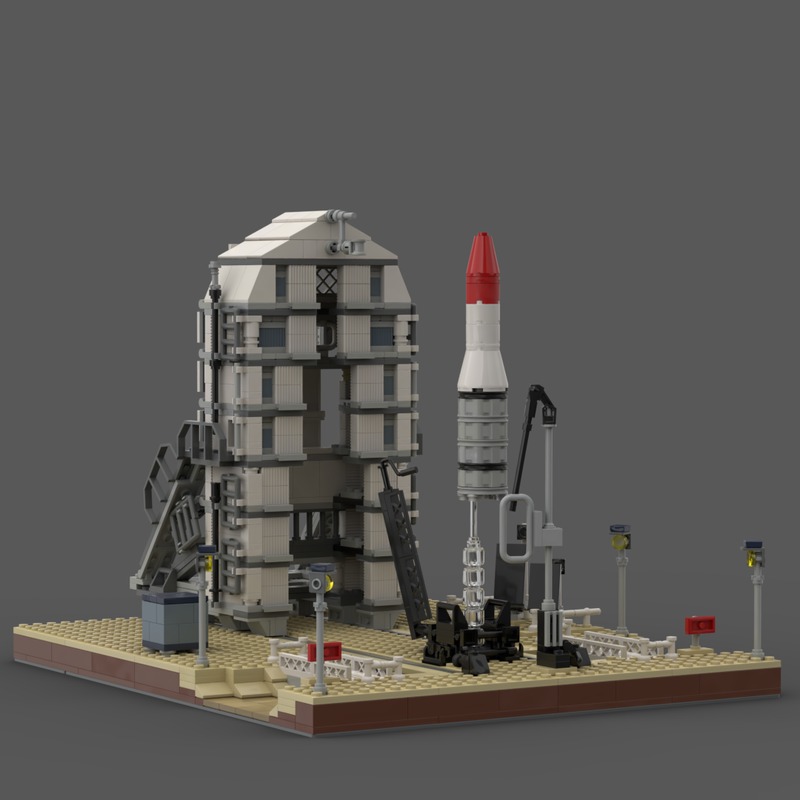
On 28 October 1971, Black Arrow R3 lifted off from Launch Area 5B at Woomera and placed the Prospero satellite into orbit. The satellite was named Prospero after the character in Shakespeare’s The Tempest — the name chosen as a reference to events in the play, in which Prospero, a sorcerer, gives up his powers. The symbolism was pointed. Britain had just cancelled its independent launch capability. The rocket that made the UK the sixth nation to independently orbit a satellite was making its first and only successful flight on the same day its programme no longer existed.
Prospero is still in orbit. It will remain there for centuries. The programme that built it lasted four launches and three years. The final unflown Black Arrow — R4, never launched — is preserved in the Science Museum in London. Britain would not attempt another indigenous orbital launcher for over fifty years, a consequence of choosing to rely on American rockets instead, a decision made on economic grounds that NASA had once offered to make unnecessary by launching British payloads for free, an offer withdrawn when the cancellation was announced.

Black Arrow
Black Arrow
1st launch attempt: 27 June 1969
control lost after 50 sec
Launch Site: LA-5b Woomera Rocket Range, SA, Australia
Orbital Type: Orbital
Country of Origin: United Kingdom
Woomera LA-5b
Woomera LA-5b
1st launch attempt:
Launch Site:
Orbital Type:
Country of Origin:
Decline and Ghost Town
When the Anglo-Australian Joint Project began to wind down in the early 1970s, Woomera’s population began to rapidly drop from its peak of around 7,000. A joint US-Australian signals intelligence facility at nearby Nurrungar, with 1,100 staff stabilised the town’s population through the 1970s and 1980s — but when Nurrungar closed in October 1999, Woomera’s permanent population fell to a few hundred.
The 2016 census recorded a permanent population of 146 people. Today Woomera contains deserted suburban streets of modern houses where no one lives, community halls standing largely unused, churches serving congregations that have not existed for decades. It appears as though the people simply walked out one day. The missile park in the centre of the village preserves what was built and launched from the surrounding range: aircraft, rockets, missiles, the hardware of a Cold War programme that was, for a period, the second busiest launch range in the world. Sixty-five thousand tourists visit each year, which keeps the town functioning at a minimal level. They come to see the rockets. They find a ghost town that used to be a city.
The range’s significance is easy to underestimate because so many of the programmes it hosted failed. ELDO never reached orbit from Woomera. Blue Streak was cancelled before it could become a weapon. Black Arrow succeeded once, then was cancelled. Australia’s satellite programme ended with a single spacecraft. What Woomera generated — in data, in engineering experience, in the X-ray astronomy surveys conducted by Skylark, in the reentry dynamics knowledge extracted from Black Knight, in the multinational cooperation demonstrated by ELDO even in failure — fed directly into programmes that came after it.
The Ariane rocket that succeeded where Europa failed was built by engineers who understood what Europa had done wrong. The ESA was formed partly because ELDO had demonstrated how much harder multinational spaceflight was than anyone anticipated, and had provided a very expensive lesson in why the governance structures mattered as much as the hardware.
The range itself never stopped being useful. In 2002, the University of Queensland launched a rocket from Woomera carrying the HyShot engine — the first successful flight of a hypersonic scramjet engine in history. The range is currently used for testing of next-generation weapons systems, drones, and hypersonic vehicles. Its size — still 122,000 square kilometres, still the largest land-based instrumented test range in the Western world — remains its primary asset. You cannot replicate that much empty sky.