

On 12 April 1955, a rocket the size of a large pencil was fired horizontally across a field in Kokubunji, a suburb of western Tokyo. It was 23 centimetres long, 1.8 centimetres in diameter, and weighed roughly 200 grams. It passed through a series of paper screens stretched across its path — there was no tracking radar in Japan capable of following a vertically launched rocket, so paper screens and cameras were the best available instrumentation. It worked. Twenty-nine such rockets were launched that day, and every one of them was successful.
The man responsible was Professor Hideo Itokawa, and that tiny rocket was the beginning of one of the most methodical, determined, and underappreciated space programmes in history.
The Father of Japanese Rocketry
Itokawa’s background was in aircraft design. During the war, he had worked at the Nakajima Aircraft Company and designed the Ki-43 Hayabusa — a fighter renowned for its extraordinary manoeuvrability, feared throughout the Pacific theatre. After Japan’s defeat, the American occupation banned all aeronautical development, and engineers like Itokawa found themselves professionally stranded. When the San Francisco Peace Treaty restored those rights in 1951, Itokawa returned to the University of Tokyo and began thinking about what came after aircraft.
He was a singular personality — a cellist, a violinist, a ballet dancer who would eventually perform at the Imperial Theatre in Tokyo, a poet who wrote haiku on the range blackboard between rocket tests. His doctoral thesis had been an analysis of violin design. A professor at the University of Tokyo who worked with him believed that Itokawa’s wide-ranging curiosity and challenging spirit were the secret of his achievements. He was also, it turned out, a visionary engineer who could see further than almost anyone around him.
The propellant for Japan’s first rockets was sourced from leftover bazooka fuel from the Korean War — small sticks of solid propellant found at a chemical company near Nagoya. It was an inauspicious beginning. But the team launched 29 rockets over the course of those first experiments, and each one taught them something. The Pencil was never meant to reach space. It was meant to prove that Japan could build a rocket at all.
Growing Up: Baby, Kappa and the Path to Space
From the Pencil came the Baby rocket — 120 centimetres long, equipped with a telemetry system in its nose and, in one variant, a parachute for soft recovery. Japan’s first successful recovery of launched hardware. Then came the Kappa series, gradually more capable, each version pushing higher than the last.
By 1958, the Kappa 6 had reached 40 kilometres — enough to contribute data to the International Geophysical Year alongside the efforts of the superpowers. The team had shifted sites by then, moving from the cramped suburban field at Kokubunji to Michikawa Beach in Akita Prefecture on the Sea of Japan coast, and then, as the rockets grew larger still, to an entirely new facility at Uchinoura in Kagoshima Prefecture, on a hilltop overlooking the Pacific. In 1960, the Kappa 8 crossed 200 kilometres — above the Kármán line, technically into space.
These rockets were built on almost nothing. Funding was chronically inadequate. The tracking radar was operated manually. Production relied on trial and error, and the engineers doing the work were making it up as they went — in the best possible sense. What they lacked in resources they made up in ingenuity and stubbornness.
Lambda, Ohsumi and the Fourth Nation
In the 1960s, the goal shifted from sounding rockets to orbit. The Lambda series was designed as a satellite delivery vehicle, and it was here that Japan encountered its first serious political turbulence. Rocket guidance technology was deemed by some to be inherently military in nature — a controversy that delayed development and complicated funding. There was no easy separation, in postwar Japan, between the civilian space programme that Itokawa represented and the military applications that the technology implied. The debate was real, and it slowed things down considerably.
The Lambda programme also simply failed, repeatedly. Four rockets were lost before the design was right. The Japanese press was openly contemptuous. The failures cost Itokawa his position at ISAS — he resigned, and in a move that said something about his character, immediately enrolled in ballet classes. After five years of training, he performed the role of a nobleman in Romeo and Juliet at the Imperial Theatre. He was in his late fifties.
On 11 February 1970, an unguided L-4S rocket — the fifth attempt — placed the Ohsumi satellite into orbit. Japan became the fourth nation to launch its own satellite on its own rocket, after the USSR, the United States, and France. Ohsumi weighed just 23.8 kilograms and its orbit was highly elliptical, but it was in space and it had got there on a Japanese rocket. The engineers who had built their first propellant from bazooka leftovers had made it to orbit in fifteen years.
Itokawa wasn’t there to see it. He had already left. The asteroid that the Hayabusa probe would later visit was named in his honour.
Two Programmes, One Nation
Japan’s space programme from this point forward ran on two parallel tracks that operated almost entirely independently of each other, which was as strange as it sounds.
ISAS — the Institute of Space and Astronautical Science, heir to Itokawa’s university tradition — focused on scientific satellites and continued developing solid-propellant rockets. It was academic in culture, relatively small in budget, and produced a series of genuinely impressive research satellites: X-ray astronomy platforms, atmospheric observation satellites, and eventually Sakigake and Suisei, which joined the international Halley’s Comet armada in 1986 — the first Japanese deep-space probes, launched on the M-3SII solid rocket that ISAS had developed entirely in-house.
NASDA — the National Space Development Agency, established in 1969 — had a different mandate and a different philosophy. It was focused on practical and commercial applications: communications satellites, weather satellites, the infrastructure of a modern space-faring economy. And to get there quickly, it made a pragmatic decision that would shape the next two decades of Japanese rocketry: it bought American technology.
The Black Box Problem
NASDA’s N-I rocket, first flown in 1975, was built around licensed technology from the American Delta rocket. This got Japan into the business of launching practical satellites quickly and reliably. The N-II followed in 1981, larger and more capable. Both worked well. But there was a problem buried inside the success.
When parts such as the satellite’s apogee kick motor wore down, information on how to improve them was very difficult to obtain. Imported components from the United States were black box systems, which Japanese engineers were not allowed to inspect. The rockets flew. But when something went wrong, NASDA’s engineers couldn’t always understand why, because the critical components were sealed from them by technology transfer agreements. They were operating systems they didn’t fully comprehend.
This was intolerable for a programme built on the principle of self-sufficiency. The answer was the H-I rocket, introduced in 1986, which incorporated a domestically developed second stage engine — the LE-5, burning liquid hydrogen and liquid oxygen — alongside the licensed American first stage. It was a half-step, but an important one. Nine H-I rockets flew, and all nine were successful. Japan was learning, incrementally, how to build its own engines.
The logical endpoint was a rocket that owed nothing to anyone else.
The H-II: Ambition and its Costs
Development of the H-II began in 1984 with a clear mandate: Japan would build its first entirely domestically produced liquid-fuelled rocket. No licensed components. No black boxes. Everything from the ground up.
The centrepiece was the LE-7 first stage engine — a high-performance liquid hydrogen and liquid oxygen design that ranked among the most sophisticated rocket engines in the world. It was also extraordinarily difficult to build. The development programme ran for a decade and claimed, along the way, a worker killed in an accidental hydrogen explosion. Parts were damaged by vibrations. Materials failed durability tests. Hydrogen leaked and ignited in ways that took years to fully understand and prevent.
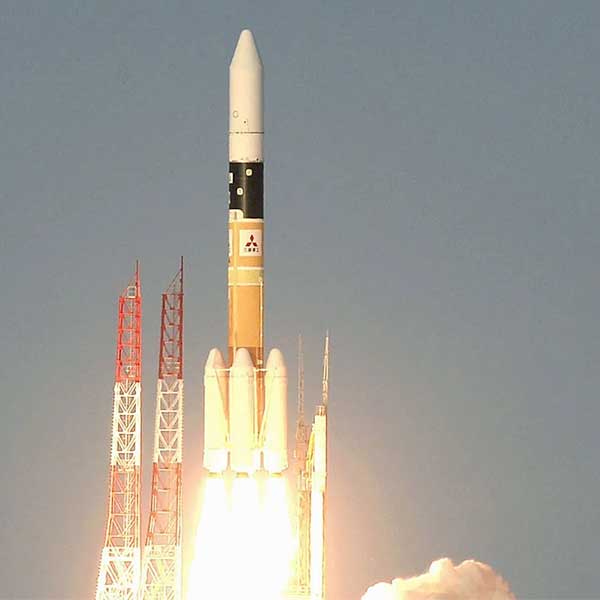
On 4 February 1994, the H-II lifted off from Tanegashima Space Center. It worked. Japan had, at last, a fully indigenous heavy-lift rocket — 50 metres tall, capable of placing satellites into geostationary orbit, built entirely with Japanese technology and Japanese hands.
Each launch cost 19 billion yen — approximately $190 million — too expensive compared to international competitors like Ariane. Rare Historical Photos Part of this was the Plaza Accord’s effects on exchange rates, which had moved dramatically against Japan between the programme’s planning phase and its operational debut. But the cost problem was real regardless, and it put pressure on the programme from the start.
Five H-II launches succeeded. Then, in 1998, Flight 5 suffered a second-stage engine failure — a faulty cooling joint caused premature shutdown, leaving its payload in the wrong orbit. A partial failure, recoverable but damaging. Then, in 1999, Flight 8 failed entirely when cavitation in the LE-7 turbopump caused the first stage engine to cut off early. NASDA sent a submersible to recover the failed engine from 3,000 metres below the Pacific Ocean surface, and conducted exhaustive analysis. The programme was cancelled. A planned seventh launch was scrapped, and the H-II series was terminated.
It was a bruising period. The failures, combined with administrative pressure for reform, led to calls for a complete overhaul of Japan’s space institutions. NASDA issued a public apology — a notably Japanese response to technical failure, carrying real cultural weight. Then they went back to the drawing board.
Starting Again, Simply
The H-IIA was the answer, and the philosophy behind it was deliberately different. Rather than chasing the absolute frontier of engine performance, the design team prioritised reliability and simplicity — fewer weld joints, a redesigned injector, improved turbopump materials drawing on lessons from the LE-7’s failures. The LE-7A that powered the H-IIA was not dramatically more powerful than its predecessor. It was dramatically more robust.
The first H-IIA flew successfully in August 2001. A sixth launch in 2003 failed — a solid rocket booster nozzle burned through, preventing separation — but the programme recovered, resumed in 2005, and proceeded to build one of the most reliable launch records of any rocket in the world. By mid-2025, the H-IIA had achieved a 98% success rate across 50 launches.
In 2003, Japan’s fragmented space institutions — ISAS, NASDA, and the National Aerospace Laboratory — were merged into a single unified agency: JAXA, the Japan Aerospace Exploration Agency. It was overdue. The two-track system had produced genuine achievements on both sides, but it had also produced duplication, competition for funding, and occasional contradictions in national space policy. A unified agency could speak with one voice and set coherent priorities.
That same year, the Hayabusa asteroid sample return mission launched on an ISAS-heritage M-V rocket. Its target: the asteroid 25143 Itokawa.
The Long View
The Japanese space programme’s defining characteristic, across its entire history, is patience. Not the patience of resignation — the patience of a programme that understood it was building something that would take generations, and refused to take shortcuts that would compromise the foundation.
It started with bazooka propellant and paper screens. It navigated occupation, postwar restrictions, political controversy over guidance systems, budget shortfalls, and the frustration of repeated public failure. It bought technology when it needed to, learned from what it bought, and then built its own. It ran two programmes in parallel for three decades that could barely communicate with each other, and somehow produced world-class science from both of them.
By the time JAXA launched the H-IIB in 2009 — capable of delivering supplies to the International Space Station — Japan had one of the most reliable launch vehicles on the planet, built entirely from domestic technology, operated by engineers who understood every component because they had built every component themselves.