

In May 1945, as Allied forces moved through the ruins of Germany, an unusual interrogation was taking place somewhere in the conquered Reich. A Chinese-American scientist wearing an American Army colonel’s uniform was sitting across from Wernher von Braun, asking precise technical questions about the V-2 in language that made the German rocket engineer sit up straight. Von Braun, recognising the quality of the questioning, leaned back and muttered words that would prove prophetic: “You do not realise what you have in this man. He is a genius.”
Nobody in the room knew it, but the father of the American space programme had just been interviewed by the father of the Chinese space programme. And the Americans, through a spectacular act of political self-destruction, were about to hand him to China.
The Man America Sent Away
Qian Xuesen was born in Hangzhou in 1911 and came to the United States on a scholarship in 1935, studying aeronautical engineering at MIT before joining Theodore von Kármán’s group at Caltech. In 1943, Qian and two others in the Caltech rocketry group drafted the first document to use the name Jet Propulsion Laboratory — a proposal to the Army for developing missiles in response to Germany’s V-2 rocket. He co-founded what would become NASA’s primary planetary exploration centre. He was, by any measure, one of the most important aerospace engineers in America.
Then came McCarthyism. In June 1950, the Army abruptly revoked Qian’s security clearance on the basis of alleged communist sympathies — evidence that amounted to his attendance at a pre-war dinner party in Pasadena that the FBI believed had been organised by communists. The Immigration Bureau decided to expel Qian under the Subversive Control Act of 1950. Paradoxically, the Department of Justice simultaneously prevented him from leaving because his technical research might be used by enemy countries for military purposes. Qian was caught between two contradictory laws. He spent five years under effective house arrest, neither free to work nor free to leave.
In 1955, after years of political pressure and diplomatic negotiations, he was released in exchange for the repatriation of American pilots who had been captured during the Korean War. He boarded a ship in Los Angeles and never returned. The US Deputy Secretary of State who had been involved in the case, Dan Kimball, later reflected: “It was the most stupid thing that the US has ever done. He was no more a communist than I was, but we forced him to go.”
In China, Qian received a hero’s welcome. Within a year he had submitted a proposal for a national missile and space programme, approved in record time. The institute he established with fewer than 200 staff — many of them recruited personally by Qian — became the seed of what is today the China Aerospace Science and Technology Corporation. The man America had tried to silence would spend the next four decades building the rockets that China would one day use to challenge American dominance in space.
Starting From Zero
China’s rocket programme in 1956 had almost nothing. What it had was Soviet assistance — and for a few years, that was enough.
Two R-2 missiles, the Soviet upgrade of the German V-2, were secretly shipped to China in December 1957 as part of a technology transfer agreement. Chinese engineers studied them, copied them, and designated the result Dongfeng-1 — East Wind 1. The first successful launch came on 5 December 1960. It was a moment of triumph. It was also almost immediately rendered irrelevant by geopolitics.
The Sino-Soviet split of 1960 ended all Soviet technical assistance abruptly and completely. Soviet advisers departed, taking their documentation with them. Chinese engineers who had been learning from them were left with incomplete knowledge, insufficient equipment, and the instruction to continue anyway. In one of the more remarkable achievements of the early space age — rarely acknowledged in Western histories — they did.
The Dongfeng-2, the first missile designed entirely by Chinese engineers rather than copied from a Soviet template, failed on its first attempt in March 1962. After hundreds of engine firing tests and extensive redesign, it succeeded on its second attempt in June 1964. On 27 October 1966, as part of the Two Bombs One Satellite project, an improved Dongfeng-2A successfully launched and detonated a nuclear warhead at its target. China had tested a live nuclear warhead on a ballistic missile trajectory — a test of terrifying ambition that no other nation had attempted or has attempted since. The missile worked. The warhead detonated at its designated point. The world noticed.
Reaching Orbit
Through the mid-1960s, the missile programme and the nascent space programme evolved in parallel, each feeding the other. The Dongfeng-4, a two-stage intermediate-range ballistic missile first tested in January 1970, provided the propulsion technology for the Long March 1 — China’s first orbital launch vehicle. A solid-propellant third stage was added above the DF-4’s two existing liquid stages, providing the final push to orbital velocity.
On 24 April 1970, a Long March 1 lifted off from Jiuquan Satellite Launch Center and placed the Dong Fang Hong 1 satellite into orbit. The satellite — its name meaning The East Is Red, after the revolutionary anthem — weighed 173 kilograms, making it the heaviest first satellite placed into orbit by any nation. It broadcast the anthem on repeat from orbit, clearly audible to radio receivers on the ground below. China had become the fifth nation in history to reach orbit independently.
It had taken fourteen years from Qian’s return to orbit. It had taken two years after a first crewed spaceflight programme — Project 714, cancelled in 1971 due to political turmoil before any cosmonaut flew — had been abandoned. It had survived the Cultural Revolution, which disrupted everything including space development. The Long March had, in every sense of the name, been long.
Two Paths, One Family
The Long March rocket family that emerged from the early 1970s was not a single programme but two parallel development tracks that would eventually converge into the most prolific launch vehicle family in Chinese history.
The first track began with Long March 2, derived from the Dongfeng-5 ICBM and developed by the First Research Academy in Beijing — what would become the China Academy of Launch Vehicle Technology. Long March 2 used nitrogen tetroxide and UDMH propellants, the same storable hypergolic combination as its missile predecessor. On 26 November 1975, it launched the FSW-0 recoverable satellite into orbit. Three days later the satellite returned to Earth and was successfully recovered — making China the third country after the Soviet Union and the United States capable of retrieving a payload from orbit. The reconnaissance implications were obvious and entirely deliberate.
The second track was the Feng Bao 1, developed by Shanghai’s space industry on the same DF-5 technology base but along a separate institutional lineage. It successfully placed a 1,107-kilogram satellite — the largest Chinese payload yet — into orbit on 26 July 1975. The two parallel programmes, developed by different institutes in different cities from the same missile heritage, would evolve into the Long March 4 and Long March 2 branches of the family respectively — a deliberate redundancy that reflected both the competitive institutional culture of Chinese aerospace and the strategic desire never again to be dependent on a single source of knowledge.
Long March 2C, an upgraded version with improved payload capacity, became the backbone of Chinese launches through the early 1980s. Its reliability record was steadily improving with each flight, and the lessons being accumulated were systematic rather than ad hoc — the quality management culture that Qian and his generation had instilled was beginning to show results.
The Cryogenic Challenge
The next major milestone was geostationary orbit. Communications satellites lived there, in the band of positions 36,000 kilometres above the equator where a satellite’s orbital period matches Earth’s rotation and it appears stationary from the ground. Every television broadcast, every international phone call routed through satellite, every weather image from a geostationary platform depended on the ability to reach that altitude. And the existing Long March rockets couldn’t get there.
The solution was Long March 3 — a Long March 2C with a new third stage powered by a cryogenic liquid hydrogen and liquid oxygen engine. The choice of propellant was controversial internally. Liquid hydrogen required materials, manufacturing tolerances, and handling procedures far beyond anything in the existing Chinese rocket industry. The simpler option was another storable hypergolic upper stage. Chief Designer Ren Xinmin chose the harder path, reasoning that cryogenic propulsion would be essential for China’s long-term space ambitions. Development of a restartable cryogenic engine began in 1976 and wasn’t completed until 1983 — seven years of work on a single engine component.
Long March 3’s first flight on 29 January 1984 suffered a third-stage reignition failure, stranding its experimental communications satellite in low Earth orbit rather than the intended geostationary transfer orbit. Engineers worked through the fault analysis at speed. Less than seventy days later, on 8 April 1984, Long March 3 flew again and placed China’s first geostationary communications satellite — DFH-2 — into its correct orbit. The success made China the fifth country in the world with independent geostationary satellite development and launch capability.
China had ended its reliance on foreign communications satellites in a single decade of focused development.
Opening for Business
The success of Long March 3 opened a door that Chinese authorities moved quickly through. In 1985, China announced a commercial launch programme for international customers — offering Long March vehicles at prices significantly below Western competitors. The first contract, signed with AsiaSat in January 1989 for a Hughes-built communications satellite, reflected the commercial logic clearly: the Long March 3 price was roughly half what an Ariane launch cost. For satellite operators facing the post-Challenger scramble for launch capacity, Chinese pricing was genuinely attractive.
On 7 April 1990, Long March 3 placed AsiaSat 1 precisely into its target orbit. China’s commercial launch programme had its opening success.
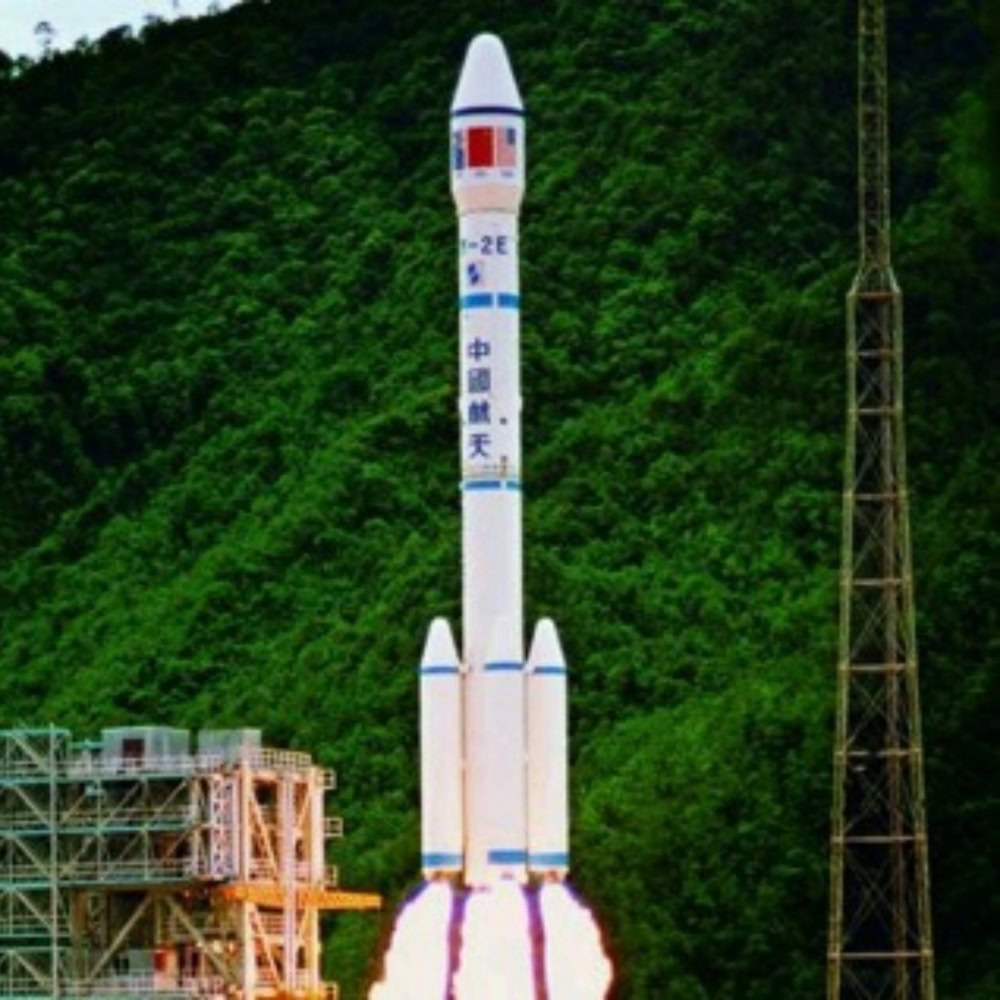
The demand for heavier satellites created the next development. Long March 2E, the first Chinese rocket with strap-on boosters, was designed to lift up to 3,000 kilograms to geostationary transfer orbit — enough for the new generation of commercial telecommunications platforms. Its development story was extraordinary even by the compressed timelines of Chinese rocketry: the contract to launch Australian Optus satellites was signed in November 1988 when neither the rocket nor its launch facility existed beyond conceptual designs. The engineers built all the hardware from scratch in a record-breaking period of eighteen months, impressing the Western contractors who watched the process. Long March 2E’s test flight on 16 September 1990 succeeded in reaching its intended orbit.
The Disasters
What followed was the most turbulent period in the history of Chinese launch vehicles — a sequence of failures that nearly destroyed the commercial programme before it had properly started, and which ended in catastrophe.
On 22 March 1992, a Long March 2E carrying an Optus satellite suffered a launch abort when aluminium scraps caused a short circuit in the control system, triggering an emergency engine shutdown. The rocket — fully fuelled, tipped slightly on the pad — somehow remained standing. A 39-hour rescue operation preserved the payload, rocket, and launch facilities. Five months later a replacement vehicle successfully launched the Optus satellite.
Then, on 26 January 1995, a Long March 2E carrying the Hughes Apstar 2 satellite exploded shortly after launch from Xichang. The shockwave and debris damaged buildings at the launch centre. The failure was attributed to aerodynamic forces causing a payload fairing collapse.
These incidents were manageable — costly, damaging to reputation, but recoverable. What came next was not.
On the night of 14-15 February 1996, a festive atmosphere surrounded the Xichang Satellite Launch Center. The maiden flight of Long March 3B — China’s most powerful rocket yet, configured with four liquid strap-on boosters around a Long March 3A core — was carrying Intelsat 708, a contract worth $56 million. The launch was being broadcast live on Chinese state television, the signal transmitted simultaneously to Intelsat’s headquarters in the United States. American engineers from Space Systems/Loral were on site. Outside the launch centre’s main gate, a crowd of local residents had gathered, dressed in their best clothes, in a party atmosphere, to watch the liftoff. The launch had been deliberately delayed from 2:51 to 3:00 am — three being a lucky number.
At 3:01 Beijing time, the Long March 3B was ignited and slowly lifted off from Pad 2. During the first two seconds, everything seemed to go well. But to everyone’s surprise, before the rocket had even cleared the umbilical tower, it veered off and started to fly horizontally. The rocket pitched east, flew directly over the tower, turned sideways and flew toward the residential area adjacent to the launch complex. Twenty-two seconds after liftoff it was remotely detonated — it crashed into a hillside and the propellant ignited in a massive explosion that flattened Mayelin Village.
The Chinese official death toll was six killed and 57 injured. The American engineers present told a different story. Bruce Campbell of Astrotech, one of the eyewitnesses, described seeing many dozens if not hundreds of people gathered at the main gate moments before the explosion. Dozens of ambulances and military trucks were seen in the aftermath. Western reporters were sequestered for hours while, some alleged, the site was cleared. The remains of the village were promptly demolished. A year after the accident, almost nothing remained. No memorial was ever erected. The true death toll has never been established and almost certainly never will be.
The disaster was the most severe in the history of Chinese space launch. It came four days before Chinese New Year. It was broadcast live to American television screens. And it happened in front of dozens of Western witnesses whose accounts the Chinese government couldn’t fully control. The investigation identified a guidance platform failure — a short circuit at the moment of liftoff. The cause was identified. The fix was implemented. The consequences for those killed in Mayelin Village have never been officially acknowledged.
Recovery and Reckoning
The Chinese space industry’s response to the failures was systematic and determined. A closed-loop quality management system was established, addressing both technical processes and institutional culture. The changes were genuine rather than cosmetic — what emerged was a reliability improvement that would eventually produce one of the best long-run records in the industry.
Long March 3B flew successfully for the first time on 20 August 1997, placing the 3,770-kilogram Agila-2 communications satellite into orbit. It offered a GTO payload capacity as high as 5,000 kilograms, capable of putting the different kinds of heavy satellites available on the international market into orbit. ESA Long March 3B became the backbone of China’s commercial and institutional geostationary launches from that point forward.
Then came the political earthquake.
In 1998, the United States accused Hughes and Loral of having shared technical information with Chinese engineers during investigations of the 1995 and 1996 failures — information that American authorities alleged had inadvertently improved Chinese ballistic missile reliability. The Cox Report, released in 1999, made sweeping accusations about Chinese theft of American space and weapons technology. Congress responded by reclassifying commercial satellites as munitions under the International Traffic in Arms Regulations, effectively prohibiting the launch of any satellite containing American components on Chinese rockets. The two Iridium satellites launched by Long March 2C on 12 June 1999 became the last American satellites launched by a Chinese rocket.
The irony was immediate and obvious to anyone paying attention. The same political logic that had deported Qian Xuesen — the belief that restricting Chinese access to American technology would contain Chinese capabilities — was being applied again. And as before, the primary effect was to accelerate Chinese self-sufficiency. Cut off from American components and American customers, Chinese aerospace concentrated on developing domestic alternatives. The sanctions that were intended to limit China’s space capabilities became, over the following two decades, one of the primary drivers of Chinese space independence.
Qian Xuesen lived to see his programme reach its first crewed spaceflight in 2003 — the Shenzhou spacecraft he had helped design, launched on a Long March 2F derived from technologies he had set in motion fifty years earlier. He died in 2009 at the age of ninety-seven, having outlasted the Soviet Union that had briefly been his programme’s patron, the Cultural Revolution that had tried to destroy everything he built, and the Cold War that had made him an exile in the first place.