

In 1962, a small fishing village on the southwestern tip of India became the unlikely birthplace of a space programme. Thumba, in Kerala, sat almost precisely on the magnetic equator of the Earth — scientifically ideal for launching sounding rockets to study the upper atmosphere. There was just one problem. The land required for the launch station was occupied by the St. Mary Magdalene Church, its bishop’s residence, and the homes of the local fishing community.
The man sent to negotiate was Vikram Sarabhai, a physicist from Ahmedabad who had recently convinced the Indian government to establish a national space research committee. He did not arrive with lawyers or compulsory purchase orders. He met with the Bishop of Trivandrum and explained, quietly and at length, that science and spirituality share a common quest for truth — both are attempts to understand the universe. The church was voluntarily ceded to the scientists. The prayer hall became the design workshop. The bishop’s house became the office. A nearby school became the laboratory.
When the first rockets arrived, there were no heavy vehicles to transport them to the pad. The nose cones were loaded onto bicycles and pedalled to the launch site by hand.
This was how India’s space programme began — not with the might of a superpower’s industrial complex, not with the urgency of a Cold War arms race, but with a borrowed church, borrowed bicycles, and a vision so practical and so human that it barely resembled what the Americans and Soviets were doing at the same moment. Where Kennedy had declared a Moon race and Khrushchev had responded in kind, Vikram Sarabhai wrote a document that asked a different question entirely: what could space technology do for a developing nation of 450 million people, most of them rural, many of them poor?
His answer shaped everything that followed.
The Vision
Sarabhai was not an obvious revolutionary. Born in 1919 into one of Gujarat’s wealthiest industrial families, educated at Cambridge, he had every reason to pursue a comfortable career in pure science. Instead he returned to an independent India in 1947 and immediately began building institutions — the Physical Research Laboratory in Ahmedabad, founded the same year in a room of his own residence with support from family trusts, was the first. He was 28 years old.
What distinguished Sarabhai from almost every other space programme founder of his era was his explicit rejection of prestige as a justification. In 1961, a colleague described Sarabhai speaking at a space research meeting in Washington: “He spoke of agricultural, family planning and health education being given to the non-urban population by satellites. He argued that it would be faster to use a satellite to provide a high-quality, nationwide telephone system than to use a conventional ground-based microwave system. He spoke of space scientists applying their intellectual capabilities to practical problems.” Space, in Sarabhai’s framework, was not for planting flags. It was for connecting rural teachers to educational broadcasts, for giving weather forecasts to fishermen before they put to sea, for surveying crops and tracking monsoons across a subcontinent too large for conventional ground infrastructure to serve efficiently.
This philosophy — space technology as development tool rather than prestige project — was the founding DNA of what became ISRO, formally established on 15 August 1969, India’s Independence Day. It has shaped every budget decision, every mission priority, and every engineering choice the organisation has made in the half century since.
The cost of building a space programme on development principles, rather than prestige principles, was that funding was always limited and always contested. ISRO has never had anything like the budgets available to NASA or the Soviet programme. What it developed instead was something Sarabhai called “frugal engineering” — the discipline of achieving maximum results from minimum resources, of building systems that work rather than systems that impress, of designing for reliability rather than spectacle. The phrase would become a kind of institutional creed, repeated by successive ISRO chairmen and eventually cited approvingly by prime ministers. It was also, from the beginning, simply a description of necessity. ISRO had no choice but to be frugal. It made frugality into a virtue.
Sounding Rockets and the Satellite Years
The Thumba station, formally the Thumba Equatorial Rocket Launching Station, launched its first rocket on 21 November 1963 — a Nike-Apache sounding rocket purchased from the United States. Over the following years an indigenous sounding rocket family, the Rohini series, was developed and flew from the same site. The rockets grew from modest research vehicles into the developmental testbeds for the propulsion technologies that would eventually power orbital launch vehicles.
The international dimension was present from the early years. Sarabhai cultivated relationships with NASA, with the French space agency CNES, and with the Soviet Union — pragmatically drawing on whatever knowledge and cooperation was available without ideological constraint. The Satellite Instructional Television Experiment of 1975-76, a collaboration with NASA, used an American Applications Technology Satellite to broadcast educational television directly to 2,400 villages across India. Teachers in remote areas received satellite-delivered lessons. The experiment reached an estimated 200,000 people. Sarabhai had argued for exactly this use of space technology since 1961. It worked exactly as he had said it would.
He did not live to see it. Vikram Sarabhai died on 30 December 1971, aged 52, of a cardiac arrest in his hotel room in Trivandrum — the same city where, nine years earlier, he had persuaded a bishop to lend a church to science. He had been on the telephone with APJ Abdul Kalam, then a young rocket engineer who would himself one day lead the organisation, discussing the SLV design just before his death. He was gone before India had launched a single satellite.
The first Indian satellite, Aryabhata, flew in April 1975 on a Soviet Kosmos rocket — the same pragmatism that had characterised the whole programme. India didn’t yet have its own orbital launch vehicle, but it could build the satellite. It did, and a Soviet rocket carried it to orbit. The satellite was named for the fifth-century Indian mathematician who had calculated the approximate value of pi and proposed that the Earth rotates on its axis.
SLV: The Long Road to Orbit
Building the Satellite Launch Vehicle was ISRO’s first major indigenous engineering challenge, and it was led by the man who would become India’s most celebrated scientist. APJ Abdul Kalam — the son of a boat owner from Tamil Nadu, who had studied aeronautics in Madras and gone to work for ISRO in the 1960s — was appointed project director of the SLV programme. He was 39.
The SLV was a four-stage solid-fuelled rocket, modest by international standards — designed to carry 40 kilograms to 400 kilometres altitude — but representing an enormous leap for an organisation that had been launching sounding rockets from a converted church yard. It took seven years to develop. Every component of the propulsion system, the guidance system, the stage separation mechanisms, had to be designed and manufactured domestically, by engineers who were learning as they built.
The first launch, in August 1979, failed to achieve orbit — an attitude control problem sent the satellite into a lower trajectory than intended. The loss was absorbed. The lessons were incorporated. In July 1980, the SLV carried a Rohini satellite to orbit successfully, making India the seventh nation in history to achieve orbital launch capability with an indigenously developed rocket.
India had a launch vehicle. It had taken fifteen years from the first rockets at Thumba. By the standards of the international space industry, it had cost almost nothing.
The Augmented Vehicle and the PSLV
The Augmented Satellite Launch Vehicle that followed the SLV was, in hindsight, a vehicle that ISRO was right to abandon quickly. The ASLV’s height-to-diameter ratio made it aerodynamically unstable, and the critical events of its flight — core ignition, booster separation — happened at exactly the point in the ascent where aerodynamic loads were highest. Of four launches between 1987 and 1994, only one succeeded. The programme was cancelled when ISRO’s engineers concluded that the Polar Satellite Launch Vehicle, in simultaneous development, was the better investment of limited funds.
The PSLV was an entirely different proposition. Where the ASLV had been a stopgap, the PSLV was a considered design: a first stage of solid propellant surrounded by six strap-on boosters derived from the SLV first stage, a liquid-fuelled second stage, and two further upper stages that evolved through the programme’s development. The configuration gave ISRO a vehicle capable of reaching sun-synchronous polar orbit — the altitude and inclination needed for Earth observation satellites, which were the core of the programme’s practical mandate. Remote sensing satellites could map agricultural land, track drought, monitor deforestation, and survey mineral deposits. They were the most directly Sarabhai-ian application of space technology that ISRO could build.
The PSLV’s first launch, in September 1993, failed — an attitude control problem caused the second and third stages to collide at separation. The loss stung. What followed was one of the most consistent reliability records of any launch vehicle in history. After that maiden failure, the PSLV compiled a streak that would eventually exceed fifty consecutive successful missions, carrying Indian remote sensing satellites, foreign commercial payloads, and planetary spacecraft on a vehicle that had become, by common consensus, one of the most dependable rockets on Earth.
Its most remarkable single mission came in February 2017, when a single PSLV launched 104 satellites simultaneously — 101 of them foreign commercial cubesats, deploying in sequence from a single carrier — setting a world record for the most spacecraft launched on one rocket that stood for years.
GSLV
The Geosynchronous Satellite Launch Vehicle was ISRO’s attempt to match what the major space agencies could do: place heavy communications satellites into geostationary transfer orbit, the high elliptical path that allows a satellite to reach the geostationary arc where it can hover over a fixed point on Earth. Everything ISRO had built so far went to low Earth orbit or sun-synchronous orbit. GTO required a cryogenic upper stage — liquid hydrogen and liquid oxygen — and India did not have one.
The Soviet Union, in 1991, signed an agreement to supply Russia’s KVD-1 cryogenic engine and transfer the technology for India to eventually build its own. Then came the Americans. The United States pressured Russia not to complete the technology transfer, arguing that it would violate the Missile Technology Control Regime. Russia complied with the American pressure and supplied the engines but not the manufacturing knowledge. India had cryogenic engines it could use but could not reproduce. It would have to develop its own from scratch.
The decision would have consequences the Americans had not intended. Rather than limiting India’s cryogenic capability, the denial of technology transfer transformed the GSLV Mk. II programme into a decade-long crash course in indigenous cryogenic engineering. ISRO’s engineers learned to design turbopumps and combustion chambers and insulated propellant lines through the most demanding educational method available — trial, error, analysis, and repetition. The first GSLV Mk. II flight using India’s own cryogenic upper stage, in April 2010, failed due to a turbopump malfunction. The programme continued. On 5 January 2014, the CE-7.5 cryogenic engine successfully powered the GSLV-D5 mission, placing the GSAT-14 communications satellite into orbit.
India had its cryogenic engine. It had been denied the shortcut and had built the capability anyway. The pattern — technology denial leading to accelerated indigenous development — was one that Qian Xuesen would have recognised immediately.
Chandrayaan: To the Moon
On 22 October 2008, a modified PSLV launched Chandrayaan-1 — Moon Craft in Sanskrit — from the Satish Dhawan Space Centre at Sriharikota. India had joined the small group of nations with lunar exploration capability. The spacecraft carried eleven scientific instruments from India, the United States, the European Space Agency, and Bulgaria, reflecting Sarabhai’s original internationalist philosophy. Its most significant finding came from its Moon Mineralogy Mapper instrument, contributed by NASA: water molecules in the permanently shadowed craters near the lunar poles. Chandrayaan-1 confirmed, for the first time with certainty, that water ice exists on the Moon. The discovery changed the strategic calculus of every future lunar mission planning programme in the world.
Chandrayaan-2, launched in July 2019, was a more ambitious undertaking: an orbiter, a lander named Vikram after Sarabhai, and a rover named Pragyan — wisdom. The mission aimed to land near the lunar south pole, a region of intense scientific and strategic interest precisely because of the water ice Chandrayaan-1 had found. The lander performed nominally until an altitude of 2.1 kilometres, when a software glitch caused it to deviate from its planned trajectory. Telemetry was lost seconds before touchdown. Vikram had crashed. The orbiter reached its planned position and continues operating, its mission life extended from one year to seven. The grief in the ISRO control room was genuine and public. Prime Minister Modi, who had stayed through the night to watch the landing, embraced ISRO chairman K. Sivan on the floor of mission control. The image of the country’s leader comforting its chief space scientist after a mission failure said something true about how India had come to understand its space programme — as a collective endeavour, shared nationally, the failures as much as the successes.
Three years later Chandrayaan-3 carried no orbiter — only a lander and a rover, communicating with Chandrayaan-2’s still-operational orbiter above. On 23 August 2023, the Vikram lander touched down gently on the lunar south pole. India became the first space agency in history to land a spacecraft on that part of the Moon, and only the fourth to land on the Moon at all. In the ISRO control room, scientists wept.
Mangalyaan: The Cheaper Way to Mars
On 5 November 2013, with the United States government in partial shutdown and NASA’s Mars MAVEN orbiter already en route, India launched its first interplanetary mission. The Mars Orbiter Mission — Mangalyaan, or Mars Craft — was built in 15 months. It cost $74 million. The PSLV, which could not put Mangalyaan on a direct trajectory to Mars, instead performed a series of engine burns over several weeks, progressively raising the spacecraft’s orbit until it broke free of Earth’s gravity and began its 298-day journey.
On 24 September 2014, Mangalyaan entered Mars orbit. India became the first country in history to reach Mars on its first attempt, and the fourth space agency after the Soviet Union, NASA, and ESA to achieve Mars orbit. It was also the first Asian nation there — ahead of China, ahead of Japan, both of which had attempted and failed.
Prime Minister Modi noted publicly that the mission had cost less than the $100 million production budget of the Hollywood film Gravity. The comparison was glib but the underlying point was real: NASA’s MAVEN orbiter, which reached Mars orbit two days before Mangalyaan, had cost $671 million — nine times as much, for a spacecraft with more instruments and greater capability, but not nine times more science. Mangalyaan operated for nearly eight years, far beyond its planned six-month mission life, before losing contact in April 2022 when a seven-hour eclipse drained its batteries beyond recovery. It had been designed to survive eclipses of 1.7 hours.
In 2016, the Reserve Bank of India put an illustration of Mangalyaan on the country’s highest denomination currency note. A spacecraft built on a development budget, frugally engineered and efficiently operated, had become a national symbol.
GSLV Mk. III
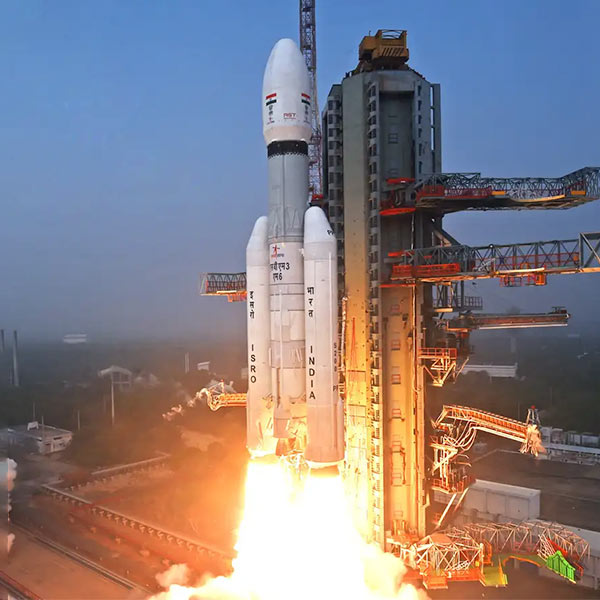
The GSLV Mk. III — later redesignated LVM3, the Launch Vehicle Mark-III — was ISRO’s answer to the question of what came after the PSLV and the GSLV. Where the PSLV could lift around 3,800 kilograms to low Earth orbit, the LVM3 could lift 8,000. Its first stage used two large solid rocket boosters. Its second stage burned liquid propellants through two Vikas engines — the same engine family derived from France’s Viking, whose development began at ISRO’s Liquid Propulsion Systems Centre in the 1980s. Its cryogenic upper stage used the CE-20 engine, the product of those hard years of domestic cryogenic development.
The LVM3’s first full orbital flight in June 2017 placed GSAT-19 into geostationary transfer orbit. Its most visible mission to date was Chandrayaan-2 in 2019. In 2023 it launched 36 OneWeb internet satellites in a single mission — a commercial launch for a British consortium, marking ISRO’s growing presence in the international commercial launch market. A human-rated version will carry India’s Gaganyaan crewed spacecraft, the country’s first crewed orbital mission.