

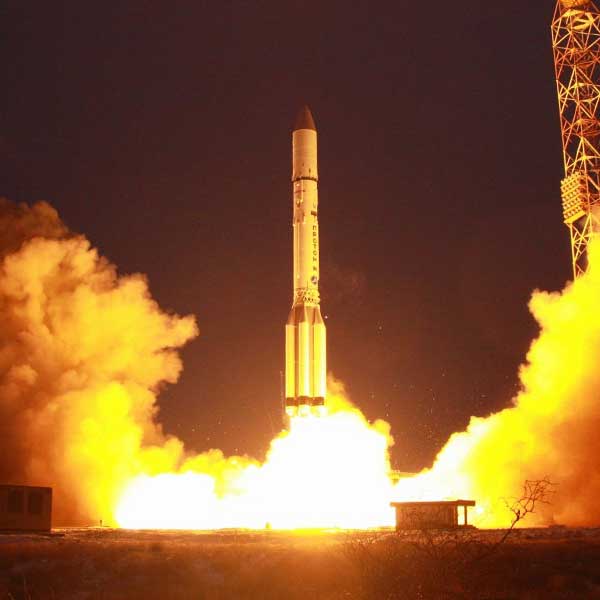
For every Soyuz climbing toward a space station, dozens of other launches were happening — military reconnaissance satellites, navigation constellations, planetary probes, communications platforms — quietly building the infrastructure of a space-faring nation. These missions didn’t get parades. The rockets that flew them didn’t get names the public would remember. They were the trucks of the Soviet space programme, and without them, none of the celebrated missions would have been possible.
Three families carried most of that load. Proton, the heavy, launched all of the Soviet Union’s Salyut space stations, the Mir core segment and expansion modules, and both the Zarya and Zvezda modules of the International Space Station. The Kosmos rocket family — derived from military missiles and flying under a designation designed to conceal almost everything about its payloads — launched over 700 times across four decades. And supporting them were a cast of specialist vehicles: Tsyklon, Molniya, Zenit — each evolved from a weapons programme, each repurposed for a world that needed satellites more than it needed warheads.
Proton: The Rocket Born from a Monster
The Proton’s origin is one of the more extraordinary in the history of rocketry. In the early 1960s, the Soviet military formulated a requirement called GR-2 — a Global Rocket capable of delivering a thermonuclear warhead of up to 100 megatons to any point on Earth. It was designed to launch a 100-megaton or larger thermonuclear weapon over a distance of 13,000 kilometres. For context, the largest nuclear weapon ever detonated — the Tsar Bomba test of 1961 — was 50 megatons. The GR-2 requirement was for something twice as destructive, delivered by rocket to anywhere on the planet.
It was hugely oversized for an ICBM and was never deployed in such a capacity. A weapon that large required a rocket so enormous it couldn’t practically be hidden or rapidly deployed — the entire rationale of a ballistic missile as a deterrent weapon depended on the adversary not being able to destroy it before it launched. The GR-2 requirement was militarily absurd almost from the day it was written. But it gave Vladimir Chelomei the justification he needed to build the rocket he actually wanted to build.
Chelomei’s design bureau — OKB-52 — had been fighting for resources and political support against Korolev’s dominant OKB-1 throughout the early 1960s. The UR-500 was the brainchild of Vladimir Chelomei’s design bureau as a foil to Sergei Korolev’s N1 rocket. By pitching the UR-500 as both an ICBM and a heavy space launcher, Chelomei secured military funding for what was, in practical terms, primarily a space vehicle. The GR-2 missile was cancelled in 1965. The space launcher survived.
The propellant choice was the source of its most bitter controversy. Korolev despised storable hypergolic propellants — the nitrogen tetroxide and unsymmetrical dimethylhydrazine mixture that Chelomei’s rocket would burn — regarding them as unnecessarily toxic and environmentally disastrous. Glushko, Korolev’s longstanding rival and the Soviet Union’s greatest engine designer, took the opposite view. Their disagreement was so fundamental and so personal that it directly drove Korolev to commission his N1 engines from an aviation bureau instead of Glushko’s team — with the consequences we’ve already seen. Meanwhile, since Chelomei agreed with Glushko on the selection of propellants, Glushko’s engine instead went into the first stage of the UR-500. The personal feud between two rocket designers shaped the architecture of both vehicles.
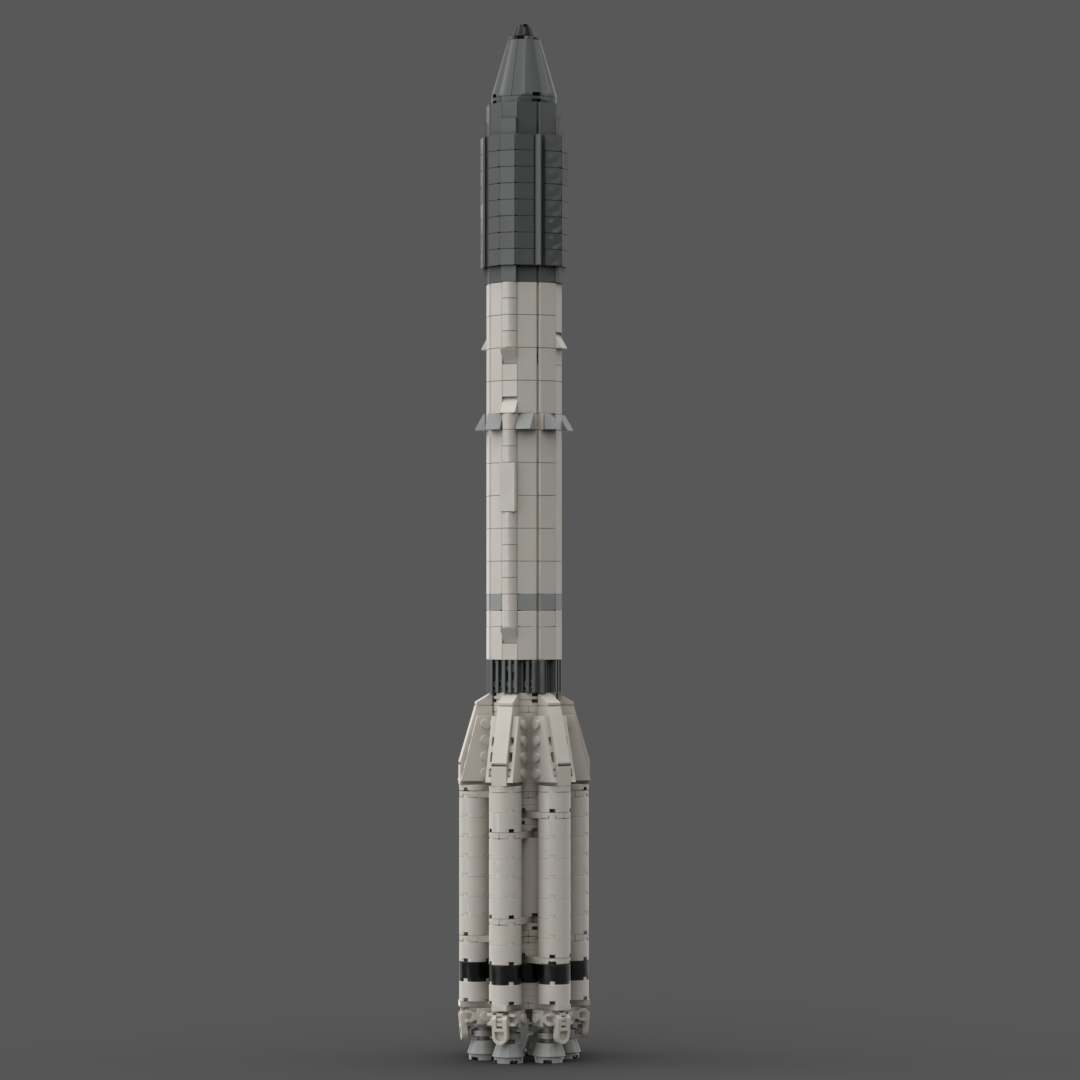
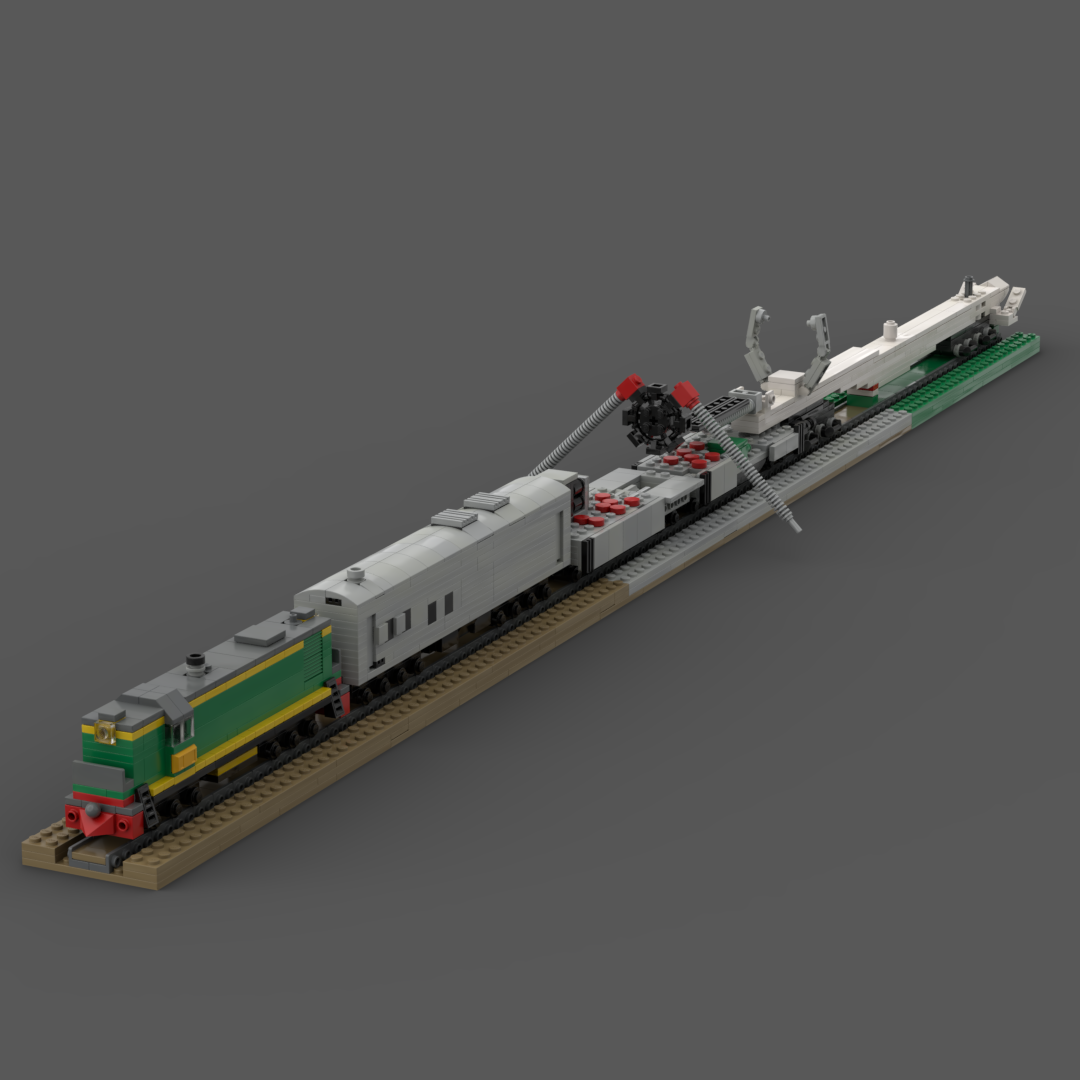
The first stage of the Proton is one of the most distinctive structures in rocketry. The unusual appearance of the first stage results from the need to transport components by rail. The central oxidiser tank is the maximum width the rail loading gauge permits. Around it are clustered six cylindrical fuel tanks, each carrying an RD-253 engine at its base — six engines in total, producing a combined thrust of nearly 10,000 kilonewtons. Despite resembling strap-on boosters, they are not designed to separate from the central oxidiser tank. The six peripheral tanks and the central core fire together and fall away together. It is an arrangement that looks like clustering and functions like a single stage, and it came entirely from the constraints of Soviet railway infrastructure.
A rushed development program led to dozens of failures between 1965 and 1972. The first two-stage variant flew in July 1965 and managed to place its payload — a heavy scientific satellite, also named Proton, which gave the rocket its public designation — into orbit. The maiden flight successfully placed the Proton 1 X-ray astronomy satellite into low Earth orbit despite an oxidiser leak in the second stage that limited its operational life to mere hours. The pattern of partial successes and outright failures continued for years. Propellant leaks. Engine shutdowns. Upper stage failures. The complexity of the vehicle and the pace of its development produced a reliability record that would have been unacceptable by Western standards.
Proton did not complete its State Trials until 1977, at which point it was judged to have a higher than 90% reliability. That twelve-year journey from first flight to formal acceptance was longer than most rockets’ entire operational lives. But by that point, Proton had already done too many essential things to be cancelled regardless of its reliability statistics.
Proton’s design was kept secret until 1986, with the public being only shown the upper stages in film clips and photographs. The first time the complete vehicle was shown to the outside world happened during the televised launch of Mir. For twenty-one years, the most important rocket in the Soviet heavy-lift programme existed only in partial glimpses for anyone outside the programme. Western intelligence agencies designated it variously as D-1, D-1e, SL-12, and SL-13, tracking it by its effects without fully understanding its configuration.
Proton M
Proton series
Proton Carrier Train
What Proton Carried
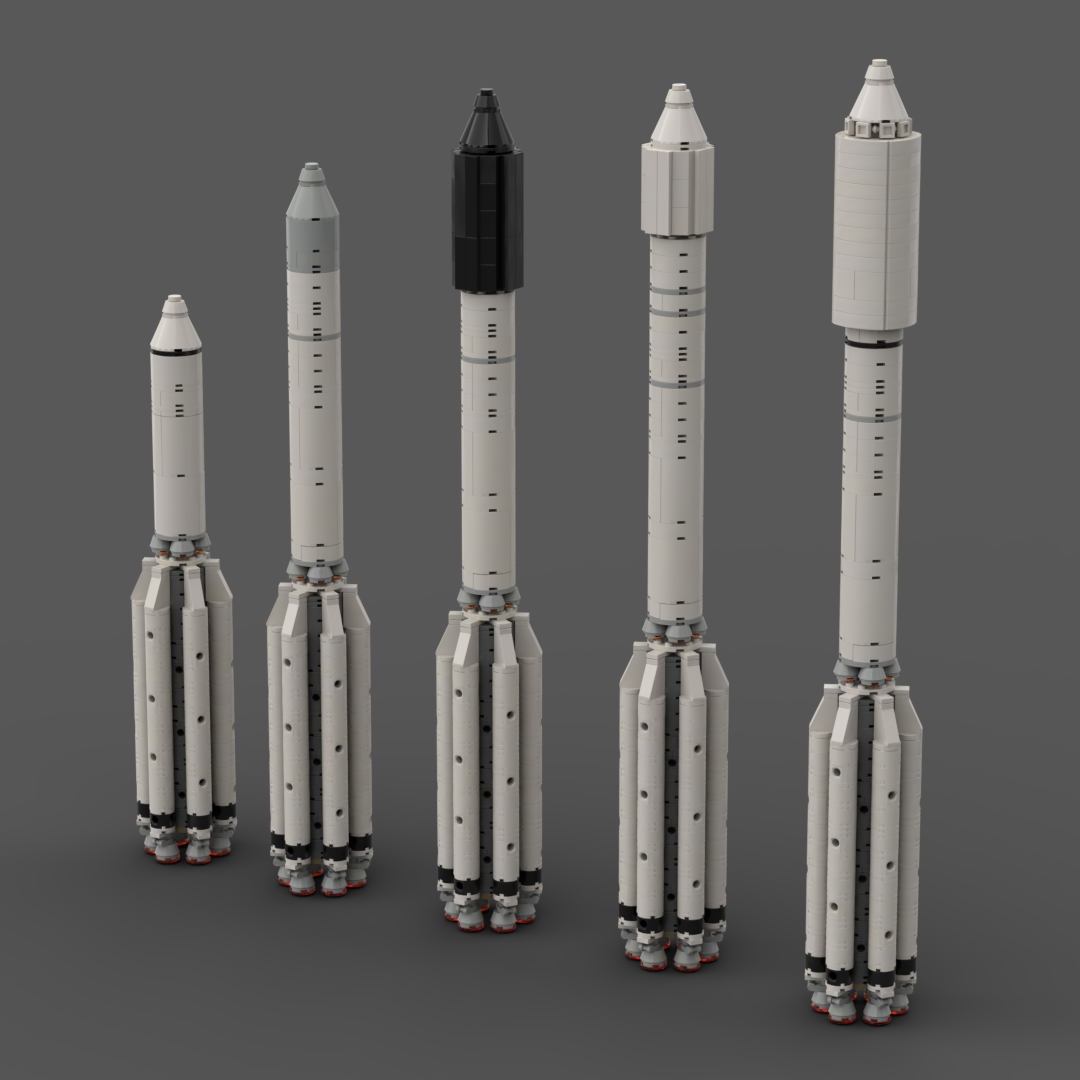
The three-stage Proton-K, which became the primary operational variant from 1968 onward, could place around 20 tonnes into low Earth orbit — comparable to the American Titan III and significantly more than anything the Soyuz family could manage. With the Blok-D upper stage added as a fourth stage, it could reach geostationary orbit, the Moon, or the inner planets of the solar system.
Its payload manifest reads like a history of Soviet space ambition. The Zond circumlunar probes that nearly beat Apollo 8 around the Moon flew on Proton. Every Salyut space station rode a Proton to orbit. The core module of Mir launched on a Proton in February 1986, and every subsequent Mir module — Kvant, Kvant-2, Kristall, Spektr, Priroda — followed the same route. The Luna and Mars probes of the 1970s flew on Proton-K with Blok-D upper stages. The Vega probes that flew to Venus and then to Halley’s Comet in 1985-86 launched on Proton. GLONASS navigation satellites — the Soviet equivalent of GPS — flew on Proton in clusters of three, building the constellation that gave the Soviet military global positioning capability.
And then, after the Soviet Union dissolved, Proton became something it had never been designed to be: a commercial launcher competing on the open market.
The economic collapse that followed the Soviet Union’s dissolution in 1991 left the rocket industry facing an existential crisis. Military launch rates collapsed. Scientific missions were cancelled. Engineers went unpaid. The factories that had built rockets for ideological and strategic reasons now had to find commercial customers or shut down.
Proton’s heavy-lift capability — which had always been its defining characteristic — turned out to be exactly what the commercial satellite market needed. Telecommunications satellites were getting heavier as operators demanded more transponders and longer operational lives. Western launch vehicles were struggling to keep pace. Proton could lift what Ariane 4 could not, and at prices that reflected the financial desperation of its operators.
The first International Launch Services Proton launch was on 9 April 1996 with the launch of the SES Astra 1F communications satellite. Between 1994 and mid-2010, Proton revenues were $4.3 billion. The rocket that had been designed to deliver a 100-megaton warhead was now launching television satellites for European broadcasters. The Cold War ended; the rocket found new customers.
The Proton-M, introduced in 2001, updated the vehicle with improved guidance systems, reduced structural mass, and a new Briz-M upper stage that could perform multiple restarts to place payloads precisely into geostationary orbit. It can place up to 21,000 kilograms into low Earth orbit, or with the Briz-M upper stage, a 5,500 kilogram payload into geostationary transfer orbit. The basic first stage architecture — six peripheral engines around a central oxidiser tank — remained identical to what Chelomei had designed in 1961. As of March 2023, 430 launches have been conducted, achieving a success rate of 88.8%.
The failures, when they came, were spectacular. A 2013 launch failure was caused by three angular velocity sensors installed upside down — an error affecting both primary and redundant systems, which left the rocket with no yaw control from the moment it left the pad. It corkscrewed violently and broke apart 30 seconds after liftoff, crashing back onto the launch pad in a fireball of hypergolic propellants that burned for hours. A Proton failure involving toxic propellants was not merely an engineering problem — it was an environmental one, as hundreds of tonnes of UDMH and nitrogen tetroxide burned or soaked into the Kazakh steppe. Communities near Baikonur had lived with that risk for decades. In January 2017, the Proton was temporarily grounded due to the manufacturer having substituted a heat-resistant alloy in the engines with a cheaper metal. Someone had been cutting costs on rocket engines. With hypergolic propellants.
Proton flew its final mission in March 2023, after 58 years of continuous operation. Its successor, the Angara family, had been in development for thirty of those years.
Kosmos: The Name That Hid Everything
If Proton was the Soviet Union’s heavy truck, the Kosmos designation was its filing system — and its filing system was deliberately designed to make it impossible to read.
Kosmos is a designation given to many satellites operated by the Soviet Union and subsequently Russia. The spacecraft do not form a single programme, but instead consist of almost all Soviet and Russian military satellites, as well as a number of scientific satellites, and spacecraft which failed during or immediately after launch but still reached orbit.
That last category is the key to understanding what the Kosmos designation actually meant. Typically, Soviet lunar and planetary missions were initially put into a low Earth parking orbit along with an upper stage, which would later burn for around four minutes to place the spacecraft into a cislunar or heliocentric orbit. If the engine misfired or the burn was not completed, the probes which would be left in Earth orbit would be given a Kosmos designation. A failed mission to Mars would not be announced as a failed mission to Mars. It would be designated Kosmos-something and listed alongside weather satellites and navigation platforms, invisible in the noise. Western analysts spent decades trying to identify which Kosmos satellites were what they appeared to be and which were failed planetary probes, military reconnaissance platforms, or anti-satellite weapons tests quietly conducting their business in orbit.
Over 2,500 Kosmos satellites have been launched. They included optical reconnaissance satellites that returned film canisters from orbit for physical recovery — the Soviet equivalent of the American Corona programme. They included early warning satellites monitoring American missile launches. They included navigation systems providing positioning data to Soviet submarines. They included technology demonstrators, scientific research platforms, biological experiment capsules, and uncrewed tests of crewed spacecraft. Kosmos 186 and Kosmos 188 performed the world’s first automatic docking of two spacecraft in 1967, a milestone that was publicly announced but whose military implications for space rendezvous capability were clear to Western analysts.
The Kosmos Rockets
The rockets that carried Kosmos payloads were as diverse as the payloads themselves, but two families did the bulk of the work.
The Kosmos rocket family — confusingly sharing a name with the designation system it served — comprised vehicles derived from the R-12 and R-14 intermediate-range ballistic missiles. The first variant, the Kosmos-2I, derived from the R-12 missile, was used to orbit satellites between 1961 and 1977. It was superseded by the Kosmos-3M — the definitive member of the family, derived from the R-14, and with over 440 launches to its name the most prolific variant of the family.
The Kosmos-3M was a compact two-stage vehicle, 32 metres tall and burning UDMH and red fuming nitric acid — the same propellant combination as its missile predecessor. It could lift roughly 1,400 kilograms into orbit, differing from the earlier Kosmos-3 in its finer control of the second-stage burn, allowing operators to tune the thrust and even channel it through nozzles that helped orient the rocket for the launching of multiple satellites at one time. That multi-satellite capability was essential for the Strela military communications constellation — eight small satellites launched simultaneously on a single Kosmos-3M, building out a store-and-forward messaging network for Soviet naval forces that could transmit data as the satellites passed overhead.
On 26 June 1973, a Kosmos-3M exploded on the pad at Plesetsk Cosmodrome during propellant loading. Nine people were killed when oxidiser and propellant were accidentally mixed together during fuelling. The accident remained classified for years. It was not the last time hypergolic propellants would kill people at a Soviet launch site — the hazards were intrinsic to the chemistry, and the procedures that prevented accidents depended entirely on human discipline that occasionally failed.
In January 1983, another Kosmos-3M failed 40 seconds into launch when its first-stage engine lost thrust. The rocket fell into the Northern Dvina river. Due to the tense relations between the US and Soviet Union at this time, the US military was widely suspected of having shot down the launch vehicle, and General Secretary Yuri Andropov was personally informed of this possibility. However, a group of locals ice fishing in the Dvina had witnessed the booster plunge into the river and reported what they’d seen to authorities. The Cold War had reached the point where a routine rocket failure was immediately suspected to be an act of war.
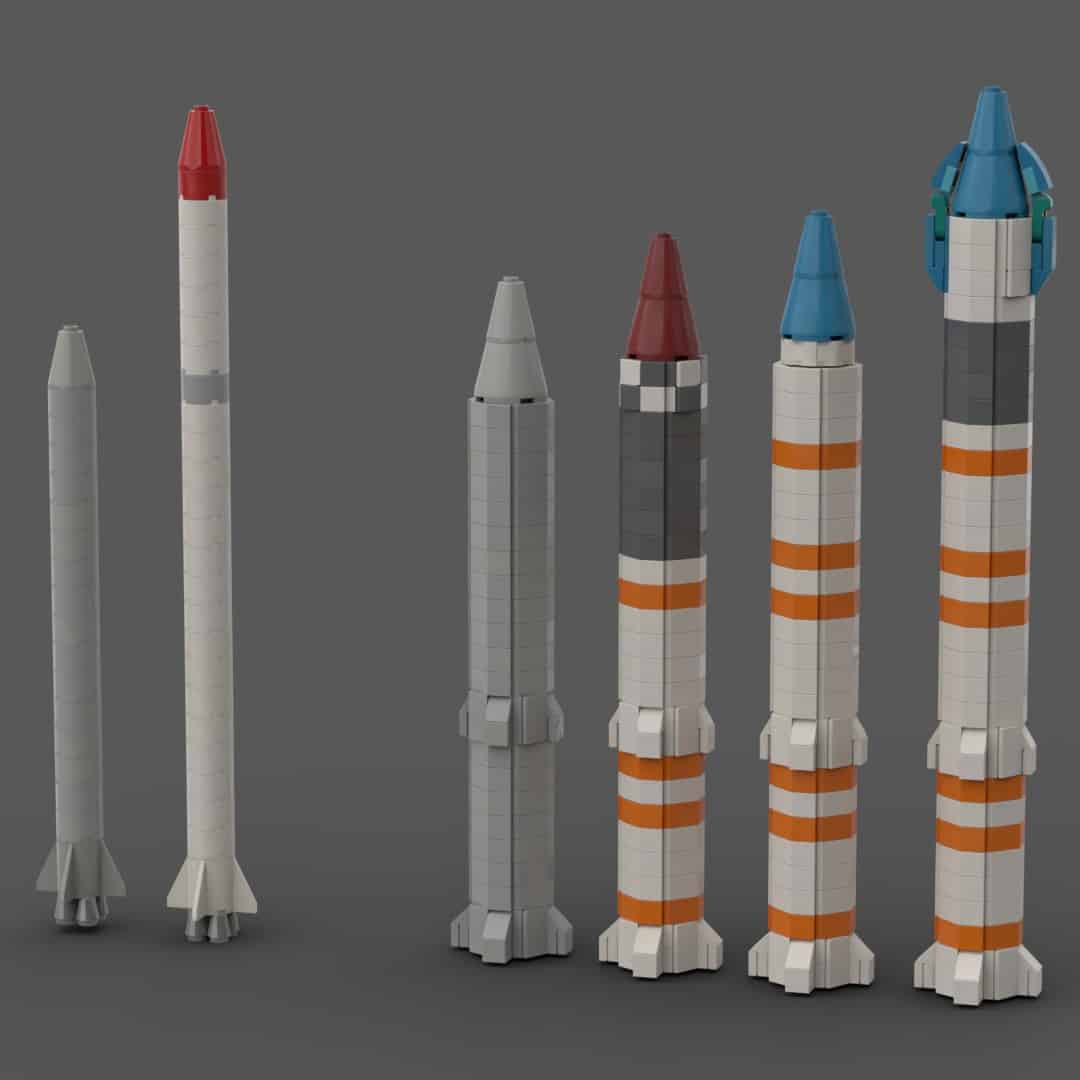
Kosmos Series
Kosmos Series
Tsyklon: The Missile Recycled
While Proton and the Kosmos family handled the bulk of Soviet launches, several specialist vehicles filled important niches.
Tsyklon — meaning cyclone — was derived from Yangel’s R-36 ICBM, the same missile family that NATO designated SS-18 Satan. The two-stage Tsyklon-2, which flew from 1969 to 1999, made 106 flights with only 2 failures, which makes it one of the most reliable rockets ever made. It launched exclusively from Baikonur into near-equatorial orbits, serving primarily as the carrier for RORSAT ocean surveillance satellites — the same programme that produced Kosmos 954. The three-stage Tsyklon-3 extended the family to polar orbits, serving the Tselina signals intelligence programme and carrying meteorological satellites from Plesetsk through the 1970s and 1980s.
The Molniya rocket — an R-7 derivative with a specialised upper stage — served a different niche entirely. The Molniya orbit that gave the rocket its name was a highly elliptical path reaching an apogee over the Northern Hemisphere, where it would linger for hours before swinging back down. For a country as large and northern as the Soviet Union, Molniya orbit provided better coverage than geostationary orbit, which appeared low on the horizon from high latitudes. The Molniya rocket placed communications satellites, early warning platforms, and deep space probes into high-energy trajectories, including Luna 9 — the first spacecraft to soft-land on the Moon — and Mars and Venus probes of the 1970s.
Zenit: The Modern Outlier
The Zenit was, in many ways, the most technically sophisticated Soviet launcher of the Cold War era — and the one with the strangest post-Soviet career.
Designed from the outset in the late 1970s as both a standalone medium-lift launcher and the strap-on booster for the Energia rocket, Zenit was built around the RD-171 engine — more powerful than the F-1 engine used in the first stage of the Saturn V — and used environmentally cleaner liquid oxygen and kerosene rather than the toxic storable propellants that Proton and Tsyklon burned. Zenit is highly automated and can be launched within hours of being erected on its launch pad, a characteristic inherited from its Tsyklon predecessor and far ahead of most contemporary rockets in operational responsiveness.
The two-stage Zenit-2 first flew in 1985, but its early history was troubled — several failures including a catastrophic pad explosion in 1990 damaged confidence in the vehicle. The programme recovered, and after the Soviet collapse, Zenit found an unexpected commercial future.
KB Yuzhnoye succeeded in commercialising the Zenit rocket through a project known as Sea Launch, a consortium of KB Yuzhnoye, RKK Energia, Boeing, and the Norwegian aerospace company Kvaerner. Using a converted giant oil rig in the Pacific Ocean, Sea Launch launched Zenits at the equator. A three-stage Zenit-3SL, launched from a floating platform at the equator, offered performance to geostationary orbit that land-based competitors launching from higher latitudes could not easily match. The first commercial Sea Launch mission flew in October 1999, carrying a DirecTV broadcast satellite. It was an arrangement that would have seemed science fiction in 1985: a former Soviet military rocket, built in Ukraine, launched from a converted Norwegian oil rig in the Pacific, marketed by an American aerospace company, putting an American television satellite into orbit.
The programme ran until geopolitical reality intervened. The deteriorating relationship between Russia and Ukraine after 2014 gradually made the arrangement impractical, and Sea Launch eventually ceased operations. The Zenit production line in Dnepropetrovsk shut down. The oil platform was towed to a port in Russia. A rocket designed for the Cold War’s final decade had found twenty years of post-Cold War commercial success before the political tides turned against it.