

The case for space-based astronomy had been made in 1946, in a RAND Corporation report by a 33-year-old Yale physicist named Lyman Spitzer Jr. Above the atmosphere, Spitzer argued, a telescope could observe wavelengths absorbed or distorted by the air — ultraviolet, infrared, X-rays, gamma rays — and achieve angular resolution no ground-based instrument could match. The idea was visionary, technically correct, and three decades ahead of the technology needed to realise it. Spitzer spent the rest of his career arguing for it. He died in 1997, before the telescope that would eventually bear his name had left the ground — but not before he saw Hubble fly, which was also partly his doing. The man who died in 1997 had set in motion two of the most important telescopes in history.
The atmosphere that Spitzer wanted to escape is both humanity’s shield and its blindfold. It blocks most of the electromagnetic spectrum. Radio waves and visible light get through. The rest — the ultraviolet, infrared, X-ray, and gamma-ray bands in which enormous amounts of cosmic activity takes place — is absorbed before it reaches the ground. Every cosmic explosion, every star being born in a cloud of dust, every black hole consuming surrounding matter in a fury of X-ray emission, every ancient galaxy receding toward the edge of the observable universe with its light redshifted into the infrared — none of it was visible to ground-based astronomers working in visible light. Space telescopes didn’t just offer sharper versions of what we already knew. They revealed entirely different phenomena.
COBE: The Sound of the Big Bang
The first of the great observatory era’s gifts to cosmology wasn’t an image. It was a temperature map — or more precisely, a map of temperature variations so tiny they almost weren’t there.
The Cosmic Background Explorer launched on a Delta rocket from Vandenberg Air Force Base on 18 November 1989, into a 900-kilometre polar orbit. It was looking for the cosmic microwave background — the afterglow of the Big Bang itself, the heat radiation left over from a universe that had been, 380,000 years after its beginning, a glowing plasma cooling as it expanded. The CMB had been accidentally discovered by two Bell Labs engineers in 1964, who initially thought it was interference from pigeon droppings on their antenna. Its existence had confirmed the Big Bang theory. What COBE was looking for was something subtler: the tiny temperature fluctuations within the CMB that would explain how a perfectly uniform early universe had developed the lumpy structure of galaxies and galaxy clusters we see today.
Challenger’s explosion in 1986 had destroyed the planned Shuttle launch for COBE. Engineers scrambled to redesign the satellite for a smaller Delta rocket, nearly losing the mission entirely. When it finally launched, COBE carried three instruments: FIRAS, measuring the CMB spectrum; DIRBE, mapping infrared emission from dust; and the DMR, the differential microwave radiometer led by George Smoot, searching for those temperature variations at the edge of detectability.
After two years of observations, on 23 April 1992, Smoot stood before a packed session of the American Physical Society and announced that COBE had found the fluctuations. The temperature variations were tiny — one part in 100,000 — but they were there, and their pattern matched precisely what the Big Bang theory predicted. The ripples in the cosmic microwave background were the seeds from which every galaxy, every star, every planet, and every person had eventually grown. Stephen Hawking, in an interview with The Times the following week, called it “the greatest scientific discovery of the century, if not of all time.”
Smoot, at the press conference, said: “If you’re religious, it’s like looking at God.”
The Nobel Committee agreed with the sentiment if not the metaphor. In 2006, Smoot and his colleague John Mather — who had led the FIRAS instrument confirming the CMB’s perfect blackbody spectrum — shared the Nobel Prize in Physics. The committee noted that “the COBE project can also be regarded as the starting point for cosmology as a precision science.” George Smoot died in Paris in September 2025, at the age of 80.
Hubble: The Eye That Needed Glasses
The Hubble Space Telescope had been in development since the 1970s, the fulfilment of Lyman Spitzer’s four-decade campaign for a space-based optical observatory. It carried a 2.4-metre primary mirror, polished to the most precise specifications in telescope history. The polishing was done by Perkin-Elmer Corporation using a device called a null corrector. The null corrector contained a small lens that was mispositioned by 1.3 millimetres. The mirror was polished to precisely the wrong shape. Because the null corrector itself was the reference standard used to verify the mirror, every verification test confirmed that the mirror was correct. It wasn’t.
NASA had taken the decision not to test the finished mirror against a second independent optical system. It would have cost a few million dollars. The cost of the Corrective Optics Space Telescope Axial Replacement — COSTAR — that would ultimately fix the problem from orbit was $50 million. The total cost of the spherical aberration, in remediation and lost observation time, ran into hundreds of millions.
And yet Hubble, even blurry, was not useless. Its ultraviolet capability was unavailable from the ground regardless of its focus quality. Its positional precision was unmatched. Astronomers learned to work around the aberration with image processing software. And then, in December 1993, came STS-61 — the servicing mission we’ve already described in the Shuttle chapter — in which five consecutive days of spacewalks installed the corrective optics. When the first corrected images arrived, showing a universe in crystalline detail that no telescope had ever previously revealed, the reaction from the astronomical community was close to euphoric.
What Hubble saw over the following decades transformed astronomy across virtually every field. The Hubble Deep Fields — long-exposure images of tiny patches of apparently empty sky — revealed thousands of previously unknown galaxies in a single frame, demonstrating that the observable universe contains something in the order of two trillion galaxies. The precise measurement of Cepheid variable stars in distant galaxies allowed astronomers to pin down the Hubble constant — the rate at which the universe is expanding — and the value they found suggested the expansion was accelerating, not decelerating. Combining Hubble data with other observations led to the discovery of dark energy, the mysterious repulsive force that appears to constitute 68% of the universe’s total energy content. The 2011 Nobel Prize in Physics, awarded for that discovery, would not have been possible without Hubble’s measurements.
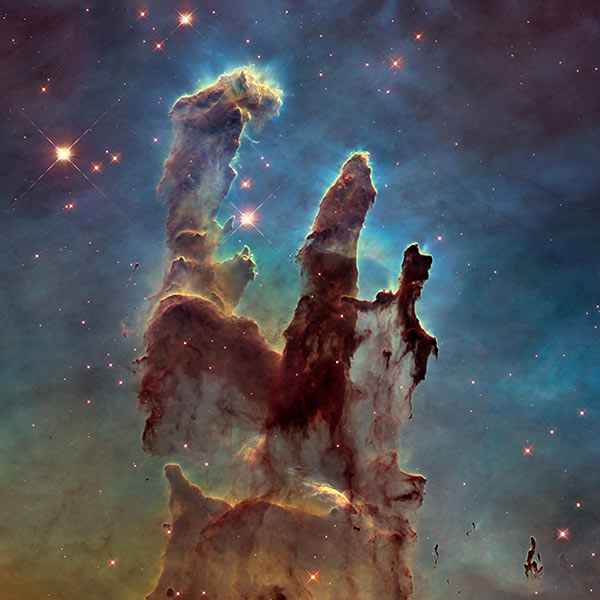
Hubble observed the collision of Comet Shoemaker-Levy 9 with Jupiter in 1994, producing images of impact scars the size of the Earth. It imaged the birth of stars in the Eagle Nebula’s Pillars of Creation — an image that became one of the most reproduced astronomical photographs in history and which depicted star formation happening in real time. It provided the first direct evidence that supermassive black holes inhabit the centres of most large galaxies. It studied the atmospheres of exoplanets. It watched stellar nurseries and dying stars and galaxy mergers and gravitational lensing events from a vantage point that made all of it possible.
Five servicing missions extended and upgraded Hubble’s capabilities. When the STS-125 crew left it in 2009 with new instruments, repaired cameras, and fresh gyroscopes, it was in better condition than at any point in its operational life. It is still operating today, in its fourth decade, having outlasted the Space Shuttle programme that serviced it and nearly every person who originally designed it.
The telescope will eventually fail — a gyroscope will give out, a power system will degrade — but unlike Webb, nobody can go and fix it this time. When it goes, it will leave a hole in humanity’s observational capability that will not be easily filled.
Compton: The Violent Sky
Alongside Hubble, NASA conceived the Great Observatories programme — four flagship telescopes, each observing the universe in a different band of the electromagnetic spectrum, building a composite picture no single instrument could provide.
The Compton Gamma Ray Observatory launched aboard Space Shuttle Atlantis on STS-37 on 5 April 1991. At 17 tonnes it was the heaviest astrophysical payload ever flown — a record that stood until Chandra. Named after Nobel laureate Arthur Holly Compton, who had discovered that X-ray photons lose energy when they scatter off electrons, the observatory carried four instruments covering the highest-energy light in the universe, from 20 kiloelectronvolts to 30 gigaelectronvolts — an energy range spanning six orders of magnitude.
Deployment almost immediately went wrong. The high-gain antenna, needed to transmit the science data to Earth, failed to extend from its launch configuration despite repeated commands from the ground. After six failed attempts, mission specialists Jerry Ross and Jay Apt performed the programme’s first unscheduled spacewalk in nearly six years. Ross physically grabbed the antenna and applied what a NASA report diplomatically described as force. It deployed. The telescope began its observations.
What Compton found in the gamma-ray sky was a universe more violent and energetic than anyone had anticipated. Its BATSE instrument detected gamma-ray bursts — brief but extraordinarily powerful flashes of the most energetic radiation in the cosmos — at the rate of roughly one per day. Before Compton, astronomers debated whether these bursts originated within the Milky Way or from cosmological distances. BATSE found them distributed isotropically across the entire sky — uniformly in all directions — which meant they couldn’t be confined to our galaxy. They were the most distant and powerful explosions in the universe, occurring in other galaxies billions of light-years away. We now understand them to be the birth cries of black holes, formed when massive stars collapse or when neutron stars merge.
Compton also detected gamma rays coming from thunderstorms on Earth — a phenomenon nobody had predicted and which was initially met with scepticism. Terrestrial Gamma-ray Flashes, produced by lightning-related electron acceleration in the upper atmosphere, are now a recognised phenomenon that Compton discovered accidentally while looking at something else entirely.
When one of Compton’s three gyroscopes failed in December 1999, NASA faced a decision. The observatory was still operational and scientifically productive, but without gyroscope redundancy a future failure could make controlled reentry impossible. Rather than risk an uncontrolled crash — the observatory was large enough that substantial debris would survive reentry — NASA deliberately deorbited Compton over the Pacific Ocean on 4 June 2000. It was a controversial decision, made against the advice of scientists who wanted to extend the mission. The debris that survived reentry fell harmlessly into the ocean. Its scientific legacy lives on in the Fermi Gamma-ray Space Telescope, which carries its tradition forward.
Chandra: The X-Ray Universe
Where Compton saw the most energetic light, Chandra was built to see a step below — X-rays, produced by gas heated to millions of degrees in the most extreme environments the universe produces. Black holes consuming surrounding matter, galaxy clusters of hot gas, the remnants of supernova explosions, neutron stars spinning hundreds of times per second — these were Chandra’s targets.
The Chandra X-ray Observatory launched from Space Shuttle Columbia on STS-93 on 23 July 1999, placed into an unusually high elliptical orbit reaching one-third of the way to the Moon — high enough to spend most of its time above Earth’s radiation belts, which would otherwise contaminate its detectors. Its mirrors, polished to an accuracy of a few atoms, could resolve X-ray sources 100 times fainter than any previous X-ray telescope. The angular resolution was so precise it could, in principle, read a stop sign at a distance of 12 miles.
Named after Nobel laureate Subrahmanyan Chandrasekhar — the Indian-American astrophysicist who had calculated the maximum mass of white dwarf stars, work that had unlocked the theoretical framework for neutron stars and black holes — Chandra produced its first light image of Cassiopeia A, the remnant of a supernova that exploded around 1680. At the remnant’s centre was a point source: a neutron star, the collapsed core of the destroyed star, approximately 30 kilometres across and containing more mass than the Sun.
In the years that followed, Chandra mapped the X-ray emission from the supermassive black hole at the centre of the Milky Way — Sagittarius A*, whose accretion produces X-ray flares that Chandra catches in real time. It detected X-ray emission from the Perseus Cluster of galaxies and found within it something remarkable: pressure waves — sound waves — propagating through the hot gas surrounding the cluster’s central black hole. The notes were B-flat, 57 octaves below middle C, with a period of 10 million years. The universe, in its most extreme environments, makes music. No human ear will ever hear it. Chandra is still operating as of this writing, more than 25 years after launch, though budget pressures from Webb have repeatedly threatened its future.
Spitzer: The Universe in Heat
The Space Infrared Telescope Facility — renamed Spitzer after the man who started it all, following a public naming contest in December 2003 — was the last of the four Great Observatories and the only one not launched by the Shuttle. It launched on a Delta II rocket from Cape Canaveral on 25 August 2003, into an unusual Earth-trailing solar orbit that gradually carried it away from Earth, maximising its distance from the planet’s infrared glow.
Infrared astronomy had been tried from the ground, with frustrating results. The atmosphere is opaque at most infrared wavelengths, and the telescope itself glows in the infrared unless cooled to near absolute zero. Spitzer’s elegant solution was to launch its telescope at ambient temperature and allow deep space to cool it down — the first spacecraft to use this “warm launch” approach. Its cryostat contained 360 litres of liquid helium which, combined with the cooling of deep space, kept its instruments at the few degrees Kelvin needed to detect the faint infrared emission from distant objects.
The cold helium ran out in May 2009 after five and a half years, but two of Spitzer’s instruments continued operating in a warm mode until NASA ended the mission in January 2020. In its 16-year career it produced a catalogue of discoveries that its designers had never anticipated.
Spitzer penetrated the dust clouds that obscure star-forming regions in visible light, imaging stellar nurseries in detail previously impossible. It found a new ring around Saturn — so large it could contain a billion Earths, so diffuse that it reflects almost no visible light and had been completely invisible before Spitzer looked in the infrared. It studied the chemical composition of protoplanetary discs around young stars, tracing the raw materials from which planets form. It observed galaxies in the early universe that were invisible to Hubble because their light had been redshifted out of the visible spectrum and into the infrared by cosmic expansion.
And then, in 2017, it did something that made headlines around the world. Using the transit method — measuring the tiny dimming of a star’s light as a planet passes in front of it — Spitzer confirmed the existence of seven Earth-sized rocky planets orbiting a small red dwarf star 40 light-years away, called TRAPPIST-1. Three of the seven orbit within the star’s habitable zone, where liquid water could exist on the surface. Seven potentially rocky worlds around a single nearby star, three of them potentially habitable. The discovery was not Spitzer’s alone — ground-based telescopes had found the first three planets — but Spitzer confirmed all seven and characterised their orbits with a precision no other instrument could have achieved. It was the richest system of Earth-sized planets yet discovered, and remains one of the most studied targets in the search for potentially habitable worlds.
Herschel: Cold Infrared, Cool Water
While NASA’s Great Observatories were reshaping astrophysics, the European Space Agency was pursuing its own infrared ambitions. The Herschel Space Observatory — named for William Herschel, who discovered infrared radiation in 1800 by pointing a thermometer past the red end of a spectrum and watching the temperature rise, and his sister and collaborator Caroline Herschel — had been conceived in 1982 and spent 27 years in development before finally launching on an Ariane 5 rocket from Kourou on 14 May 2009.
Herschel was the largest infrared telescope ever placed in space: a primary mirror 3.5 metres across — larger than Hubble’s 2.4-metre mirror — sensitive to far-infrared and submillimetre wavelengths longer than anything Spitzer had observed. It flew to the second Lagrange point, L2, 1.5 million kilometres from Earth in the direction away from the Sun — a gravitational balance point where the telescope could maintain a constant orientation relative to both Sun and Earth, keeping its instruments in permanent shadow. Herschel launched on the same Ariane 5 as ESA’s Planck microwave observatory, the two spacecraft separating and going their separate ways shortly after release.
Herschel’s primary focus was the cold universe — regions of space too cool to emit much in the way of the radiation Spitzer or Chandra observed, but warm enough to glow in the far infrared. Molecular clouds where stars were being born, dust-shrouded galaxies in the distant universe, the chemical composition of asteroids and comets in our own solar system. Its most significant discovery concerned water — specifically, where Earth’s water came from.
The prevailing hypothesis held that Earth’s water was delivered by comets or asteroids in the solar system’s early history. But comets in the inner solar system had, when measured, the wrong ratio of heavy water to normal water to match Earth’s oceans. Herschel measured the water from Comet Hartley 2 — a comet originating from the outer solar system’s Kuiper Belt rather than the inner Oort Cloud — and found a ratio matching Earth’s oceans almost exactly. The implication was that Earth’s water came from the outer solar system, delivered by Kuiper Belt comets billions of years ago. Every drop of water that has ever existed on Earth — in every ocean, every river, every cell of every living thing — had been carried here from the outer reaches of the solar system.
Herschel operated until 29 April 2013, when its liquid helium coolant was exhausted. It had spent approximately 26,000 hours observing the sky. The data it returned is still producing scientific results a decade later, its archive a resource that astronomers return to regularly for insights Herschel itself never got to contextualise. There is, currently, no planned successor to continue its wavelength coverage. The far infrared is a window that opened and, for now, has closed again.
Webb: A Telescope for the Age of Everything
The James Webb Space Telescope was first proposed in 1996 as the Next Generation Space Telescope, a successor to Hubble. The original launch estimate was 2007. The final launch date was 25 December 2021. Twenty-five years, three billion dollars over budget, and a development history so troubled that Congress seriously considered cancelling it multiple times — including a House committee vote in 2011 that would have terminated the programme entirely, averted only when the Senate refused to concur.
What justified the perseverance was the ambition of what Webb was trying to do. It was built to see the light of the first galaxies that formed after the Big Bang — objects so distant, and so ancient, that their light had been travelling for over 13 billion years and had been redshifted by cosmic expansion from visible wavelengths deep into the infrared. To detect this light required a mirror nearly three times larger than Hubble’s, operating at temperatures close to absolute zero, placed far enough from Earth that the planet’s own infrared glow wouldn’t overwhelm the instruments.
The 6.5-metre primary mirror was too large to fit inside any rocket fairing in its deployed configuration. It was therefore built in 18 hexagonal segments, each made of beryllium coated in a microscopically thin layer of gold, that could fold for launch and unfold in space. The five-layer sunshield — the size of a tennis court, made of a material called Kapton — had to fold like origami for the journey and unfold perfectly in the vacuum of space. In total, Webb required 344 individual deployment steps to go from launch configuration to operational telescope. Any single failure could have ended the mission. Unlike Hubble, Webb orbits at L2, 1.5 million kilometres from Earth — too far for any crewed repair mission. It would have to work.
On Christmas morning 2021, an Ariane 5 lifted off from Kourou with Webb in its fairing. The launch, in the words of NASA, was “flawless.” The Ariane 5 placed Webb on a trajectory so precise that the planned mid-course corrections consumed far less propellant than the mission had budgeted. When engineers calculated the remaining fuel margin, they found that instead of the planned ten-year operational lifetime, Webb had propellant for approximately 20 years. The last Ariane 5 to fly before the model was retired — it was the 256th Ariane mission — had given the observatory twice its designed operational life.
Over the following month Webb deployed, fold by fold and segment by segment. The sunshield unfurled across five days. The mirror wings locked into position. The 18 segments were aligned and phased, each one adjusted to within nanometres, until they acted as a single coherent mirror. On 11 July 2022, the first full-colour images were released. The reaction was immediate and worldwide.
The first deep field — a patch of sky the size of a grain of sand held at arm’s length, showing thousands of galaxies in a single frame — was sharper and deeper than anything Hubble had produced in decades of equivalent exposures. Galaxies so distant their light had left them when the universe was less than a billion years old were visible in detail. Webb subsequently detected the most distant galaxies ever confirmed, pushed the boundary of the observable universe further back in time than any previous instrument, and found evidence that the very early universe was forming large, complex galaxies far sooner than theoretical models had predicted — a finding that is still being worked through by cosmologists who are not entirely sure what to do with it.
Webb detected carbon dioxide in the atmosphere of exoplanet WASP-39 b — the first direct detection of a greenhouse gas in an exoplanet atmosphere. It imaged the direct thermal emission from exoplanet VHS 1256 b, detecting water, methane, carbon dioxide, and sulphur dioxide in its atmosphere simultaneously. It peered through the dust of the Carina Nebula to image stellar nurseries in unprecedented detail, revealing jets of material from young protostars that had been completely hidden behind dust. It detected organic molecules in the disc around a young star, demonstrating that the chemistry of life’s building blocks is being manufactured in planetary nurseries across the galaxy.
And on the night of the first images, when NASA administrator Bill Nelson stood before a room of scientists and journalists and journalists and said “this is the deepest view of our universe that has ever been taken” — he was describing something that had been 25 years in development, three billion dollars over budget, and very nearly cancelled twice. It was, in the end, worth every year of it.