

For the first three decades of the space age, the club had two members. Then it had a handful. Then, almost without anyone noticing, it had dozens — and the new arrivals were not simply copying the founding members. They were doing things the founding members had never managed, in timelines the founding members would have dismissed as impossible, for budgets that made NASA’s finance department look like a rounding error. This is how space opened up, and what the nations that arrived late brought with them.
Israel: The Rocket That Flies Backwards
Almost every orbital rocket ever launched has flown east. The reason is simple physics: Earth rotates eastward at about 1,670 kilometres per hour at the equator, and a rocket launching in the same direction gets that speed for free, reducing the fuel needed to reach orbit. It is one of the most basic economies in rocketry, exploited by every launch site from Baikonur to Kourou to Canaveral.
Israel’s Shavit rocket flies west.
The Shavit — the name means “comet” in Hebrew — launches from Palmachim Airbase, a military facility on Israel’s Mediterranean coast south of Tel Aviv. It flies westward, out over the sea, burning additional fuel to fight against Earth’s rotation rather than riding it, deliberately sacrificing roughly 30% of its potential payload capacity. It does this because to the east lie Jordan, Saudi Arabia, Iraq — countries over which an Israeli rocket trailing spent stages and debris cannot fly. The Mediterranean is the only direction available. Israel’s geography has made it the only country in the world that launches into retrograde orbit not by choice but by necessity, sending its satellites the wrong way around the planet for geopolitical reasons.
The programme that produced the Shavit began in 1982, built on the first two stages of the Jericho II ballistic missile — a lineage that was officially unconfirmed for years and is now openly acknowledged. On 19 September 1988, Israel launched Ofeq-1 from Palmachim, becoming the eighth nation to achieve independent orbital launch capability. The Ofeq satellites — the name means “horizon” — are reconnaissance spacecraft whose capabilities are classified. What is known is that they fly at a few hundred kilometres altitude, completing an orbit every 90 minutes, their retrograde path giving them frequent, differently-angled passes over the Middle East that compensate for what the unusual orbit costs in efficiency. The programme has launched thirteen times since 1988, with ten successes, the most recent being Ofeq-13 in March 2023 — a synthetic aperture radar satellite capable of imaging through clouds and darkness.
The Shavit will never be commercially competitive. It cannot fly east, its payload is small, and its military heritage makes export impossible under arms control regimes. What it provides is something money cannot easily buy: the certainty that Israel can place reconnaissance satellites in orbit without asking anyone’s permission. In a region where asking permission of neighbours is not always an option, that independence has a value that transcends the economics.
Israel’s space story has a civilian dimension too, and a heartbreaking one. In April 2019, a privately funded lunar lander named Beresheet — Hebrew for “genesis,” the first word of the Torah — made its approach to the lunar surface after a six-week, four-million-mile journey from Earth. Beresheet had been built by the non-profit SpaceIL and Israel Aerospace Industries for $100 million — a fraction of the cost of any government lunar mission — and launched on a SpaceX Falcon 9 as a rideshare passenger. It was the smallest lander ever sent to the Moon, and aboard it was a digital time capsule containing over 50 million pages of data: the entirety of Wikipedia, the Bible, children’s drawings, a Holocaust survivor memorial, the Israeli national anthem, and the Israeli Declaration of Independence.
At 149 metres above the surface, a technical glitch triggered a chain of events that cut the main engine. Engineers restarted it. By then Beresheet was moving too fast. It struck the lunar surface at well over 300 kilometres per hour. Israel became the fourth nation to reach the lunar surface, and the first to do so unintentionally. Prime Minister Netanyahu, watching from the control room, said: “If at first you don’t succeed, you try again.” One of the project engineers addressed the schoolchildren watching: “We didn’t reach the moon in one piece. That sucks. However, engineering and science are hard. Sometimes it doesn’t work the first time.” Beresheet 2 is in development.
Iran: The Proliferation Problem
If Israel’s space programme is geopolitics made hardware, Iran’s is geopolitics made uncomfortable. On 2 February 2009, Iran launched a small satellite called Omid — meaning “hope” — aboard a domestically developed Safir rocket, becoming the ninth nation to reach orbit independently and the first in the Middle East after Israel. The international reaction was considerably less celebratory than Iran’s domestic response.
The concern was and remains straightforward: the technologies required to develop an orbital rocket and those required to develop an intercontinental ballistic missile capable of delivering a nuclear warhead are substantially identical. Propulsion, guidance, staging, reentry — the physics does not distinguish between payloads. Iran’s Safir programme, and its successor Simorgh rocket, have been the subject of repeated UN Security Council resolutions and Western sanctions, with multiple Western governments arguing that the satellite programme is primarily cover for ballistic missile development. Iran maintains its space programme is civilian.
The Safir is a small two-stage rocket burning a combination of unsymmetrical dimethylhydrazine and nitrogen tetroxide — the same toxic hypergolic propellants used in many military missiles, chosen for storability rather than performance. Omid was a 27-kilogram research satellite. Iran has since launched additional satellites, including payloads placed into orbit by military-operated rockets that the IRGC — the Islamic Revolutionary Guard Corps — has openly launched and operated. The line between civilian and military space programmes, never particularly clear in any country’s early decades, has in Iran’s case been essentially erased.
The programme’s trajectory illustrates a persistent tension in space policy: the technologies of access to orbit are dual-use by nature, and the international community has no agreed mechanism for distinguishing peaceful satellite programmes from ballistic missile development programmes conducted under cover of space research. Every nation that has ever developed an indigenous launch capability has done so with technology that is, in principle, applicable to weapons. The argument that Iran is different in kind rather than degree is geopolitically loaded in ways that simple technology analysis cannot resolve.
The UAE: From Desert to Mars in Six Years
In late 2013, the leadership of the United Arab Emirates held a cabinet retreat and, among other discussions, decided to send a spacecraft to Mars. The UAE had possessed a space agency for seven years and had launched its first Earth-observation satellite four years earlier. It had no deep space experience, no interplanetary trajectory design capability, no instruments optimised for planetary science, and no tradition of graduate education in aerospace engineering that ran deep enough to staff such a programme. It announced a launch date of July 2020 — six years away. The Hope probe arrived at Mars on 9 February 2021.
The mission’s architecture was as revealing as its timeline. Sheikh Mohammed bin Rashid Al Maktoum, the ruler of Dubai, framed it explicitly as a programme for human development rather than scientific prestige: the point was not to produce scientific data for its own sake, but to build a generation of Emirati engineers capable of designing, building, and operating an interplanetary spacecraft. The knowledge transfer arrangement with American universities — the Laboratory for Atmospheric and Space Physics at the University of Colorado Boulder, Arizona State University, and the University of California Berkeley — was designed so that Emirati engineers worked alongside their American counterparts at every stage of development, not as observers but as principals. The spacecraft was assembled in Boulder. Many of the Emirati engineers lived in Colorado for extended periods.
The team that built Hope had an average age of 27. Its project manager, Omran Sharaf, was 36 at launch. More than a third of the science team were women. The mission cost $200 million — less than half what the United States spent on the MAVEN mission doing broadly comparable atmospheric science at Mars, which itself was considered a cost-controlled mission. Hope launched from Japan’s Tanegashima Space Center on a Mitsubishi Heavy Industries H-IIA rocket in July 2020, in the same two-week Mars launch window used by NASA’s Perseverance and China’s Tianwen-1. All three arrived at Mars within days of each other in February 2021 — a convergence of three nations at the same planet simultaneously that would have been unimaginable a decade earlier.
What Hope has done scientifically has exceeded initial expectations. Designed primarily to study the Martian atmosphere on daily and seasonal timescales — providing the first global, continuous weather picture of another planet — it discovered a new type of discrete aurora on Mars, detected never-before-seen high-altitude dust clouds, and measured the relationship between lower and upper atmosphere in ways that required exactly the broad, low-inclination orbit the mission’s unusual parameters provided. The mission has been extended beyond its planned Martian year of observations.
Sheikh Mohammed’s announcement had carried three messages: that Arab civilisation, which had once led the world in astronomical knowledge during the Islamic Golden Age, would contribute to that knowledge again; that nothing is impossible for Arab nations; and that ambition should have no ceiling. The first two are perhaps matters of political rhetoric. The third produced a working Mars orbiter in six years.
South Korea: Independence the Hard Way
South Korea’s path to independent launch capability is a study in the complications that attend space programmes conducted in difficult geopolitical neighbourhoods — and in what happens when a nation decides it has had enough of those complications.
For most of South Korea’s early space development, the United States discouraged Seoul from building its own launch vehicles. The concern was explicit: the Korean Peninsula’s security situation, with North Korea actively developing ballistic missiles, meant that American policymakers were reluctant to see South Korea develop rocket propulsion technology that could, in principle, also serve as the basis for medium- or long-range missiles. The restrictions were embedded in bilateral missile guidelines that limited the range of missiles South Korea could develop. The practical effect was that when South Korea built its first orbital rocket, the Naro-1, it had to source its first stage from Russia — a Khrunichev-built engine that Seoul was not permitted to develop domestically.
Naro-1 failed on its first two launches. Its third launch, in January 2013, finally reached orbit. By then South Korea had decided that the next programme would be entirely indigenous.
The Nuri rocket — the name means “world” — was developed between 2010 and 2022 at a cost of approximately $1.5 billion, involving over 300 South Korean companies. Its first stage clusters four domestically-built 75-tonne liquid engines burning kerosene and liquid oxygen. Every component, from propulsion to guidance to structure, was designed and manufactured in South Korea. The decision to use liquid propellants throughout — rather than the solid motors used by many nations for their first indigenous rockets — reflected a long-term commitment to building an engine technology base that could grow with the programme.
The first Nuri launch, in October 2021, almost succeeded. The first and second stages performed perfectly. The third stage shut down 46 seconds early, leaving the payload just short of orbital velocity. It reached the target altitude but not the target speed — close enough that engineers understood what had happened and were confident they could fix it. On 21 June 2022, Nuri’s second launch placed a 1.5-tonne satellite into a 700-kilometre sun-synchronous orbit. South Korea became the seventh nation capable of launching practical payloads using entirely domestically-developed propulsion. The minister of science announced: “We have set the stage for us to travel to space whenever we’d like, without having to rent a launchpad or a projectile from another country.”
The Nuri programme has since been transferred to Hanwha Aerospace — South Korea’s largest defence contractor — in what the government describes as the beginning of a commercial space era. A follow-on heavy-lift rocket, KSLV-III, is in development, targeting first launch around 2030. South Korea also launched its first lunar orbiter, Danuri, in 2022 on a SpaceX Falcon 9, which has been mapping the Moon’s surface resources and scouting landing sites for a future Korean lander. The 2021 revision to the bilateral missile guidelines with the United States, which removed the range restrictions on Korean missiles, acknowledged the reality that South Korea had by then built the engineering capability anyway.
New Zealand: The Sheep Farm Launch Site
Peter Beck grew up in Invercargill, the southernmost city in New Zealand, teaching himself rocketry from library books, corresponding with experts in the United States, and at one point strapping a rocket to himself to measure thrust with his own body — a testing methodology that he has acknowledged was not well-considered. He eventually made a pilgrimage to the United States, visiting NASA facilities, rocketry companies, and the parking lot of Aerojet Rocketdyne where an F-1 engine from the Saturn V sat outdoors as an ornament. He decided to come home and build an orbital rocket.
Rocket Lab was founded in 2006, incorporated in New Zealand, and spent its first several years developing the Rutherford engine — a small bipropellant liquid engine that was the first rocket engine in history to use electric motor-driven turbopumps rather than the conventional approach of using the propellant itself to drive the turbines. The simplification dramatically reduced complexity and manufacturing cost. The engine was also the first to be 3D-printed from copper alloy — an additive manufacturing approach that could produce a complete Rutherford engine in hours rather than the weeks or months conventional machining would require.
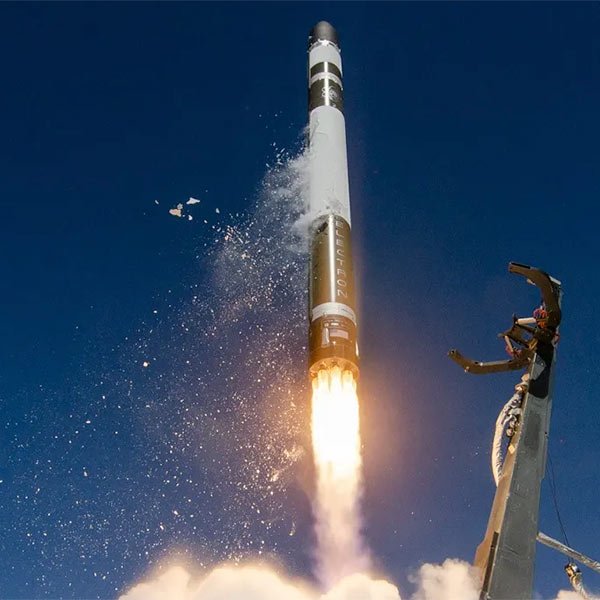
The Electron rocket — 18 metres tall, burning RP-1 and liquid oxygen across nine Rutherford engines — needed a launch site. Beck negotiated with a cattle farmer on the Māhia Peninsula of New Zealand’s North Island, proposing to build a private orbital launch facility on the farm. The farmer, whose family had been looking to diversify beyond beef and cattle, was interested. The Māhia Launch Complex opened in 2017, the first private orbital launch site in the Southern Hemisphere. It sits at the peninsula’s tip, with the Pacific Ocean on three sides, allowing launches across a wide range of orbital inclinations without overflying populated areas. New Zealand, a country of five million people better known for sheep farming and rugby, became a launch state largely before anyone was paying attention.
Electron’s first successful orbital launch was in January 2018. The rocket was designed to carry small satellites — up to 300 kilograms — to dedicated orbits on a dedicated schedule, rather than asking small satellite operators to share a large rocket with other payloads on someone else’s preferred trajectory. The market for this service was, at the time, being created by the same wave of miniaturisation that was producing ever more capable small satellites. GPS satellites that once required a refrigerator-sized spacecraft could now be approximated in a package the size of a shoebox. Electron offered these missions something that no ride-sharing arrangement could match: their own rocket, their own orbit, their own timeline.
By early 2025 Electron had completed over 50 missions, carrying payloads for NASA, the National Reconnaissance Office, commercial operators, and universities across more than a dozen countries. The rocket’s cadence — a launch every few weeks from both the New Zealand site and a second pad at NASA’s Wallops Flight Facility in Virginia — has made Rocket Lab the second most frequently launched orbital rocket operator in the United States, behind only SpaceX.
Beck, when Rocket Lab was founded, made a public commitment that the company would never build a large rocket and would never pursue reusability — a shot at SpaceX’s then-theoretical Falcon 9 recovery programme. In March 2021, he sat inside a mock-up of a new rocket’s payload fairing, placed a Rocket Lab baseball cap into a blender, poured the result into a martini glass, and ate it on camera before announcing Neutron — a partially reusable medium-lift rocket targeting 13,000 kilograms to low Earth orbit, capable of human spaceflight. “If you’re going to commit to something in this world,” he said afterwards, when asked about the hat, “you commit to it.” He has since noted that he does not recommend the experience.
Neutron has been in development since 2021. Its design — including a first stage that never goes horizontal, a second stage that sits entirely inside the first, and fairings that open like a “hungry hippo” before the second stage deploys — reflects the lessons Beck drew from years of operating Electron. As of early 2026, the company’s engineers are, in Beck’s words, “literally sleeping in the factories” to meet an aggressive first launch target.
North Korea: The Uncomfortable Milestone
No treatment of new orbital nations can avoid acknowledging North Korea, however uncomfortable the acknowledgement. On 21 November 2023, a Chollima-1 rocket launched from the Sohae Satellite Launching Station and placed the Malligyong-1 reconnaissance satellite into orbit — North Korea’s first confirmed successful satellite deployment after multiple failed attempts over more than a decade.
The international response was swift and uniform condemnation. The United Nations Security Council had prohibited North Korea from any ballistic missile development, and the technology employed was unambiguously related to intercontinental ballistic missiles. Pyongyang described the satellite as a tool for monitoring US military activities on the Korean Peninsula and the security situation in the region. The satellite’s resolution and actual capabilities were immediately disputed by outside analysts, but the launch mechanics were not: a rocket had reached orbit from North Korean soil.
North Korea joins the list of orbital nations by any technical definition. It joins it as a pariah state conducting launches that the international community regards as weapons testing under a civilian veneer. This uncomfortable distinction — between technical achievement and its political context — is one the space age has never been able to cleanly resolve.
What the New Players Tell Us
The nations that have joined the orbital club in the last two decades share almost nothing in their political systems, their geographies, their cultures, or their motivations. Israel launches backwards out of strategic necessity. Iran launches under sanctions for reasons its neighbours find alarming. The UAE launched to build engineers and to tell its young people that Arab civilisation still has things to say to the universe. South Korea launched to stop depending on a relationship that had constrained it for thirty years. New Zealand launched because one person from the southernmost city in the country taught himself rocketry from library books and decided that was sufficient preparation.
What they share is this: access to space is no longer a capability that requires superpower resources, superpower industrial infrastructure, or superpower political will. It requires sustained commitment, sufficient capital, and the willingness to absorb failure — sometimes many failures — before getting it right. The knowledge required has spread, in textbooks and universities and the biographies of people who once worked at NASA and then left. The components have become available commercially. The tools — computer-aided design, additive manufacturing, modern simulation software — have democratised the engineering.
The club is still not easy to join. Most nations that have tried have failed, repeatedly, before succeeding or given up. But the barriers have fallen enough that the map of spacefaring nations looks nothing like it did in 1990, and nothing like it will look in 2040. The question of who gets to go to space is being answered not by the superpowers but by everyone else, one rocket at a time.