

On 14 January 2004, eleven months after the Columbia disaster, President George W. Bush stood in NASA’s headquarters and announced that America would return to the Moon. The speech was careful and specific: the Space Shuttle would be retired by 2010, a new crew vehicle would fly by 2014, humans would return to the lunar surface by 2020, and from there, eventually, to Mars. The programme would be called Constellation, after the first ship of the United States Navy. It would be “Apollo on steroids,” in the words of NASA administrator Michael Griffin. It would be the next chapter of human spaceflight.
What followed was twenty years of the most revealing spectacle in the history of American space policy: a programme announced, underfunded, redesigned, extended, cancelled, resurrected under a different name, built at ruinous cost, and finally — perhaps — within reach of its original goal. The story of Constellation and its successor Artemis is the story of what happens when a democracy tries to do something hard and expensive over a timescale that spans multiple presidents, multiple Congresses, and multiple shifts in national priority. It is a story about rockets. It is, more than that, a story about politics, money, and what both do to rockets when left unsupervised.
The Vision and Its Vehicles
The programme Bush announced needed hardware. Specifically, it needed a crew vehicle to replace the Shuttle and rockets to launch it. The options studied by NASA included adapting existing rockets — the Delta IV or Atlas V — but Griffin’s Exploration Systems Architecture Study concluded that Shuttle-derived vehicles offered the most cost-effective path. The reasoning was seductive: the Shuttle’s main engines, solid rocket boosters, manufacturing facilities, and workforce already existed. Re-using them would save money. It would, of course, prove to save nothing of the sort.
Two rockets emerged from the study. Ares I was a crew launcher: a single five-segment solid rocket booster derived from the Shuttle’s SRBs, topped by a liquid upper stage powered by a J-2X engine — an updated version of the J-2 that had powered the Saturn V’s upper stages. Engineers working on the J-2X visited museums, searched Apollo-era documentation, and consulted engineers who had originally worked on the engine in the 1960s. There was something quietly poignant about that — a programme aimed at the future spending significant effort excavating the past. Ares V was the cargo launcher, a monster conceived to haul 160 metric tonnes to low Earth orbit, dwarfing the Saturn V’s already extraordinary capacity.
Between them they would carry the Orion crew capsule — a four-person vehicle broadly resembling a grown Apollo command module, equipped with solar panels rather than fuel cells and the accumulated electronic sophistication of four decades of development — and the Altair lunar lander, a vehicle five times the volume of the Apollo Lunar Module with an airlock, a glass cockpit, and a camping toilet. Where Apollo’s LM had been a masterpiece of compressed engineering necessity, Altair was spacious, comfortable, and almost certainly never going to be built.
The crew capsule was named Orion, after the constellation — and, deliberately, after the lunar module of Apollo 16. The Altair’s name derived from Arabic and meant “the flying one.” Its logo incorporated the eagle from the Apollo 11 mission patch, drawn by Michael Collins from a photograph in a 1965 National Geographic. Every detail of Constellation’s iconography reached back toward Apollo, as if naming things carefully enough might summon the original’s energy and political will.
The Gap and Its Consequences
The programme’s central problem announced itself almost immediately: it was underfunded. The first NASA budget to include Constellation requested $8.8 billion across five years, of which barely four percent was earmarked for rockets. Development was allocated almost entirely to the Orion capsule. Ares I and Ares V were being designed on paper while Orion absorbed the available money. By 2009, the programme had spent $11.9 billion — $3.1 billion over its five-year budget — and had produced, in terms of flight-ready hardware, essentially nothing.
Meanwhile, the Space Shuttle was retiring. This had been the deal: the Shuttle would stop flying after completing the ISS, freeing its budget for Constellation. The problem was that Constellation was not going to be ready when the Shuttle stopped. The gap — the period during which America would have no independent means of reaching orbit — was going to be years long, during which time American astronauts would ride Russian Soyuz capsules to the ISS at a per-seat cost that began at $21 million and would eventually reach $90 million. The nation that had put twelve men on the Moon would be dependent on a country it had competed against for four decades to get its own astronauts to a space station it had largely paid for.
Ares I flew exactly once. On 28 October 2009, the Ares I-X test vehicle — a mostly simulated rocket, the upper stage a ballasted shell — launched from Kennedy Space Center’s Pad 39B and performed a perfect flight. It reached the altitude and speed intended, separated cleanly, and its first stage parachuted back into the Atlantic. The engineers who had built it were proud, and they were right to be. It was a genuine technical success. It was also, effectively, the last flight of the programme that had created it. Two weeks later, a review commission delivered its findings to a new president who had different ideas about space.
The Augustine Commission and the Cancellation
In May 2009, the Obama administration commissioned an independent review of NASA’s human spaceflight plans. The panel was chaired by Norman Augustine, the former chief executive of Lockheed Martin. Its findings, released in October, were precise and devastating: Constellation was so behind schedule, so underfunded, and so structurally compromised that it could not achieve any of its stated goals within any realistic budget. Ares I and Orion would not be ready for crewed flight until 2017 at the earliest. Ares V and the lunar lander would not be ready until the late 2020s at the absolute best. A crewed lunar landing would require at minimum $50 billion in additional funding beyond what was projected. The programme, the report concluded, was on an “unsustainable trajectory.” Human exploration beyond low Earth orbit was not viable at the projected funding levels. Full stop.
The programme had spent nine years and the better part of $11 billion building two test articles and a prototype capsule. Obama announced the cancellation in February 2010, proposing to invest instead in commercial crew transport to the ISS and in technology development for a future heavy-lift vehicle. He gave a major space policy speech at Kennedy Space Center in April, promising that NASA would send humans to an asteroid by 2025 and orbit Mars by the mid-2030s, and predicting that private companies would revolutionise access to low Earth orbit. “By the mid-2030s,” he said, standing at the place where Saturn V had been assembled, “I believe we can send humans to orbit Mars and return them safely to Earth.”
The reaction from the Apollo generation was immediate and furious. Neil Armstrong — who almost never engaged in public policy debates, whose reserved public persona was famous — wrote an open letter calling the new plan “devastating” and said that abandoning Constellation without a funded replacement was “poorly advised.” He worried that other nations would step in where America had faltered. Eugene Cernan, the last man to walk on the Moon, called the new direction a “mission to nowhere.” The criticism from Congress was even more pointed, and considerably more interested in specifics.
Congress did not accept the cancellation. What followed was one of the most consequential pieces of political meddling in the history of NASA — and, simultaneously, what may have been the only thing that kept American heavy-lift capability alive through the commercial space revolution. The key figure was Senator Richard Shelby of Alabama. The Marshall Space Flight Center is in Huntsville, Alabama. Marshall Space Flight Center was the lead centre for the Ares development programme. Shelby was the ranking member — later chairman — of the Senate Appropriations subcommittee responsible for NASA’s budget. He had, for years, been one of the programme’s most important supporters. When Obama proposed cancellation, Shelby proposed a replacement.
The resulting vehicle — directed by Congress in the NASA Authorization Act of 2010, announced by NASA in September 2011 — was called the Space Launch System. Critics renamed it almost immediately. The “Senate Launch System” is not a nickname its creators would choose, but it is the nickname it has kept, because it captures something true: the SLS was not primarily a vehicle that NASA designed to fulfil a mission. It was a vehicle that Congress designed to preserve a constituency.
The SLS would be Shuttle-derived — using modified versions of the Shuttle’s solid rocket boosters and, astonishingly, the actual Shuttle main engines sitting in storage, RS-25 engines that had last flown in 2011, engines built using technology from the 1970s, magnificent pieces of engineering that had no business being treated as expendable but were, in the SLS architecture, precisely that. Once burned, they would be discarded into the ocean, each one worth approximately $150 million. The rocket would be built at Marshall Space Flight Center in Alabama, its main engines fired and tested at Stennis Space Center in Mississippi — home state of the overall Senate Appropriations chairman. The solid rocket boosters would be manufactured in Utah.
The former NASA deputy administrator Lori Garver, who had fought internally against the SLS architecture and lost, later described the programme’s political logic with unusual directness: “It is more the politics of pork than the politics of progress. There’s a long-time pattern at NASA where money aimed at science and research ends up with builders and contractors instead.” A report by the Booz Allen Hamilton consulting firm found that retaining the legacy Shuttle workforce and infrastructure would actually cost more than hiring new workers — the opposite of the savings the architecture was supposed to provide. Nobody particularly cared. The jobs were in the right states, the contracts were with the right companies, and the 2010 NASA Authorization Act passed with bipartisan support.
What makes the political story even richer is that a better option had been on the table all along — and the people proposing it had to do so anonymously for fear of their careers. From 2006 onward, a group called the DIRECT team had been circulating an alternative architecture to the Ares I and V programme. Their proposal centred on a family of rockets called Jupiter — Shuttle-derived, like Ares, but built around a single common core stage adapted closely from the existing external tank, flanked by standard four-segment solid rocket boosters. The naming convention was almost endearingly literal: the numbers told you exactly what you were looking at. Jupiter-130 meant one cryogenic stage, three main engines, zero upper-stage engines. Jupiter-246 meant two cryogenic stages, four main engines, six upper-stage engines. No ambiguity, no marketing.
The Jupiter-130 was conceived as the crew launcher: a common core stage powered by three RS-25 engines — the Shuttle main engines — with two solid rocket boosters, no upper stage, and Orion sitting on top. Clean, simple, capable of delivering over 60 tonnes to low Earth orbit while carrying a crew. The Jupiter-246 was the heavy lifter: four RS-25 engines on the same common core, plus a large upper stage powered by six RL10B-2 engines carrying 175 tonnes of propellant, capable of delivering over 90 tonnes to orbit and providing the Earth departure stage for lunar missions. For a Moon landing under the DIRECT architecture, the plan was to launch two Jupiter-246s — one carrying Orion and Altair on a partially fuelled upper stage, the other carrying only a fully fuelled upper stage to top up the propellant in orbit before departure. It was more orbital assembly steps than Constellation’s Ares architecture required, but the team argued the common core’s economies of scale more than compensated.
Where Ares I and Ares V were two completely different vehicles requiring entirely separate development programmes, Jupiter shared virtually everything between its variants. The DIRECT team argued this would cost less, reach the pad sooner, and preserve more of the existing Shuttle workforce than the Ares approach — and that the Jupiter-130’s greater lift capacity compared to Ares I would allow Orion to carry meaningful cargo to the ISS on each crew rotation, a capability Ares I could not offer.
The group’s membership at its peak stood at 69 people, of whom 62 were NASA engineers, NASA contractor personnel, and Constellation programme managers. Every one of those 62 participated anonymously. Their employment made it impossible to publicly advocate for an alternative to the programme they were paid to implement. The handful of non-NASA members served as the public face, presenting the proposal to conferences and eventually to the Augustine Commission itself in June 2009.
NASA’s official response was dismissive. Internal analyses found the Jupiter performance claims overstated and the cost savings speculative. The Constellation programme leadership had obvious institutional reasons to reject a proposal that would have made their two-rocket architecture redundant. The dispute between the DIRECT team and NASA’s official position generated hundreds of pages of technical rebuttal and counter-rebuttal, none of it particularly readable, all of it pointing at the same underlying reality: reasonable engineers looking at the same constraints could reach quite different conclusions about how to proceed.
The DIRECT team declared victory in October 2010, when Obama signed the NASA Authorization Act mandating the Space Launch System. Their reasoning was characteristically wry: the SLS, as eventually designed, bore far more resemblance to their Jupiter proposal than to the Ares architecture it had replaced. A common core stage adapted from the Shuttle external tank, RS-25 engines at the base, solid rocket boosters on the sides — if you squinted, the rocket Congress had directed NASA to build was the rocket the anonymous engineers had proposed four years earlier. The men and women who couldn’t put their names on the proposal had, in a roundabout way, been right. They just hadn’t been right in time to affect the $11 billion that had already been spent going in the other direction.
NASA itself tried to point out that it hadn’t asked for this. The gap between what the agency’s engineers thought was the best way to return humans to the Moon and what Congress directed them to build was, by the accounts of people who were in those meetings, substantial. The SLS was too expensive to fly frequently, too dependent on Shuttle-era infrastructure that was itself expensive to maintain, and structured in a way that made cost reduction almost impossible. A famous internal NASA study found that developing the Falcon 9 using NASA’s traditional contracting approach would have cost between $1.4 billion and $4 billion. SpaceX actually developed it for $443 million. The SLS was not going to be developed for anything like what it cost SpaceX to make a rocket.
Artemis: The Programme That Survived Everything
The Orion capsule that Obama had proposed to keep as an ISS lifeboat, the rocket that Congress had directed NASA to build from Shuttle parts, the programme that had been announced, cancelled, and reconstituted — finally produced something concrete. The programme was named Artemis, after the Greek goddess of the Moon, twin sister of Apollo. The name was deliberate: not a repetition of Apollo, but its partner. This time, the first woman to walk on the Moon. This time, the lunar south pole, where water ice sits in permanently shadowed craters. This time, a sustained presence rather than flags and footprints.
The architecture that emerged was a genuine hybrid of old and new: the SLS and Orion on one side, carrying the Apollo-derived profile of sending a crew capsule from Earth; and a SpaceX Starship human landing system on the other, meeting Orion in lunar orbit and descending to the surface. NASA had selected Starship as the Artemis III lander in April 2021 — a decision that infuriated Blue Origin, which sued and delayed the programme by several months, but which reflected the obvious reality that Starship was the only vehicle close to capable of doing the job at a cost NASA could afford.
This is the point at which it becomes important to say: the SLS, whatever its political origins and economic pathologies, is a genuinely extraordinary piece of engineering.
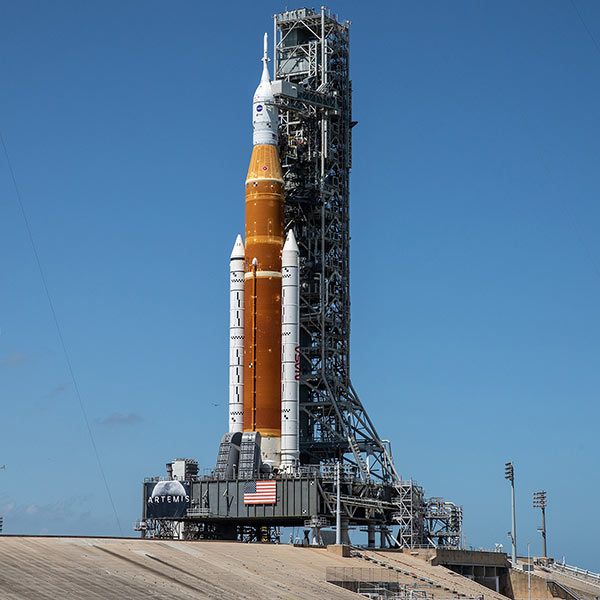
It stands 98 metres tall in its initial Block 1 configuration. Its four RS-25 engines, burning liquid hydrogen and liquid oxygen, produce 1.6 million pounds of thrust at liftoff. Its two solid rocket boosters — each the largest and most powerful solid rockets ever flown — add another 7.2 million pounds of thrust. Total liftoff thrust: 8.8 million pounds. The Orion capsule that sits atop it, built by Lockheed Martin, has a crew module volume of 19.6 cubic metres — nearly three times the Apollo capsule — and a European Service Module provided by ESA, built around heritage from the Automated Transfer Vehicle that had resupplied the ISS. It is designed for missions up to 21 days. Its heat shield is the largest ablative heat shield ever made, 5 metres across, tested to survive reentry velocities from lunar distance.
Artemis I launched on 16 November 2022 — six years later than originally promised — and was, by every technical measure, a success. The SLS performed flawlessly. Orion flew 2.3 million kilometres on a path around the Moon, entering a distant retrograde orbit and returning to a Pacific splashdown on 11 December 2022 — fifty years to the day since Apollo 17 had landed on the Moon. The heat shield survived. The systems functioned. The rocket, for all that had been said about it, flew.
The splashdown on the Apollo 17 anniversary was not planned. The trajectory requirements and launch window constraints happened to produce that date. History occasionally supplies its own symbolism without being asked.
Artemis II, the first crewed mission — not a landing, but a free-return trajectory around the Moon, the same profile flown by Apollo 8 in 1968 — has been preparing for launch since late 2025. The crew is Reid Wiseman, Victor Glover, Christina Koch, and Jeremy Hansen of the Canadian Space Agency — the first woman, the first person of colour, and the first Canadian to travel beyond low Earth orbit.
As this is being written, in February 2026, the Artemis II stack is on Pad 39B at Kennedy Space Center. The crew entered quarantine on 20 February. A helium flow issue in the rocket’s upper stage delayed the launch from March, and it currently targets no earlier than April. The hardware is ready. The crew is ready. The rocket that was announced in 2004, cancelled in 2010, reconstituted in 2011, and flew for the first time in 2022 is, finally, within a launch window of carrying people farther from Earth than any human has been in fifty-three years.
The Last of Its Kind
Artemis is probably the last programme of its kind, and the reasons are converging from multiple directions simultaneously.
From above, SpaceX’s Starship has demonstrated that a fully reusable super-heavy rocket can be built by a private company, iteratively tested to destruction, and brought to operational capability faster and cheaper than the traditional approach. If Starship reaches the reliability and cost levels its designers intend, the economic argument for an expendable government rocket costing $4 billion per flight becomes impossible to sustain. NASA’s own inspector general has described the SLS as unaffordable at the cadence Artemis requires. The Government Accountability Office has noted, repeatedly, that NASA has not established a credible life-cycle cost estimate for the programme.
From below, the political coalition that has sustained SLS is showing fracture lines. Senator Richard Shelby, who more than any other individual was responsible for directing NASA to build it, retired in 2023. The Trump administration’s 2026 budget proposal sought substantial cuts to NASA, targeting parts of the Artemis programme while pushing a shift toward commercial options. Even Congress’s instinct for preserving aerospace jobs in key states is being pulled in competing directions as SpaceX, Blue Origin, and others employ workers in Florida, Texas, and elsewhere.
From the side, China’s crewed lunar programme is advancing methodically, targeting a Moon landing before 2030 with indigenous hardware, and providing the kind of competitive pressure that historically motivates American space investment — but also, potentially, the kind of urgency that demands faster, cheaper approaches rather than more expensive traditional ones.
What will replace the SLS, is not yet settled. What is settled is that the era of government-owned, expendable heavy-lift rockets built from legacy hardware to preserve legacy workforces — the lineage that runs from Saturn V through Shuttle through SLS — is ending. The economics have changed too dramatically. The commercial alternatives are too capable. The political will to fund $4 billion launches indefinitely is not there.
But here, in February 2026, the rocket stands on the pad, carrying a capsule that traces its lineage through Orion to the Command Module that carried twelve men to the Moon, sitting atop a stack that is as tall as anything America flew in the Apollo era, pointed at a Moon that no human has orbited in fifty-three years. Four people are in quarantine in Houston, preparing to go farther from Earth than anyone alive has ever been.
That is not nothing. Whatever comes after it, whatever replaces it, whatever verdict history eventually returns on the politics and the cost and the decades of delay — the rocket on Pad 39B is a real thing, and in a few weeks it is hopefully going to fly. The last of the old way.