

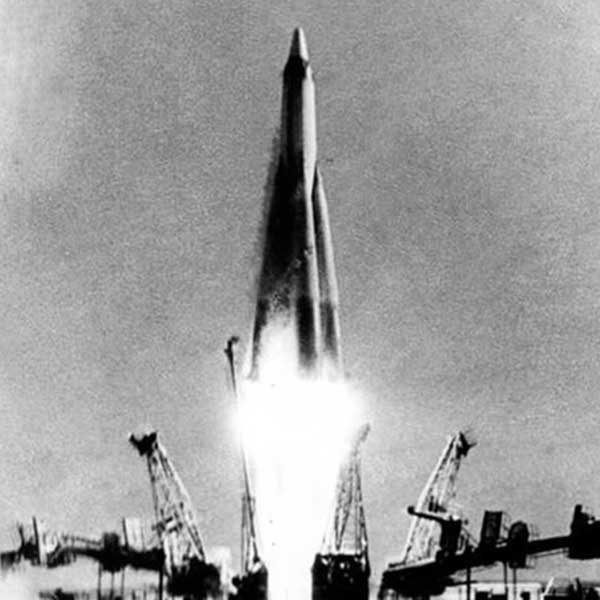
In the mid-1950s, the Soviet Union needed a missile capable of striking the United States with a nuclear warhead. What it got instead was the foundation of human spaceflight, a rocket family still flying today, nearly seventy years after its first test. That outcome was largely the work of one man. And to understand the R-7, you first have to understand Sergei Korolev.
Korolev had been one of the Soviet Union’s most promising young aerospace engineers in the 1930s, fascinated by the possibility of liquid-fuelled rockets and convinced from an early age that space was reachable. Then in 1938 at the height of Stalin’s Great Purge he was arrested on fabricated charges of sabotage. He spent years in the Soviet prison system including a brutal stint in the Kolyma labour camps where he lost most of his teeth to scurvy and may have suffered a heart attack. He was eventually transferred to a sharashka, a prison research facility where scientists and engineers worked on state projects under armed guard. He survived the war there, was released, and got back to work.
By 1953, Korolev had risen to become the Soviet Union’s leading rocket designer operating under the deliberately anonymous title of “Chief Designer”, his identity was classified, kept secret from the West and even from many of the cosmonauts he worked with to protect him from potential assassination. It was only after his death that the world learned who had built the Soviet space programme. On 20 May 1954, the Soviet government issued a resolution instructing OKB-1 to develop an intercontinental thermonuclear-capable missile. That missile would be the R-7.
Building the Semyorka
The core engineering challenge was thrust. Soviet nuclear warheads were considerably heavier than their American equivalents, a consequence of less refined weapons design, which meant Korolev needed a rocket capable of lifting an enormous payload over intercontinental distances. No single engine available could do it.
His solution was elegant: cluster multiple smaller engines around a central core. The R-7, nicknamed Semyorka, meaning “the seven”, stood 34 metres tall and weighed around 280 tonnes at launch. Four strap-on boosters surrounded the central sustainer stage, each powered by twin RD-107 engines developed by Valentin Glushko. The core used an RD-108. Crucially, all five stages ignited simultaneously at launch, a configuration that solved the thrust problem but created its own challenges in controlling and stabilising the combined exhaust plume. When the boosters separated after burnout, their symmetric fall away from the ascending rocket created a distinctive visual pattern in the smoke trails that became known as the Korolev Cross, still a signature sight at Russian launches today.
The R-7 made its first successful flight on 21 August 1957, becoming the world’s first intercontinental ballistic missile. As a weapon, however, it was nearly useless almost immediately. Its launch complexes were enormous and impossible to conceal, American U-2 overflights could photograph them with ease. Fuelling took around ten hours using cryogenic liquid oxygen that couldn’t be stored in the rocket indefinitely, meaning it could only be held at readiness for roughly an hour at a time. Any adversary with adequate warning could destroy it before it flew. The R-7 made just 28 launches as a missile and was never meaningfully deployed. What it could do was lift heavy things into space. And it was very good at that.
Sputnik and the Opening of the Space Age
Korolev had been quietly lobbying Soviet leadership for permission to launch an artificial satellite since the early 1950s, framing it carefully as a demonstration of Soviet technological superiority rather than a purely scientific exercise. He was attuned to the political reality, noting that the creation of a satellite would have enormous significance as evidence of the high development level of the country’s technology.It was the right argument for the right audience.
On 4 October 1957, less than seven weeks after the R-7’s first successful test flight, a modified version placed Sputnik 1 into orbit. The world heard the beep. A month later, Sputnik 2 carried the dog Laika. The Space Age had begun, and it had begun on the back of a missile that the Soviet military was already quietly setting aside.
The heavy warheads that had made the R-7 necessary as a weapon had accidentally given the Soviet Union an extraordinary early advantage in space. American rockets of the same era simply couldn’t match its payload capacity. The Soviets’ commanding early lead in the Space Race flowed directly from that capability.
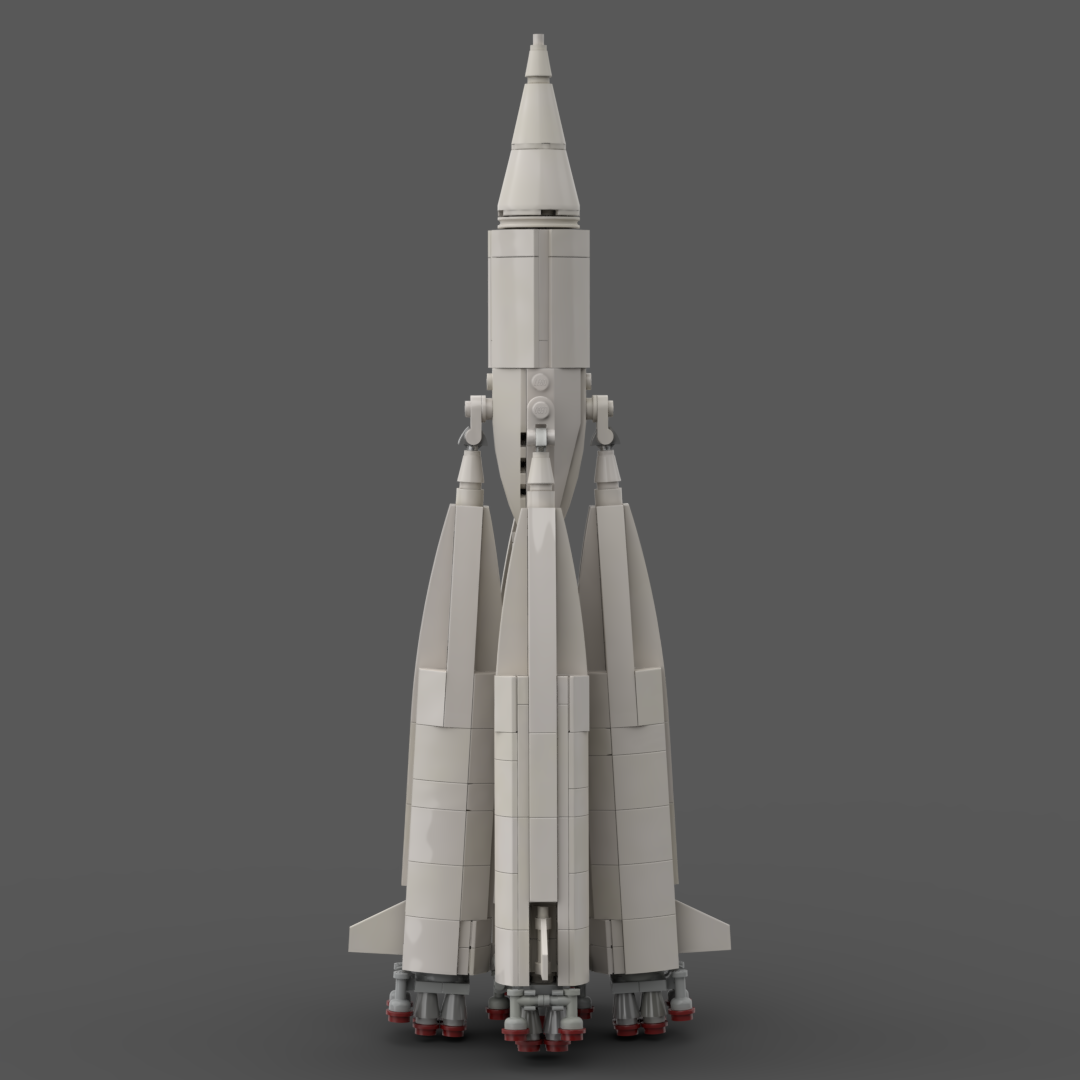
R-7 Sputnik
R-7 Sputnik
1st launch attempt:
Launch Site:
Orbital Type:
Country of Origin:
Vostok and Voskhod: Putting Humans in Orbit
To carry cosmonauts, the R-7 needed a third stage. Engineers added the Blok-E upper stage above the existing configuration, producing the Vostok launch vehicle. Before it carried people, it flew early Luna probes toward the Moon — missions of mixed success but important tests of reliability. Then came the mission that mattered most.
On 12 April 1961, Vostok 1 lifted off from Baikonur carrying Yuri Gagarin. He orbited once, spending 108 minutes in space before re-entering and ejecting from his capsule to parachute down separately, a detail the Soviets quietly omitted from official accounts for years, since aviation records required a pilot to land with their aircraft. It didn’t matter. The mission was a triumph that reordered the world’s understanding of what was possible.
Five more Vostok flights followed. Gherman Titov flew a full day in orbit on Vostok 2. Vostok 3 and 4 flew simultaneously, demonstrating group flight and radio communication between spacecraft. And in June 1963, Valentina Tereshkova became the first woman in space aboard Vostok 6, a record that would stand for nineteen years.
By the early 1960s, America’s two-man Gemini programme was on the horizon, threatening to close the gap in human spaceflight milestones. Korolev’s response was pragmatic and more than a little reckless: modify the Vostok spacecraft to carry more crew, strip out the ejection seats to make room, and fly before Gemini.
The result was Voskhod, built on a further-developed R-7 with an improved upper stage. Voskhod 1, in October 1964, carried three cosmonauts, the first multi-person crew in orbit. They had no spacesuits and no ejection capability. If anything had gone seriously wrong on ascent or re-entry, they would have had no options at all. It was a propaganda mission dressed as a scientific one, and it worked in that narrow sense. Nikita Khrushchev was reportedly on the phone to the crew while they were in orbit.
Voskhod 2, in March 1965, was more significant. Pavel Belyayev and Alexei Leonov flew with an inflatable airlock attached to the capsule’s exterior. Leonov floated free and became the first human to walk in space, though the mission nearly turned catastrophic when his spacesuit inflated rigidly in the vacuum and he couldn’t get back through the airlock. He deflated his suit to dangerous pressure levels, forced his way in headfirst, and made it. The re-entry then went wrong too, an automatic guidance failure forcing the crew to manually orient the capsule. They came down hundreds of kilometres off target in the Ural forests and spent the night surrounded by wolves before rescue teams reached them. The Soviets announced it a complete success. Only two Voskhod missions flew before the programme was shelved. Korolev had bigger things in mind.
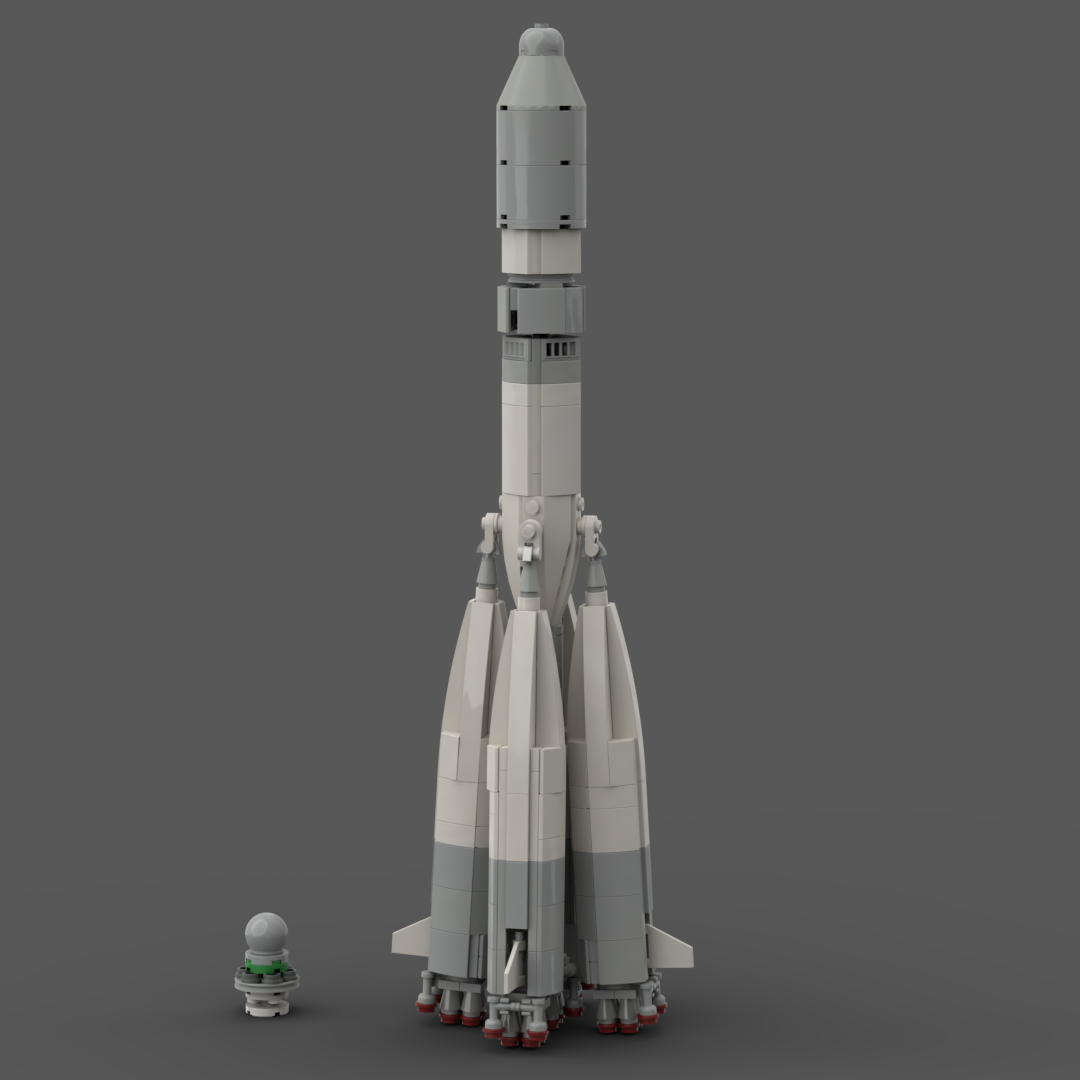
R-7 Vostok
R-7 Vostok
1st launch attempt:
Launch Site:
Orbital Type:
Country of Origin:
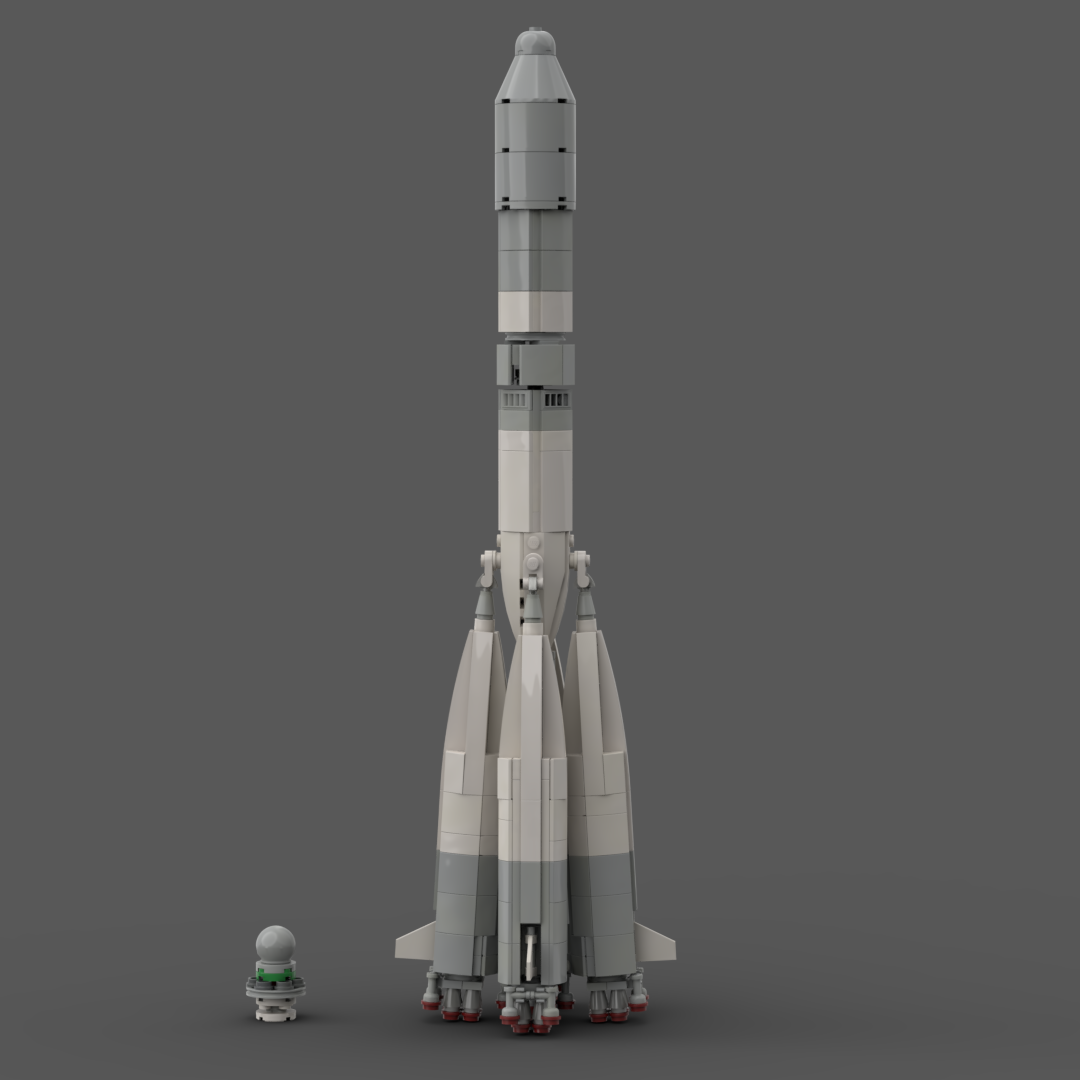
R-7 Voskhod
R-7 Voskhod
1st launch attempt:
Launch Site:
Orbital Type:
Country of Origin:
Soyuz: The workhorse of space
Soyuz was conceived from the outset as something more capable, a spacecraft and launcher designed for rendezvous, docking, and long-duration flight, intended ultimately to support the Soviet lunar programme. The launcher replaced the Blok-E upper stage with the larger and more powerful Blok-I, giving it meaningfully greater payload capacity.
Korolev didn’t live to see it fly. He died in January 1966 during what was supposed to be routine surgery, aged 59, complications emerged during the operation, and a man whose body had been broken by the gulags didn’t have the reserves to recover. He was 59. His identity was revealed to the Soviet public only in his obituary. The Chief Designer, it turned out, had a name.
Soyuz 1’s first crewed flight, in April 1967, was a disaster. Vladimir Komarov died when the parachute system failed during re-entry, the first in-flight fatality in spaceflight history. The programme was grounded for eighteen months. When it returned, it worked, and it kept working. Soyuz ferried crews to the Salyut and Mir space stations through the 1970s, 80s, and 90s. After the Space Shuttle retired in 2011, it became the only way to reach the International Space Station for nearly a decade.
More R-7 rockets have been launched than any other family of orbital rockets. The modernised Soyuz-2 is still flying today. A design conceived in the late 1940s still flying today in the 2020s, no other launch vehicle in history comes remotely close to that record. Korolev wanted to build a missile. He ended up building something that outlasted the Soviet Union itself.