

“Our building’s shaking! The roar is terrific! The building’s shaking! This big glass window is shaking. We’re holding it with our hands! Look at that rocket go! Into the clouds at 3,000 feet! The roar is terrific! Look at it going! You can see it. Part of our roof has come in here.”
Walter Cronkite had covered every American space launch since the beginning. He had watched Atlas missiles and Redstone boosters and Titan rockets and all of the Saturn I family, from his commentary position at the Cape, always measured, always composed. On the morning of 9 November 1967, composure left him entirely.
At his trailer’s observation window, ceiling tiles were falling from above as he and producer Jeff Gralnick pressed their hands against the glass to stop it shattering. The sound pressure from five F-1 engines firing simultaneously was much stronger than expected, buffeting the Vehicle Assembly Building, the Launch Control Center, and the press buildings, all of them three miles from the pad. Dust dislodged from the ceiling of the Launch Control Center formed a layer on the consoles of mission controllers.
A Columbia University acoustician described it as one of the loudest sounds in human history, short only of nuclear explosions. A flock of ducks changed course without breaking their V formation. Deke Slayton, who had watched every launch of the American space programme, said he had never seen anything as impressive in his life.
This was the Saturn V’s first flight. It was an “all-up” test, every stage live, every system functional, the Apollo command and service module flying a complete trajectory simulating a return from the Moon. It was the first time the S-IC first stage and S-II second stage had ever flown. It succeeded on every objective. The programme was back.
Before It Could Fly: Mississippi and the Machine
Before any Saturn V rocket could launch from Florida, each one had to prove itself in Mississippi. The choice of site for the Saturn V test facility, selected in October 1961, was governed by three imperatives: proximity to the manufacturing plant at Michoud, Louisiana, where Boeing was building the first stages; proximity to the waterways that were the only practical route for stages too large to fly or drive; and a buffer zone large enough to absorb the noise of five F-1 engines firing at full thrust.
The facility’s test area of 13,500 acres was surrounded by a 125,000-acre acoustical buffer zone to mitigate noise from high-thrust firings. Communities that had stood in the Pearl River lowlands for generations were bought out and relocated. The old town of Logtown, Mississippi lowered its post office flag for the last time. It was the largest construction project in the state of Mississippi at the time, and the second largest in the United States.
The Mississippi Test Facility, as it was then known, had two principal test stands. The A-2 stand, 200 feet of reinforced concrete, was built to fire the S-II second stage, five J-2 engines burning liquid hydrogen and liquid oxygen, producing a million pounds of thrust. The first static firing occurred on 23 April 1966, a fifteen-second test of the S-II-T structural test vehicle. The S-IC first stage, with its five F-1 engines and 7.5 million pounds of thrust, required something substantially larger: the B-2 stand, a dual-position vertical firing structure designed to contain the full force of the most powerful rocket engines ever built.
The first static test firings of the S-IC had taken place at Marshall Space Flight Center in Huntsville, but after a November 1966 firing, the noise of five F-1 engines at full power in an urban setting having produced predictable consequences, all subsequent tests moved to Mississippi.The S-IC test stage, nicknamed T-Bird, arrived at Mississippi by barge after a 1,086-mile journey up the Tennessee River and down the Mississippi. The first firing at the B-2 stand took place in March 1967.
The Stack: What the Saturn V Actually Was
The Saturn V that stood on Pad 39A on the morning of 9 November 1967 was 363 feet tall and weighed, fully fuelled, six million pounds, three thousand tons of vehicle before the crawler that carried it had even been counted. Understanding what it contained means understanding the problem of getting from Earth’s surface to the Moon and back again.
The S-IC first stage was built by Boeing at the Michoud Assembly Facility in New Orleans and was 138 feet tall by itself. Its five Rocketdyne F-1 engines burned liquid oxygen and RP-1 kerosene, and produced a combined 7.5 million pounds of thrust at liftoff.The power output of the S-IC was approximately 160 million horsepower. Its entire purpose was to get the vehicle off the ground and moving fast enough for the second stage to take over. It fired for about two and a half minutes, then fell away into the Atlantic Ocean 400 miles downrange. It was never recovered.
The S-II second stage, built by North American Aviation, burned liquid hydrogen and liquid oxygen in five J-2 engines. It was the stage that gave the programme its most persistent headaches, North American’s delays and quality problems with the S-II were the primary reason Apollo 4 flew in November 1967 rather than early 1966 as originally planned. The S-IVB third stage, built by Douglas Aircraft and carried to Florida in a Pregnant Guppy aircraft because it was the only stage small enough to fly, put the spacecraft into orbit and then, after coasting through checkout orbits, fired again to push the Apollo spacecraft out of Earth orbit and onto a trajectory toward the Moon. It was the same S-IVB that flew as the upper stage of the Saturn IB.
On top of the stack sat the Lunar Module, enclosed in its adapter fairing like a spider in a matchbox, and the Command and Service Module, topped by the Launch Escape System tower, a rocket on a rocket, designed to hurl the capsule clear of an exploding Saturn V in under a second. The total vehicle, standing on the launch platform, was taller than the Statue of Liberty from its base to the tip of the torch. The five F-1 engine bells at the bottom of the first stage were large enough to stand inside.
Launch Complex 39
The facilities that assembled, transported, and launched the Saturn V were as extraordinary as the rocket itself, an industrial civilisation constructed in four years on the swampy barrier island of Merritt Island, Florida, specifically to handle an object that had never existed before.
The Vehicle Assembly Building, originally called the Vertical Assembly Building, is 160 metres tall, 218 metres long, and 158 metres wide, covering eight acres of ground. It was completed in 1966 and was at that time the largest enclosed volume of any building on Earth. Its total volume is roughly equivalent to 3.75 Empire State Buildings. Each of the four high bays has a door 456 feet tall, comprising seven vertical panels and four horizontal panels, which takes 45 minutes to fully open or close.
The doors are the largest in the world. On very humid days, clouds have formed near the ceiling, the VAB is large enough to generate its own weather. The building’s air conditioning system, providing 10,000 tons of refrigeration, runs continuously not to cool the building but to control moisture. The American flag painted on the building’s south face, added for the 1976 Bicentennial, is 209 feet tall; each stripe is nine feet wide, and the blue canton is the size of a basketball court.
Building the VAB on Florida’s coastal plain required solving problems that had no existing answers. The building stands only a few feet above sea level. Salt water saturating the subsoil reacted with the steel pilings to create an electrical current, meaning the building was in danger of becoming the world’s largest wet-cell battery. To prevent electrolytic corrosion, thick copper wire was welded to each piling and connected to the steel reinforcing bars in the concrete floor slab. The foundation consisted of 4,225 steel pipes driven as far as 160 feet down to bedrock. If laid end to end, they would reach across Florida to the Tampa area.
Once assembled, the Saturn V stack could not simply be driven to the pad on a flatbed truck. The solution was one of the most remarkable pieces of engineering in the entire programme: three Mobile Launchers, each one a self-contained launch infrastructure that travelled with the rocket from building to pad and stayed with it until the moment of liftoff.
Each Mobile Launcher consisted of three main features: a two-storey platform 49 metres long and 40 metres wide, on which the launch vehicle stood both during transport and on the pad itself, held erect by four hold-down arms; a tower that resembled the Apollo-Saturn in shape and size, topped by a hammerhead crane; and nine swing arms of various sizes attached to the tower, carrying electrical, propellant, and pneumatic lines to the vehicle.The Launch Umbilical Tower stood 380 feet tall. The platform base alone, unloaded, weighed approximately 8.2 million pounds. The platform had a 14-metre square opening in its centre for the rocket exhaust, and housed computers connected directly to the Launch Control Center.
The nine swing arms were where the rocket met its ground support system. Eight were service arms and one was the crew access arm, the enclosed white room at the 320-foot level through which the astronauts walked to board the Command Module. A single umbilical carrier on just one of the arms could contain as many as 24 electrical cables, each 50 millimetres in diameter, and approximately 44 fluid service lines. Each arm averaged over 22 tonnes. They carried fuel, oxidiser, helium, electrical power, communications, and pneumatic lines to nine different points on the vehicle, and all of them had to disconnect cleanly and retract in the seconds around liftoff, most automatically, triggered by the upward movement of the rocket itself.
The three Tail Service Masts at the base of the first stage, connecting the most critical propellant lines, were designed to be pushed away by the rocket’s own motion in 3.0 seconds, with counterweight backups if the primary system failed, adding 0.2 seconds. The hold-down arms released the vehicle only after all five engines had reached full thrust and been confirmed stable, and even then, tapered metal pins slowed the initial upward movement for a further half-second, ensuring the vehicle was truly committed before it left the platform.
Three Mobile Launchers were built, designated ML-1, ML-2, and ML-3. ML-1 was used for the maiden Saturn V flight, for Apollo 8 and Apollo 11. ML-2 launched Apollo 6, 9, 12, 14. ML-3 carried Apollo 10, 13, 15, 16, and 17. After Apollo, all three had their umbilical towers removed and their bases reconfigured for the Space Shuttle, the towers were partially dismantled and their steel re-erected as the fixed service structures at pads 39A and 39B, where it stands to this day.
The whole ensemble was transported by one of two Crawler-Transporters, machines built by the Marion Power Shovel Company of Ohio, that remain among the most extraordinary land vehicles ever constructed. Each crawler is 40 metres long and 35 metres wide, with a flat deck the size of a baseball infield. The vehicle weighs 2,700 tonnes unloaded. Each of the 456 individual track shoes weighs 900 kilograms. They burned 296 litres of diesel per kilometre, roughly one gallon per 32 feet.
The two machines were nicknamed Hans and Franz. Loaded with the Saturn V stack, the crawler moved at a maximum speed of 1.6 kilometres per hour, one mile per hour, and the journey from the VAB to Pad 39A took approximately five hours. A laser levelling system kept the mobile launcher platform level to within 10 minutes of arc, about 30 centimetres at the top of the Saturn V, as it negotiated the five percent grade leading up to the launch pad. The crawlerway itself was surfaced with river rock from Alabama and Tennessee, chosen for its low friction properties and resistance to generating sparks.
The Crawlerway led to two launch pads, 39A and 39B, each elevated on a concrete pedestal above the flat Florida landscape. Between the pad and the VAB stood the Mobile Service Structure, a separate steel tower on rails. Where the Mobile Launchers had a certain brutal grandeur, the MSS looked like what it was: a scaffolding system on wheels. Originally conceived as a stationary arming tower for the installation of the Saturn’s explosive charges, the structure went through many design changes before arriving at its final form. When it turned out most ordnance could be safely installed in the VAB instead, the arming tower became a general access structure, and its design expanded accordingly.
The finished MSS stood 125 metres high, nearly matching the Mobile Launcher in height, and included five work platforms, the two lower ones vertically adjustable, that provided access to the full length of the vehicle. At 402 feet tall and twelve million pounds, it was itself a significant piece of infrastructure. After the crawler delivered the Mobile Launcher and its rocket to the pad, it returned to retrieve the MSS from its parking place and brought it out to stand on the opposite side of the vehicle.
There it remained for weeks while technicians worked at every level of the stack, installing the American flag that would be planted on the Moon, bolting the plaque to the Lunar Module’s landing leg, running last checks on pyrotechnic systems. The day before launch, the crawler came back one final time to retrieve it, rolling the MSS back along the crawlerway to its parking stand. The pad was then naked, just the rocket, the Mobile Launcher, and the launch mount, and would remain that way until the hold-down arms released.
Apollo 4 and the Test Nobody Wanted to Fail
The Saturn V’s success on its first flight was not inevitable. Under the testing philosophy von Braun’s team had used for every previous American rocket, it should not have happened, not on the first attempt, and not on the second or third either. Von Braun’s test plan called for the first live test to use the Saturn’s first stage with dummy upper stages. If the first stage worked correctly, the first two stages would then be live with a dummy third stage, and so on, with at least ten test flights before a crewed version was put into low Earth orbit.
In September 1963, George Mueller arrived at NASA as Director of the Office of Manned Space Flight and looked at the schedule. The arithmetic was brutal: ten Saturn V test flights, staged incrementally, one by one, would take years the programme did not have. Mueller called for NASA to adopt an “all-up” testing approach, every stage live, every system functional, on the very first flight. He had used the same philosophy on the Air Force’s Minuteman ICBM programme and it had worked. Von Braun’s reaction, he later recalled, suggested that Mueller had proposed something between recklessness and lunacy. Mueller outranked von Braun. The all-up philosophy was implemented.
Apollo 4 lifted off exactly on time at 7:00 am Eastern Standard Time on 9 November 1967. The S-IC burned for two and a half minutes. The S-II took over. The S-IVB placed the spacecraft into a 115-mile circular orbit. After two circuits, the S-IVB fired again, pushing the command module out to 11,200 miles altitude, a trajectory simulating the conditions of a return from the Moon. The command module’s heat shield was then tested under conditions simulating a lunar return reentry. The mission lasted eight hours and thirty-six minutes. Von Braun called it “an expert launching all the way through.” Mueller said it had restored national confidence in the management of the Apollo programme. Apollo 4 was a complete success on every objective. The Saturn V, on its first flight, had worked. Mueller later acknowledged what the stakes had been: “The whole Apollo program and my reputation would have gone down the drain” if it had failed. It didn’t fail. And von Braun, with the honesty that distinguished him, eventually wrote: “In retrospect it is clear that without all-up testing the first manned lunar landing could not have taken place as early as 1969. It sounded reckless, but George Mueller’s reasoning was impeccable.”
Apollo 6, in April 1968, was less encouraging. The second unmanned Saturn V test experienced pogo oscillations in the first stage, ruptured propellant lines in the second stage that caused two J-2 engines to quit early, and a third stage engine that refused to restart. The problems were solvable, and were solved, but they illustrated the distance between a rocket that had worked once and a rocket that could be trusted to carry human beings to the Moon.
The Audacity of Apollo 8
In the summer of 1968, George Low, head of Apollo spacecraft development at the Manned Spacecraft Center in Houston, looked at the schedule and proposed something that struck many of his colleagues as bordering on madness. The Lunar Module was not going to be ready for its first crewed test flight before the end of the year. Rather than fly another Earth-orbit-only mission with the Command and Service Module alone, Low proposed sending Apollo 8, the first crewed Saturn V flight, directly to the Moon. No Lunar Module. No landing. Just the Command and Service Module, three men, and a Saturn V that had flown twice, once successfully and once not entirely.
The scheduling problem was the primary driver. The Soviet factor added urgency. CIA intelligence estimates had noted the increasing likelihood of a Soviet crewed circumlunar flight in late 1968. The unmanned Zond 5 had circumnavigated the Moon in September 1968 with tortoises, flies, and other organisms aboard, splashing down in the Indian Ocean, a successful demonstration that a crewed version was viable. A Soviet crewed flight was expected at the mid-December lunar launch window. NASA’s Saturn V would not be ready until the December 21 window. When mid-December passed with no Soviet launch, everyone in the programme exhaled.
Borman’s crew had two to three months less training and preparation time than originally planned, and their Lunar Module training was replaced with translunar navigation training. Frank Borman, who had served on the Apollo 1 accident review board and spent the better part of two years steeped in grief and redesign, commanded the mission. Jim Lovell, who had flown Gemini 7 with Borman and Gemini 12 alone, was Command Module Pilot. Bill Anders, a rookie, was Lunar Module Pilot, on a mission with no Lunar Module.
They launched on 21 December 1968. It took 68 hours to reach the Moon. The crew had been told they would have the largest audience that had ever listened to a human voice. On Christmas Eve, while passing over the lunar surface on their ninth orbit, each of the three astronauts read in succession from the first chapter of Genesis, the beginning of all things. Borman finished: “And from the crew of Apollo 8, we close with good night, good luck, a Merry Christmas, and God bless all of you, all of you on the good Earth.” An estimated quarter of the people alive at the time saw or heard the Christmas Eve transmission.
Anders took a photograph. It showed the Earth, blue and white and impossibly luminous, rising above the grey desolation of the lunar horizon. The astronauts had been so focused on photographing the Moon that when the Earth appeared in their window they scrambled for a camera. It was Anders who caught the moment. Earthrise became one of the most reproduced photographs in human history, and its effect on how people understood their own planet was immediate and lasting. The Apollo programme, and the images it produced, directly affected environmental activism in the 1970s.
On Christmas morning, the Service Propulsion System engine fired on the far side of the Moon to push the spacecraft out of lunar orbit. The world waited in silence. When the spacecraft emerged from blackout, Jim Lovell radioed Mission Control: “Roger, please be informed there is a Santa Claus.” It was 1968. The year of the Tet Offensive, the assassinations of Martin Luther King and Robert Kennedy, of the violence at the Democratic convention and cities on fire. A quarter of the planet’s population had been following the flight. Apollo 8 had given the year its last act, and it was this one.
Apollo 9: Spider and Gumdrop
James McDivitt, David Scott, and Rusty Schweickart launched on 3 March 1969 on a mission that was, in some ways, the most technically consequential of the entire programme. Apollo 8 had proved the Saturn V and the journey to lunar orbit. Apollo 9 had to prove the thing that was actually going to land on the Moon.
The crew named their Command Module Gumdrop and their Lunar Module Spider, clear references to the appearance of each vehicle. After Apollo 10, NASA would require more dignified names. On Apollo 9, the names fitted. Gumdrop was a blunt blue cone in its launch wrapping. Spider was exactly what it looked like: four legs, a round pressurised cabin, an ungainly collection of angular panels and antennae, nothing that could survive Earth’s atmosphere, nothing aerodynamic at all, a machine built for a world without air.
Schweickart suffered severe space sickness for the first two days of the mission, reducing the planned spacewalk from two hours to 38 minutes. He tested the Portable Life Support System backpack that the lunar surface astronauts would use, standing on Spider’s porch while Scott stood in Gumdrop’s open hatch. On the fifth day came the mission’s essential test. McDivitt and Schweickart undocked Spider from Gumdrop, leaving Scott alone in the Command Module. The Lunar Module lacked a heat shield, it had no way of returning the crew to Earth. For the first time in the history of spaceflight, two human beings were flying a vehicle that physically could not bring them home.
Spider flew independently for six hours and twenty-three minutes. McDivitt fired the descent engine at multiple throttle settings. He fired the nt engine, jettisoned the descent stage, and brought Snoopy, the nt stage, back to dock with Gumdrop. Maximum separation between the two spacecraft reached 98 nautical miles. They found each other, in orbit, 100 miles above the Earth. Buzz Aldrin, watching from Mission Control as Spider and Gumdrop docked, knew at that moment that Apollo 10 would succeed, and that he and Armstrong would attempt to land on the Moon. The ten-day mission ended with a splashdown in the Atlantic on 13 March.
Apollo 10: As Close as You Can Get Without Landing
The dress rehearsal flew on 18 May 1969 with the most experienced crew NASA had sent to space. Tom Stafford and Gene Cernan had each flown twice; John Young had flown twice. They named their Command Module Charlie Brown and their Lunar Module Snoopy, after the Peanuts characters whose black-and-white markings the vehicles’ paint schemes happened to resemble.
NASA took a specific precaution with Apollo 10’s Lunar Module: the nt stage fuel tanks were not filled to capacity. The concern was not engineering, it was temperament. The worry, explicitly expressed within the agency, was that if Stafford and Cernan found themselves 47,000 feet above the Sea of Tranquility with a functioning descent engine, they might simply land.
They did not land. They descended to 47,400 feet, just over fourteen kilometres, above the Apollo 11 landing site in the Sea of Tranquility, photographing it, testing the landing radar, observing the surface features that Armstrong and Aldrin would use for navigation. Cernan reported to Mission Control: “We is down among them, Charlie.” Then came staging, the separation of the descent stage from the nt stage, simulating the moment of lunar liftoff.
At the moment of staging, all hell broke loose. The LM’s abort guidance system had inadvertently been left in AUTO mode, searching for the Command Module when it had no business doing so, and Snoopy’s nt stage began spinning and rolling wildly. Cernan later reported seeing the horizon flash past his window eight times. The vehicle was dangerously close to an unrecoverable spin. Stafford switched to the primary guidance system and got control back in about eight seconds. “I think we have got all our marbles,” he called to Houston. It was the single most frightening moment of any Apollo mission that successfully landed, and it happened on the one that didn’t.
Snoopy’s ascent stage was eventually jettisoned into a heliocentric orbit, it is still out there, somewhere around the Sun, the only Apollo Lunar Module whose fate is unknown. Charlie Brown came home on 26 May 1969. It is currently on loan to the Science Museum in London, the only Apollo Command Module on display outside the United States.
On its return from the Moon, Apollo 10 set a speed record that still stands: 39,897 kilometres per hour, 24,791 miles per hour, the highest speed ever attained by a crewed vehicle relative to Earth’s surface.
Everything was ready, the programme had proven its rocket, proven its spacecraft, proven its techniques, and proven its people. The last thing left to prove was the landing itself.
The Moon Landing: Apollo 11
At 4:17 pm EDT on 20 July 1969, the Lunar Module Eagle landed in the Sea of Tranquility. Neil Armstrong had taken manual control during the final approach when the guidance computer, overloaded with data, kept triggering alarms, and when the designated landing zone turned out to be a boulder field. He flew past it and put the spacecraft down with seventeen seconds of fuel remaining. Six hours and thirty-nine minutes later, he stepped off the ladder.
The words he said have been quoted so often they’ve almost lost meaning. What hasn’t been lost is the engineering fact underneath them: a machine built by 400,000 people, carrying two humans 238,000 miles through the vacuum of space, had landed on another world and would shortly return them safely home. It remains the only time in history this has been done.
Armstrong and Aldrin spent 21 hours on the surface, collecting 47 pounds of samples and deploying a seismometer, a laser ranging retroreflector, still used today to measure the precise distance between the Earth and Moon, and a solar wind collector. They planted a flag. They took a phone call from President Nixon. They left a plaque: We came in peace for all mankind.
Michael Collins, orbiting above in Columbia, performed what he later described as the loneliest job in history, passing over the far side of the Moon, out of contact with Earth, genuinely uncertain whether the ascent engine would fire. Thankfully, It fired.
Apollo 12: Precision and Lightning
The second lunar landing was almost over before it began. Thirty-six seconds after Apollo 12’s Saturn V cleared the launch tower on 14 November 1969, a bolt of lightning struck the vehicle. Then another. Every warning light in the Command Module illuminated simultaneously. Flight controller John Aaron, watching the telemetry from Houston, recognised a pattern from an obscure test he’d witnessed a year earlier. He called out an instruction to switch an auxiliary power unit to a specific position, “SCE to AUX” a setting almost nobody knew existed. Pete Conrad, in the Command Module, had never heard of it. His capsule communicator hadn’t heard of it. Flight Director Gerry Griffin turned to his Flight Dynamics Officer: “I don’t know what he’s doing, but I’ll go with it.” The switch was thrown. Every system came back online. The Saturn V continued to orbit.
The electric power failure of Apollo 12 due to lightning remains one of only two major Saturn V anomalies in the crewed programme. On the lunar surface, Conrad and Bean achieved a pinpoint landing within walking distance of the unmanned Surveyor 3 probe that had been sitting in the Ocean of Storms since 1967. They retrieved its camera and brought it home, the first recovery of hardware from another world. Analysis of the camera revealed that certain bacteria from Earth had survived two and a half years in the vacuum of space, which produced implications for the sterilisation of spacecraft that the planetary protection community is still working through.
Apollo 13: Successful Failure
The oxygen tank that exploded on Apollo 13’s journey to the Moon on 13 April 1970 had originally been installed in Apollo 10. It was removed for modification, and during extraction it was dropped approximately two inches, jarring an internal fill line. The exterior was inspected and found undamaged. The internal damage was not identified.
The problem itself was the consequence of two unrelated events. The second was a design modification that had upgraded tank components to handle 65-volt ground power, except for one thermostat switch that had been overlooked. When that switch failed during ground testing and the tank was heated for eight hours at 65 volts to boil off its contents, the internal wiring insulation was severely damaged. Nobody realised it.
Fifty-six hours into the mission, a routine stir of the cryogenic tanks sent electrical current through the damaged wiring. The exposed fan wires shorted and the Teflon insulation caught fire in the pure oxygen environment, rapidly heating and increasing the pressure of the oxygen inside the tank until it ruptured. The explosion blew a panel off the Service Module, damaged the second oxygen tank, and destroyed the fuel cells that provided the Command Module’s power and water. Apollo 13 was 200,000 miles from Earth with a dead spacecraft.
What followed over the next four days, the crew transferring to the Lunar Module as a lifeboat, Mission Control improvising new power-up sequences that had never been tested, the carbon dioxide scrubbing problem solved with duct tape and a sock, the agonising reentry uncertainty about whether the Command Module heat shield had survived the cold, was one of the most extraordinary demonstrations of applied engineering under pressure in the history of technology.
All three astronauts came home. The Lunar Module that saved them burned up over the Pacific. Grumman, the company that built it, sent North American Rockwell a mock invoice for towing services: 400,001 miles at a dollar a mile plus $4 for the first mile. Four nights’ accommodation for an additional guest in the room, at $8 per night. The successful improvements made after Apollo 1 had, as Borman predicted, been what saved the crew, the redesigned wiring pathways that prevented the short circuit from cascading into the Command Module itself.
Apollo 14: The Long Way Back
The mission was postponed following the failure of Apollo 13 and the need for modifications to the spacecraft. When it finally flew, on 31 January 1971, it carried what NASA’s own people had taken to calling — good-naturedly, mostly — “the three rookies.” Between them, the crew had only a few minutes of accumulated spaceflight experience. That was Shepard’s fifteen minutes in Freedom 7, ten years earlier. Mitchell and Roosa had never flown at all.
Alan Shepard’s return to flight was one of the more improbable second acts in the history of the programme. Grounded in 1963 with Ménière’s disease — a condition of the inner ear causing disorientation and vertigo — he had spent years as Chief of the Astronaut Office, the man who assigned other people to the missions he could not fly himself. An experimental surgical procedure in 1969 corrected the condition, and Shepard lobbied successfully for a crew assignment. At 47, he was the oldest of the Apollo astronauts to walk on the Moon.
The mission nearly didn’t reach the surface at all. During the transposition and docking manoeuvre — where Kitty Hawk had to extract Antares from the Saturn V adapter — the docking latches refused to engage. Six attempts were required before a hard dock was achieved. Shepard landed Antares less than 30 metres from the target point — the most accurate landing of the programme.
On the final EVA, Shepard produced a 6-iron club head he had smuggled aboard inside a sock, attached it to the extension handle of a lunar soil sampler, and addressed two golf balls on the surface of the Moon. He was wearing a pressurised suit with limited wrist mobility — he had to swing one-handed. The first ball veered into a nearby crater. The second, with a solid swing, soared for “miles and miles and miles” in the lunar gravity. Later analysis estimated it travelled approximately 40 metres.
The J Missions: Science Takes Over
After Apollo 14, NASA quietly changed direction. The remaining missions, Apollo 15, 16, and 17, were designated J missions, with extended surface stays, upgraded equipment, and a scientific mandate that transformed the programme from a demonstration of national capability into a genuine planetary exploration effort.
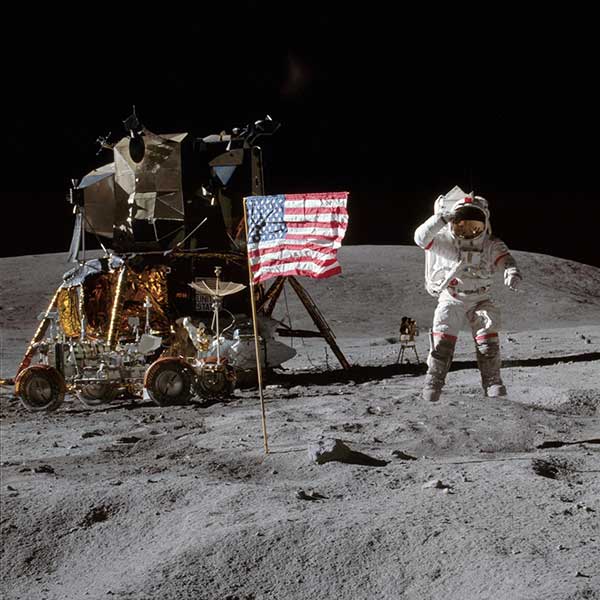
The centrepiece of the J mission surface operations was the Lunar Roving Vehicle, an electric car, folded into the Lunar Module’s descent stage, that unfolded on deployment and could carry two astronauts, their equipment, and their samples at up to eight miles per hour. The rover extended the crew’s range from a few hundred metres to tens of kilometres, opening up terrain that would otherwise have been unreachable.
Apollo 15’s Dave Scott and Jim Irwin drove to the base of the Apennine Mountains and found the Genesis Rock, a piece of anorthosite thought to be a fragment of the Moon’s original crust, crystallised over four billion years ago.
Apollo 16’s John Young and Charlie Duke explored the lunar highlands at Descartes, discovering to the scientific community’s considerable disappointment that the terrain they had expected to be volcanic was in fact formed by ancient impacts.
Apollo 17’s Gene Cernan and Harrison Schmitt, the only professional geologist to walk on the Moon, spent 22 hours on the surface across three EVAs, covering 30 kilometres in the rover and collecting 110 kilograms of samples, the largest haul of any mission.
While surface crews worked below, the Command Module Pilots were no longer just waiting in orbit. Apollo 15, 16, and 17 all carried a Scientific Instrument Module bay in the Service Module, an entire sector of the spacecraft converted into an orbital science platform. The instruments it carried had remarkable origins. The SIM bay carried a powerful Itek 24-inch focal length camera originally developed for the Lockheed U-2 and SR-71 reconnaissance aircraft, the same cameras that had photographed Soviet missile installations during the Cold War were now mapping the Moon in extraordinary detail.
Alongside it, gamma-ray spectrometers, X-ray spectrometers, mass spectrometers, laser altimeters, and mapping cameras built a comprehensive picture of the lunar surface composition, gravity field, and environment from above. Apollo 17’s SIM bay added a lunar sounder, a radar system that could penetrate the surface and return data on the geological layers beneath.
Retrieving the SIM bay film required an EVA in deep space, performed on the journey home. Alfred Worden on Apollo 15 performed the first deep space EVA in history, at approximately 171,000 nautical miles from Earth, climbing out of the Command Module, making his way along the Service Module’s exterior, and retrieving film cassettes from the cameras before returning inside. It took eighteen minutes, against the sixty that had been allocated. Evans on Apollo 16 and Evans on Apollo 17 did the same. Three EVAs conducted further from Earth than any human had ever been, in the small dark hours between the Moon and home.
The End
On 14 December 1972, Gene Cernan climbed the ladder of the Lunar Module Challenger for the last time. Before he did, he said: “We leave as we came and, God willing, as we shall return, with peace and hope for all mankind.” He has not returned. Nobody has.
Apollo 17 was the last crewed lunar mission. Three more had been planned, 18, 19, and 20, and were cancelled for budgetary reasons. The hardware had already been built. Two of the Saturn V rockets that would have flown them are on display at Kennedy Space Center and Johnson Space Center, lying on their sides in the open air, the largest museum exhibits in the world.
The twelve men who walked on the Moon brought back 842 pounds of lunar samples that scientists are still studying today. They deployed seismometers that recorded moonquakes for years after the missions ended. They left laser ranging targets that precisely measure the Moon’s distance and the rate at which it is slowly receding from Earth. They answered questions about the solar system’s formation that had been open since the beginning of science, and opened new ones that haven’t been answered yet.
For a brief window between 1969 and 1972, human beings regularly travelled to another world and came home. It remains the most distant destination any human has ever reached. The footprints they left in the lunar regolith will still be there in a million years, undisturbed by wind or weather, waiting.