

In May 1961, Alan Shepard spent fifteen minutes in space. In February 1962, John Glenn orbited the Earth three times. Both missions were remarkable achievements, and both left NASA facing an uncomfortable truth: neither had moved the agency meaningfully closer to the Moon.
To land on the Moon and return safely, NASA needed to know things it didn’t know yet. Could humans survive in space for eight days — the minimum required for a lunar round trip? Could two spacecraft find each other in orbit and dock, the manoeuvre at the heart of the lunar orbit rendezvous mission plan? Could astronauts work outside their spacecraft, as they would need to on the lunar surface? And could a returning capsule be guided to a precise landing point rather than wherever physics happened to deliver it?
None of these questions had answers in 1961. Project Gemini was built to answer all of them before Apollo arrived.
The Machine
The Gemini spacecraft was a significant departure from Mercury — larger, more capable, and designed from the outset to be actively flown rather than merely ridden. Where Mercury astronauts had been, controversially, little more than passengers in an automated system, Gemini put real flight controls in the crew’s hands. The spacecraft could change its orbit, adjust its trajectory, and manoeuvre in three dimensions. It had to — rendezvous and docking were impossible without it.
Built by McDonnell Aircraft — the same company that had built Mercury — Gemini seated two astronauts side by side in an ejection-seat-equipped cabin. Its reentry module was designed with a controllable lift profile, allowing the crew to steer toward a specific landing point during atmospheric entry. The launch vehicle was the Titan II, a liquid-fuelled ICBM that had been adapted for human spaceflight and offered nearly twice the thrust of the Atlas that had launched Glenn. Two unmanned test flights in 1964 validated the system. Then the astronauts got in.
Gemini 3 and 4: Opening Moves
The first crewed Gemini mission, Gemini 3, launched on 23 March 1965 with Gus Grissom — a Mercury veteran — commanding and John Young flying for the first time. The mission lasted just under five hours and three orbits, but accomplished its primary goal: demonstrating that the Gemini spacecraft could change its own orbit using onboard thrusters. Young also smuggled a corned beef sandwich aboard, which shed crumbs in the cabin and prompted a congressional enquiry. Space exploration in 1965 was, in some ways, a simpler time.
Gemini 4, in June 1965, was more ambitious. The mission lasted four days — a significant endurance test — and carried a secondary objective that immediately captured the world’s attention. On 3 June, Ed White opened his hatch at 14,000 feet per second over the Pacific Ocean and floated outside. He spent 23 minutes attached to the spacecraft by a tether, propelling himself with a handheld maneuvering gun, describing what he saw below him with barely contained exhilaration. When Mission Control told him it was time to come back inside, he refused. “I’m doing great,” he said. “It’s the saddest moment of my life.” He was eventually ordered back in — and it took several more minutes of persuasion before he complied. The hatch then stuck, requiring a sustained effort from both White and commander Jim McDivitt to close it.
White’s spacewalk looked effortless. That appearance, it would turn out, was deeply misleading.
Endurance: Gemini 5 and the Long Haul
If a lunar mission required eight days, NASA needed to know that astronauts could function for at least that long. Gemini 5, launched in August 1965, was designed to find out. Gordon Cooper and Pete Conrad spent eight days in orbit — a new world record — and came back with data showing that the human body could manage the duration, though not without cost. Both astronauts experienced significant muscle loss and cardiovascular deconditioning. The lesson was noted: long-duration spaceflight would require countermeasures.
Then, in December 1965, came one of the most quietly audacious achievements of the entire programme.
Gemini 6 and 7: The Christmas Rendezvous
Gemini 7, launched on 4 December 1965, was the endurance mission — Frank Borman and Jim Lovell, spending fourteen days in a cabin described by Lovell as resembling the front seat of a Volkswagen Beetle, wearing lightweight suits and conducting medical experiments for the entire duration. Uncomfortable, cramped, and tedious in ways that no training fully prepares you for. They orbited, and they waited.
What they were waiting for was Gemini 6. Originally planned to dock with an unmanned Agena target vehicle, Gemini 6 had been left without a target when its Agena blew up during launch on 25 October. Rather than cancel the mission, NASA improvised: Gemini 6 would launch while Gemini 7 was still in orbit, and the two crewed spacecraft would rendezvous. No docking — neither vehicle had the right equipment — but rendezvous.
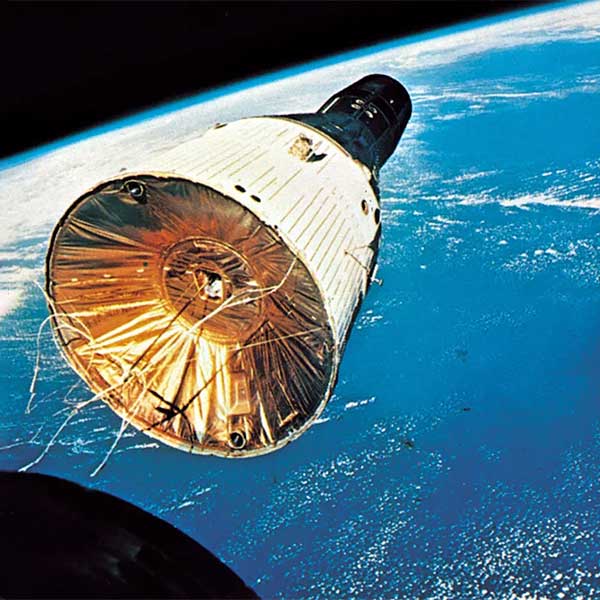
Gemini 6 launched on 15 December, and Wally Schirra flew it to within one foot of Gemini 7 — close enough for the two crews to see each other clearly through their windows. They flew in formation for several hours, at one point moving to within inches of each other. It was the first rendezvous of two crewed spacecraft in history, conducted with a precision that startled even the flight controllers watching from the ground. Schirra also smuggled a harmonica and bells aboard and played “Jingle Bells” to Mission Control — the first musical performance in space, twelve days before Christmas.
Borman and Lovell came home on 18 December after fourteen days — long enough for a lunar mission. The endurance question had its answer.
Gemini 8: Armstrong’s Fifteen Minutes
The next objective was docking — physically connecting two spacecraft in orbit. It had never been done before. On 16 March 1966, Neil Armstrong and David Scott launched in Gemini 8 and chased down an unmanned Agena target vehicle that had been placed in orbit ninety minutes earlier. The rendezvous was textbook. Armstrong manoeuvred to within forty-six metres of the Agena, inspected it carefully for damage, and moved in.
“Flight, we are docked,” Scott radioed. “Yes, it’s really a smoothie.”
Twenty-seven minutes later, the docked assembly began to roll. Armstrong used Gemini’s thrusters to stop it. It started again immediately. He and Scott, flying over an ocean with no contact with Mission Control, assumed the problem was a malfunctioning thruster on the Agena — and undocked.
It was the wrong decision, though an entirely understandable one. The problem was a short-circuited thruster on Gemini itself, not the Agena. The Agena’s thrusters had actually been firing automatically in a futile attempt to counteract it. Once cut loose from the Agena’s stabilising mass, the Gemini immediately increased its roll rate catastrophically. The tumble rate reached 296 degrees per second — one full rotation every 1.2 seconds. Armstrong and Scott began experiencing coriolis effect and nystagmus — their inner ears were overwhelmed by the rotation, their eyes moving involuntarily, their ability to read the instruments in front of them deteriorating by the second. Had either effect become severe enough, the two astronauts would have been unable to see or operate their controls.
Armstrong, out of contact with the ground, shut down all sixteen of the orbital manoeuvring thrusters — a decision that was not in any procedure manual — and activated the reentry control thrusters instead, a system reserved exclusively for atmospheric entry. It worked. The tumbling stopped. Scott later praised Armstrong: “The guy was brilliant. He knew the system so well. He found the solution, he activated the solution, under extreme circumstances.”
Using the reentry thrusters meant the mission had to end immediately — regulations required it, and they’d used 75% of the fuel. Gemini 8 splashed down in the Pacific after ten hours and forty-one minutes — 15% of the planned mission duration. Scott’s spacewalk was cancelled. Armstrong said almost nothing to the press about what had happened. Three years later, he was the first human to walk on the Moon, and displayed in that moment exactly the same quality that had saved Gemini 8: an ability to think with perfect clarity under conditions that would paralyse most people.
The EVA Crisis: Gemini 9 to 11
Ed White’s spacewalk had looked easy. Gene Cernan’s, on Gemini 9A in June 1966, revealed the truth.
Cernan’s task was ambitious: move to the back of the adapter section and strap into the Astronaut Maneuvering Unit — an Air Force jetpack that would allow him to fly independently of the spacecraft. In training and on paper, it seemed achievable. In orbit, it was a near disaster.
After pumping up his pressure suit, “the suit took on a life of its own and became so stiff that it didn’t want to bend at all.” Without handholds or footholds, every movement sent him tumbling in the opposite direction. Newton’s third law, which is easy to work around on Earth, is absolute in weightlessness. The harder Cernan worked, the worse it got. His heart rate rose to near his maximum, the exertion so great that his visor fogged, obscuring his vision. He never reached the jetpack. His EVA was cut short after an exhausting two hours — he was later found to have lost 10 pounds during that time. Even with careful direction from Stafford, he barely made it back inside the spacecraft.
The same story repeated on Gemini 10 and 11. Michael Collins performed a partial EVA and struggled badly. Richard Gordon became so exhausted and overheated during an EVA on Gemini 11 that he had to abandon his objectives entirely. The pattern was impossible to ignore: NASA did not know how to make spacewalking work, and there was one mission left.
The problem, it turned out, wasn’t the astronauts. It was the training. EVA preparation had relied on aircraft flying parabolic arcs to simulate weightlessness — providing around thirty seconds of zero-g at a time, nowhere near enough to learn the patient, deliberate movement style that weightlessness actually required. Underwater EVA experiments being done by a small contractor in a school pool outside Baltimore suddenly looked a lot more interesting. Neutral buoyancy — weighting a suited astronaut so they neither rose nor sank — could simulate weightlessness almost indefinitely. The solution had been sitting in a swimming pool the whole time.
Gemini 12: Aldrin Saves the Programme
By the time Gemini 12 launched on 11 November 1966, the stakes were stark. Spacewalking remained an enigma. With only one more Gemini flight on the schedule, solving the problems of working outside a spacecraft would be the primary goal. If Gemini 12 failed to demonstrate functional EVA, Apollo would inherit a problem nobody knew how to solve.
Buzz Aldrin had spent months preparing for exactly this moment. Being the backup to Gene Cernan on Gemini 9, and thus potentially filling the right-hand seat on Gemini 12, put Aldrin in the middle of training for extravehicular activity. He had studied the failures of White, Cernan, Collins, and Gordon systematically, identifying the common factors — no footholds, no handholds, no rest periods, tasks that demanded sustained effort rather than deliberate pace. He had trained in the Baltimore pool, worked through procedures until they were instinct, and helped design a set of modifications to the spacecraft exterior: handholds and railings on the capsule and target vehicle, and shoe restraints in the area where Aldrin would be working.
In orbit, it worked. Aldrin moved methodically, rested between tasks, and completed everything he was assigned. His two-hour, twenty-minute tethered spacewalk, during which he photographed star fields, retrieved a micrometeorite collector, and did other tasks, at last demonstrated the feasibility of extravehicular activity. He also took the first selfie during a spacewalk, pointing the camera at himself while standing in the hatch. Total EVA time across three separate periods: five hours and thirty minutes, all without incident.
Gemini 12 also demonstrated, when its rendezvous radar failed, that manual docking procedures were viable — Aldrin, who had written his MIT doctoral thesis on orbital rendezvous, used a sextant and the onboard computer to calculate the approach manually. It was the kind of mission where everything that could go wrong did, and the crew solved each problem as it appeared.
The Inheritance
Gemini ended in November 1966. In twenty months of crewed flight, ten missions had answered every question Apollo needed answered. Astronauts could survive two weeks in space. Two spacecraft could find each other in orbit and dock. Humans could work outside their spacecraft given the right tools and training. A capsule could be guided to a precise landing point.
The programme had also given NASA something less tangible but equally important: operational confidence. Flight controllers who had managed ten consecutive crewed missions — including a near-disaster that required real-time problem solving with no procedures to follow — were ready for Apollo. Astronauts who had rendezvoused, docked, spacewalked, and endured weeks of confinement were ready for the Moon.
Almost every name that mattered in Apollo had flown Gemini first. Armstrong and Aldrin, who would walk on the Moon in 1969. Borman, who commanded Apollo 8’s flight around the Moon. Collins, who orbited above while Armstrong and Aldrin descended. Conrad, Bean, Lovell, Young, Scott — all of them shaped by the missions they flew between 1965 and 1966.
Gemini is the programme that the history books most often skip in their rush from Mercury to Apollo. That’s exactly backwards. Mercury proved Americans could get to space. Gemini proved they could get to the Moon. Without it, Apollo would have been an aspiration rather than an achievement.