

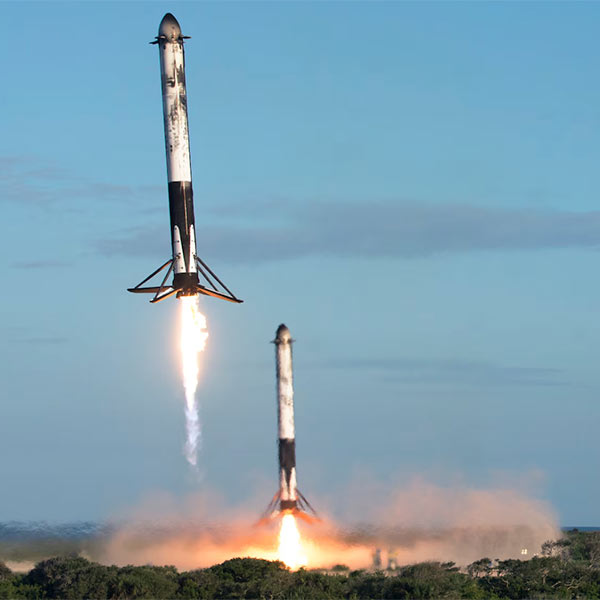
The rocket that landed at Cape Canaveral on 21 December 2015 had, nine and a half minutes earlier, been the first stage of a Falcon 9 carrying eleven Orbcomm communications satellites. It had accelerated to three thousand miles per hour, separated from the second stage, fired its engines in a boostback burn to reverse its trajectory, survived reentry through the atmosphere — “like riding a broomstick in a hurricane,” one engineer described it — fired again to slow its descent, and landed itself on four legs in the dead centre of a circular concrete pad six kilometres from where it had launched. The entire sequence took less than ten minutes. A small fire burned briefly at its base and was extinguished. The rocket stood there, vertical, intact, smoking slightly, having done something no orbital rocket had ever done before.
The crowd at SpaceX’s mission control in Hawthorne, California erupted. Outside, residents of Brevard County, Florida had been warned to expect sonic booms from the inbound rocket. Many had stayed up. The sonic booms arrived. The rocket landed. People who had never thought much about rocketry found themselves watching a video of a machine coming home and feeling something they couldn’t quite explain. The economics of space travel had just changed permanently, and almost everyone who watched it could sense that even before the analysis arrived.
Why Reusability Mattered
The logic of reusable rocketry is so straightforward it raises the question of why it took so long. A rocket’s first stage — the large lower section that provides the initial thrust and then separates — represents roughly 60-70% of the total vehicle cost. In the traditional model, that component was discarded into the ocean after every flight, a few minutes of use for hardware that cost tens or hundreds of millions of dollars to build. Elon Musk had made the analogy explicit years earlier: it was like throwing away a Boeing 747 after every flight and building a new one for the next journey. No airline could operate on that economics. No space industry could either, if it wanted to grow beyond the handful of government and commercial customers willing to pay traditional launch prices.
SpaceX had been working toward propulsive landing since at least 2011. The Grasshopper test vehicle — a Falcon 9 first stage with landing legs attached — flew a series of increasingly ambitious vertical takeoff and landing hops between 2012 and 2013, the highest reaching 744 metres before descending and landing. These were low-altitude, low-velocity tests that proved the concept of propulsive landing at speeds where the atmosphere could be used for braking. The hard part was what came after separation from an orbital-class mission: a rocket stage travelling at Mach 10 or more needed to flip itself around, survive reentry heating, slow down to landing speed, and arrive at a precise location on a surface that might be hundreds of kilometres downrange. No automated system had ever been asked to do all of this reliably.
The first attempts to land Falcon 9 stages at sea, in January and April 2015, both failed — the stages arrived at the drone ship but tipped over on landing, either from a sticking valve or from running out of landing fuel. SpaceX had described both attempts in advance as long shots. Nobody was disappointed. The January failure was the company’s first attempt to land a stage on what would become its signature piece of infrastructure.
The Ships Named After Novels
The drone ships deserve their full introduction, because they are one of the most quietly charming details in the entire story of commercial spaceflight. Musk is an avid reader of science fiction, and his favourite series is Iain M. Banks’ Culture novels — a sprawling, humane collection of books set in a utopian interstellar civilisation where superintelligent artificial minds inhabit enormous starships, and where those minds choose their own names, which tend toward the sardonic, the philosophical, and the absurd. Banks died of cancer in 2013 at the age of 59, two years before the first drone ship was named. In tribute to him, Musk named SpaceX’s autonomous ocean-going landing platforms after Culture ships. The first was Just Read the Instructions, operating in the Pacific, named for a sentient starship in The Player of Games. The Atlantic platform was Of Course I Still Love You — the same novel, the same implied context of a ship that has been away somewhere difficult and has returned. A third ship, added in 2021 for the increasing East Coast launch cadence, became A Shortfall of Gravitas — named for a ship called Experiencing A Significant Gravitas Shortfall in Look to Windward. The names were Musk’s private homage to a dead writer who had imagined autonomous machines doing remarkable things and given them names that made people smile.
Rockets landing on barges at sea managed by thrusters and computers, named after characters from science fiction novels, miles from the nearest land: the aesthetic of SpaceX’s operation was, from the beginning, self-consciously aware of where it sat in history.
The Routine Miracle
The first landed stage — Booster B1019, the vehicle that had carried the Orbcomm satellites — was taken to SpaceX’s hangar, inspected, static-fired on the same pad it had launched from, and eventually placed on a stand outside SpaceX’s Hawthorne headquarters, where it remains as of this writing. Musk had said in December that there were no immediate plans to reflY it — the first landing was the proof of concept, and the engineering lessons from the inspection were more valuable than another flight. That restraint lasted a little over a year.
On 30 March 2017, Booster B1021 — which had carried the CRS-8 resupply mission to the ISS in April 2016 and performed the first successful drone ship landing in SpaceX history — launched again, carrying the SES-10 communications satellite to geostationary transfer orbit. It was the first time in the history of orbital spaceflight that a previously-flown rocket first stage had been reflown on a new mission. It landed again after the flight, on Of Course I Still Love You, making it the first stage to land twice. Musk said it was a “huge revolution in spaceflight.”
The revolution normalised quickly. By 2019, reflying stages was standard practice. By 2020, a stage might fly three, four, or five times. By 2022, the programme record was a stage that had flown eleven times. By 2024, stages routinely flew fifteen or more missions, some approaching twenty. SpaceX had established refurbishment procedures that could turn around a recovered stage in weeks. The economics had changed exactly as the theory predicted: the cost of each additional Falcon 9 launch, using a recovered stage, fell dramatically compared to the cost of flying an entirely new vehicle. By 2024 SpaceX was conducting 134 Falcon launches in a year — accounting for over half of all orbital launches on Earth — at a cadence and cost that would have seemed impossible in 2012.
Virgin Galactic and the Different Vision
While SpaceX was landing orbital rockets, the space tourism sector was pursuing a different approach to reusability — and learning, at terrible cost, the consequences of insufficient caution. Virgin Galactic had been the most publicly prominent space tourism company since Richard Branson announced it in 2004, riding on the success of SpaceShipOne, the Burt Rutan-designed aircraft that had won the $10 million Ansari X Prize in October 2004 by flying to 100 kilometres twice in two weeks. SpaceShipTwo, its commercial successor, used the same elegant “feathering” reentry system: the tail booms rotated upward before reentry, creating drag and stabilising the craft automatically for descent, before returning to their normal position for the glide back to the runway. It was mechanically simple, which was the point. Simple systems fail in fewer ways.
On 31 October 2014, SpaceShipTwo VSS Enterprise separated from its carrier aircraft WhiteKnightTwo at 46,000 feet above the Mojave Desert and ignited its hybrid rocket motor for the fourth powered test flight. Fourteen seconds after ignition, at Mach 1, co-pilot Michael Alsbury reached for the handle that locked the feathering mechanism and moved it to the unlocked position. He was not supposed to do this until Mach 1.4. Nobody is certain why he did it early — he was an experienced test pilot with 1,600 hours in research aircraft, he had flown the vehicle before, and the investigation found no definitive explanation for the timing. What the investigation found was that the handle’s position in the cockpit made it easy to move during the stress of a rocket burn, that the consequences of moving it too early had been discussed in a single email in 2010 and a single presentation slide in 2011 and never subsequently, and that no mechanical interlock existed to prevent exactly this from happening.
When Alsbury unlocked the feathering system at Mach 0.8 rather than Mach 1.4, the aerodynamic forces on the unlocked tail booms were strong enough to force them upward without any further command. The vehicle broke apart immediately. Alsbury was killed. Pilot Peter Siebold was blown free and survived — the only person in the history of spaceflight to survive the destruction of their spacecraft in flight — deploying his parachute at lower altitude with a shoulder injury. The National Transportation Safety Board found that Scaled Composites, the vehicle’s builder, had failed to design adequate safeguards against a single human error that could be catastrophic. The FAA had approved the test flights without adequate attention to human factors. The window in which Alsbury was supposed to act was, investigators noted, incredibly narrow — unlock before Mach 1.4 was forbidden, but waiting past Mach 1.5 would trigger a caution light. The conflicting pressures of the tight band made the timing error, in retrospect, less surprising than it had initially appeared.
A successor vehicle, VSS Unity, eventually flew Branson himself to the edge of space in July 2021 — ten days before Bezos flew on New Shepard. Virgin Galactic went on to conduct commercial tourist flights in 2023, then grounded its fleet for an upgrade programme, then in 2024 announced it was pausing passenger flights entirely while it developed a next-generation vehicle called the Delta class. The company’s stock, which had briefly reached a valuation of $8 billion in 2021, had fallen to near zero by 2024. As of early 2026 the company is restructuring. The vision of routine space tourism in a winged aircraft remains unrealised.
Blue Origin’s Long Game
Jeff Bezos founded Blue Origin in September 2000, two years before SpaceX, and operated it in near-total secrecy for a decade. Its motto — Gradatim Ferociter, Latin for “step by step, ferociously” — described a philosophy that was the deliberate opposite of SpaceX’s public iterative chaos. Where SpaceX failed loudly and learned visibly, Blue Origin tested quietly, moved slowly, and announced when it had something polished to show. The approach had virtues. It also had a decade-shaped gap in its competitive position.
New Shepard — named for Alan Shepard, America’s first man in space — was the company’s first vehicle: a suborbital rocket and capsule system designed to carry passengers to just above the Kármán line, the internationally recognised boundary of space at 100 kilometres, give them three to four minutes of weightlessness through the largest windows ever fitted to a spacecraft, and return them to the West Texas desert under parachutes. It was not an orbital vehicle. It was, in every technical sense, a very sophisticated tourist attraction — a theme park ride with a genuine cosmic view.
Blue Origin completed eighteen uncrewed test flights before putting humans aboard. The first crewed flight, on 20 July 2021, carried Bezos himself, his brother Mark, 18-year-old Dutch student Oliver Daemen — the youngest person ever to reach space — and Wally Funk, then 82, a pioneering aviator who had completed Mercury astronaut training in the early 1960s as one of the “Mercury 13” women only to be denied a flight because NASA would not consider female candidates. She had waited sixty years. She led the crew up the seven-floor launch gantry at a pace that left the others struggling to keep up.
Three months later, on 13 October 2021, Blue Origin flew its most famous passenger. William Shatner — 90 years old, the man who had played Captain James T. Kirk in Star Trek for 55 years, who had spent more of his professional life pretending to be in space than most astronauts had spent actually being there — climbed into New Shepard’s capsule and went for real. The flight lasted eleven minutes. Shatner spent three of them weightless, pressing his face against the window, looking down at the curve of the Earth and up at the absolute black above it. When he climbed out on the Texas desert and Bezos approached with a celebratory champagne bottle, Shatner stopped him with a gesture and spoke for several minutes without pausing, his voice breaking repeatedly, trying to articulate something he clearly hadn’t expected to feel.
“What you have given me is the most profound experience I can imagine,” The Washington Post he told Bezos. He described looking down at the thin blue line of the atmosphere and suddenly understanding, viscerally, how fragile it was — and looking up at the blackness and thinking about death. Not abstractly. Immediately. “In the moment, this is life, and that’s death,” he said, gesturing upward. “And in an instant you go: ‘wow, that’s death.'” He had spent fifty years playing a character who treated space as an adventure. The reality, he said, was nothing like the simulation. He called it “the covering of blue” — a soft, impossibly thin layer that was all that stood between everything alive and the void above it. Bezos stood with his champagne bottle and waited. It was not quite the press event the Blue Origin communications team had planned.
The celebrity passenger list that followed read like a booking agent’s fever dream: NFL Hall of Famer Michael Strahan, Laura Shepard Churchley — Alan Shepard’s daughter — Ed Dwight, the first Black astronaut candidate who had been denied a flight in the 1960s and finally reached space at 90, and, in April 2025, an all-female crew that included pop star Katy Perry, television journalist Gayle King, and Jeff Bezos’s fiancée Lauren Sanchez, who had organised the flight and invited the others. Perry sang “What a Wonderful World” in zero gravity. King and Perry both knelt and kissed the ground when they returned.
The public reaction to these flights has never been entirely comfortable. A common criticism frames them as expensive vanity projects for the ultra-wealthy — a billionaire using his rocket company to send celebrities to the edge of space while the serious work of spaceflight happens elsewhere. The criticism is not entirely wrong, and it is not entirely fair. The reusability of New Shepard’s booster is genuine — the same vehicle flew multiple times without major refurbishment, demonstrating exactly the economics the chapter has been discussing. The experience of landing and reflying boosters fed directly into Blue Origin’s engineering culture, and when New Glenn flew its first orbital mission in January 2025, its booster was recovered on the second flight, only the second company ever to achieve that.
What the celebrity flights also did, unintentionally but perhaps most valuably, was provide a series of unrehearsed human reactions to the overview effect — that shift in perspective that astronauts have described since the Apollo era, in which seeing Earth from outside produces an almost involuntary re-evaluation of what matters. Most of Blue Origin’s passengers were not scientists or test pilots. They were ordinary people — extraordinary in their fame or wealth, ordinary in their lack of preparation for what they were about to feel — and their reactions on landing were raw in a way that no trained astronaut’s post-flight press conference ever quite is. Shatner’s broken, unprompted eulogy on the Texas dirt, trying to describe something he couldn’t quite name, was watched by millions. It may have done more to communicate what space actually feels like than fifty years of NASA press releases.
Blue Origin paused New Shepard flights in January 2026, redirecting resources toward the Blue Moon lander and New Glenn operations. The tourist programme has carried 98 people to the edge of space across eleven crewed missions. Whether it advanced the cause of reusable spaceflight or merely illustrated its possibilities while the serious work happened elsewhere is a question the industry has not settled. Both things may be true simultaneously.
So What Changed
The Falcon 9 first stage that landed at Cape Canaveral in December 2015 is now on a stand outside SpaceX’s headquarters. It has been there for nearly a decade. It never flew again. The stage that came after it flew, landed, flew again, and landed again — the first time that had ever happened. The stage that came after that is now, in all probability, on its fifteenth or twentieth mission, an ordinary working vehicle.
The cost of a kilogram to low Earth orbit has fallen further in the decade since that first landing than in the preceding five decades of the space age. SpaceX launched more orbital missions in 2024 than any organisation in history, more than half of all orbital launches on Earth that year, using rocket hardware that had flown before and would fly again. The industry that had dismissed SpaceX in 2002, and then dismissed its reusability programme in 2012, was, by 2024, either building its own reusable systems or acknowledging that the alternative was not competing for the most important contracts.
The problem of reusable spaceflight was not, in the end, a technical problem beyond humanity’s reach. It was an economic and institutional problem: nobody had prioritised it, because nobody had believed the savings would justify the investment, and because the existing market structure rewarded expendable launches. SpaceX prioritised it because Musk’s back-of-envelope calculation on a plane from Moscow had concluded that rockets should cost much less than they did, and that the gap between what they cost and what their materials cost was a problem waiting for someone willing to solve it.
On the night of 21 December 2015, at 8:38 pm Eastern Standard Time, that problem was solved. The rest has been engineering.