

The Moon race was over in July 1969. Both superpowers had been left with the same question: now what?
The answer, it turned out, was to build places to live in space — to move from demonstrating the ability to get there and back to learning what it actually meant to stay. Both countries had been thinking about space stations since before Apollo flew. Both now had the political justification and the engineering momentum to build them. What neither could have predicted was how much drama would surround the attempt.
The World’s First Space Station
On 19 April 1971, a Proton rocket carried Salyut 1 into orbit — the world’s first space station. It was 15.8 metres long, weighed nearly 19 tonnes, and provided a habitable volume of 90 cubic metres across its pressurised compartments. Its docking port waited for the first crew.
The first crew never got inside. Soyuz 10, launched three days later, managed a soft dock but couldn’t complete the hard docking required to open the hatch. Three cosmonauts orbited a station they couldn’t enter and came home. The second crew — Georgi Dobrovolsky, Vladislav Volkov, and Viktor Patsayev — succeeded where Soyuz 10 had failed.
They boarded Salyut 1 on 7 June 1971 and spent 23 days conducting experiments, exercising on the station’s treadmill, growing onion shoots, and broadcasting live television to a captivated Soviet public. They celebrated Patsayev’s birthday in orbit — the first birthday ever marked in space, with a surprise meal of veal, biscuits, and blackberry juice prepared by his crewmates. An electrical fire on day 11 briefly threatened the mission. The exercise treadmill vibrated the entire station when used. It was, in many ways, exactly the kind of experience that would define long-duration spaceflight for the next fifty years: productive, difficult, and occasionally alarming.
On 29 June they undocked and began their journey home. Volkov radioed Mission Control to ensure cognac would be waiting at the landing site. “See you tomorrow,” he signed off. Twenty-nine minutes before touchdown, at 100 miles altitude, the explosive bolts that separated the Soyuz descent module from the rest of the spacecraft fired. The shock from the explosive bolts jarred open a pressure equalisation valve that normally opened only once the spacecraft was descending on its parachute, well inside the atmosphere.
As the capsule rapidly depressurised, Patsayev tried to close the valve by hand but failed. Flight recorder data from the single cosmonaut outfitted with biomedical sensors showed death occurred within 40 seconds of pressure loss. The capsule descended perfectly under its parachute, landed softly in Kazakhstan, and sat undamaged in the steppe. The recovery team knocked on the hull. There was no response.
The would-be rescuers opened the hatch to find all three cosmonauts dead in their seats, with blue splotches on their faces and blood trickling from their noses and ears. The national outpouring of grief reportedly matched the sorrow that followed President Kennedy’s assassination in 1963.
Dobrovolsky, Volkov, and Patsayev remain the only humans to have died in space. The Soyuz was grounded and extensively redesigned. The pressure suits that all subsequent Soyuz crews have worn during ascent and descent exist because of what happened to them.
Salyut 1 was deorbited over the Pacific four months later, unmanned. Its only crew had not returned.
The Secret Stations
The Salyut programme continued through the 1970s, but not all of it was what it appeared. Alongside the civilian DOS stations — which carried the Salyut name publicly — the Soviet military was simultaneously operating a parallel programme of Almaz stations, also publicly designated as Salyut to conceal their purpose.
Salyut 2, launched in April 1973, was the first Almaz military station. It suffered a malfunction shortly after reaching orbit and was never crewed. Salyut 3, launched in June 1974, was more successful. It carried an extraordinary array of reconnaissance cameras — cosmonaut Pavel Popovich recalled the station was equipped with 14 cameras — and something even more remarkable: a gun. Salyut 3 was equipped with a self-defence gun, the Rikhter R-23 cannon, fixed to the station and aimed by rotating the entire vehicle. Due to the potential vibration during firing, tests were only conducted after the crew had departed. The Cold War had, briefly and surreally, extended into orbit.
Salyut 4 and 5 continued the programme’s scientific and military work respectively. Then, in 1977, came Salyut 6 — a significant evolution that introduced a second docking port, allowing resupply missions and crew rotations without requiring the station to be abandoned. For the first time, long-duration missions became genuinely sustainable. International cosmonauts from Soviet-allied nations began flying to the station under the Intercosmos programme. The era of the space station as a permanent institution, rather than a temporary outpost, had begun.
Salyut 7: The Station That Refused to Die
Salyut 7 launched in April 1982 and, in its early years, quietly set records. Its third crew spent 237 days aboard — a world record at the time. It hosted the first French and Indian cosmonauts to fly in space. Svetlana Savitskaya became the first woman to perform an EVA, conducting metal cutting and welding experiments alongside her crewmate on the station’s exterior. A fuel line rupture in 1983 required a series of emergency spacewalks to repair. The station was elderly, patched, and increasingly temperamental — but it was working.
Then, on 11 February 1985, with no crew aboard, it stopped.
Salyut 7 was orbiting in automatic mode when, without warning, it stopped responding to commands from the ground. Engineers determined that a faulty sensor had caused the entire electrical system to shut down. The batteries drained. Every system switched off. The station began tumbling slowly, its solar panels pointing randomly, no longer tracking the sun. Without electronic correction of its flight trajectory, Salyut 7 became an uncontrollable dead weight of 19 tonnes, slowly spiralling toward Earth. Calculations suggested it would reenter the atmosphere within months — and that its debris field, for anything that survived the heat, could fall anywhere between 51 degrees north and 51 degrees south latitude. That corridor encompassed most of the inhabited world.
The Soviet Union made a decision that it told almost nobody about: they would send two men to dock with the dead station and bring it back to life. The task had never been attempted. Nobody knew if it was possible.
Vladimir Dzhanibekov was chosen to command the mission for one specific reason: he had docked with Salyut 7 manually before, and he was the most skilled manual pilot in the cosmonaut corps. Viktor Savinykh, his flight engineer, spent four months studying every available document on Salyut 7’s systems — because when they arrived, there would be no power for instruments, no automatic guidance, no telemetry. Savinykh also practised moving through a full-scale model of the station in complete darkness. Whatever awaited them inside, he would need to find it by feel.
The Soyuz T-13 was reconfigured for the rescue: the automatic docking apparatus was removed to free space, and extra supplies, fuel, cold-weather gear, and a handheld laser rangefinder were loaded in its place. The laser rangefinder replaced the radio docking system that Salyut 7 could no longer activate. They would navigate by eye and by light.
On 6 June 1985, Soyuz T-13 launched from Baikonur. Two days later, Dzhanibekov and Savinykh closed in on their target. The station was not broadcasting radar or telemetry for rendezvous. Its solar arrays were pointing randomly as it rolled slowly about its long axis. As they drew closer they could see that the thermal blankets had turned a dull grey from years of unshielded solar exposure. They circled the station, assessing. The forward docking port was accessible.
Dzhanibekov matched Soyuz T-13’s rotation to the tumbling station — a feat of piloting that required him to essentially become part of the station’s motion before nudging forward to close the final metres. The spaceship froze for a moment. The cosmonauts felt a light push, then the clang of automated latches sounded. They were docked to a dead station, 200 kilometres above the Earth, with no idea what was inside.
They equalised pressure carefully through a small valve before opening the hatch. A rush of freezing air met them. Inside, the temperature was well below zero. Every surface was coated in frost. They confirmed that the station’s electrical system was dead, and attired in winter fur-lined clothing, entered to conduct repairs. The water tanks were frozen solid. The equipment had been exposed to temperatures it had never been designed to survive. Whether any of it still worked was entirely unknown.
They connected the surviving batteries directly to the solar panels, then used Soyuz T-13’s thrusters to rotate the entire combined mass — station and spacecraft together — until Salyut 7’s arrays faced the sun. Power began to trickle in. Working tirelessly in the freezing cold, Dzhanibekov and Savinykh began bringing systems back online one at a time — lights, communications, water delivery, heating. As the station warmed and its frozen surfaces began to thaw, they faced a new problem: water was everywhere, pooling on equipment, soaking into electrical systems, coating every surface. They dried the station using every rug they could find, even their own space clothes. Only once the moisture had been removed could the communications system be safely reactivated.
On 13 June — five days after docking — Mission Control received the first signal from Salyut 7 since February. The station was alive.
Working tirelessly under the harshest of conditions, Dzhanibekov and Savinykh resuscitated all of Salyut 7’s systems in just ten days. Within a week of that, a Progress cargo ship was able to dock automatically and deliver replacement parts. The rescue was complete. In the words of space historian David Portree, it remains “one of the most impressive feats of in-space repairs in history” — a description that stands unchallenged.
There was one detail the Soviets kept to themselves at the time. The crew was aware that Space Shuttle Challenger was in orbit simultaneously, and feared that America might use the opportunity to capture the drifting station. Getting there first was not just a matter of national pride — it was, in their minds, a matter of security.
Salyut 7 continued operating for another year after the rescue, hosting further crews and welcoming Mir’s first expedition, which crossed from the new station to Salyut to collect valuable equipment — the only station-to-station crew transfer in the history of spaceflight. It was then boosted to a higher orbit and mothballed. The plan had been to return to it with the Buran shuttle. Buran flew once and was never used again. Funding evaporated. The Soviet Union dissolved. Salyut 7’s orbit decayed ahead of schedule, and on 7 February 1991 it reentered the atmosphere and burned up over South America — its direct lineage living on in the Zvezda module of the ISS, which traces its design heritage directly to the Salyut programme.
America’s First Station: Nearly Lost Before It Opened
NASA’s answer to Salyut was Skylab — converted from a Saturn V third stage into a capacious orbital laboratory, offering more habitable volume than any station that had preceded it. Skylab was launched on 14 May 1973 by a modified Saturn V.The launch appeared to go well. Then the telemetry started telling a different story.
A design flaw had allowed air to rush under the micrometeoroid shield during ascent, causing it to peel away from the workshop. In peeling away, the shield had torn one solar panel completely off the station and jammed the other against the hull. Temperatures inside the station soared, threatening to melt plastic insulation and release poisonous gases. Skylab was in orbit, overheating, and generating a fraction of the power it needed. Without intervention, it would be uninhabitable.
The first crew’s launch was delayed ten days while engineers worked around the clock. Jack Kinzler, chief of the Technical Services Division at NASA’s Johnson Space Center, devised a parasol constructed of aluminium poles and fabric made of nylon, Mylar, and aluminium that could be passed through a scientific airlock in the workshop and opened like an umbrella against the outside skin of the station. It was designed, manufactured, and tested in days, then packed below the crew’s seats on the morning before launch. Nobody had ever attempted an orbital repair of this kind. Nobody was entirely sure it would work.
On 25 May, Pete Conrad, Paul Weitz, and Joseph Kerwin launched to meet their damaged station. They flew around it first, documenting the torn hull and the jammed solar panel. Weitz leaned out of the open hatch while Kerwin held him by the legs, attempting to free the panel with improvised tools. It didn’t work. They docked — on the sixth attempt, after fixing a fault in the docking mechanism by hand — and entered a station where the temperature had climbed to 130 degrees Fahrenheit. The crew deployed the parasol sunshade through a small instrument port, bringing station temperatures down to acceptable levels. Then, two weeks into the mission, Conrad and Kerwin went outside and freed the jammed solar panel with a cable cutter improvised from tools that had been designed in a week and tested underwater at Marshall Space Flight Center. Full power was restored.
The repairs, unprecedented in the history of spaceflight, not only ensured that Skylab could carry out its full mission but set the example of in-flight repair for future programmes. Pete Conrad had already walked on the Moon. Rescuing Skylab may have been the more impressive achievement.
Three crews lived aboard the station in 1973 and 1974, setting records that fell with each mission: 28 days, then 59, then 84. The third crew — Gerald Carr, Edward Gibson, and William Pogue — spent so long in orbit that they eventually negotiated a slower work pace with the ground after growing exhausted from the relentless schedule controllers were imposing. It was the first instance of astronauts going on strike, more or less. They spent Christmas in orbit, photographed Comet Kohoutek, observed solar flares in real time through Skylab’s extraordinary Apollo Telescope Mount, and came home in February 1974 having exceeded every scientific objective.
Skylab was then shut down and placed in a storage configuration, waiting for the Space Shuttle — which was supposed to arrive within a few years and reboost it to a higher orbit. The Shuttle wasn’t ready in time. Skylab’s orbit decayed and it disintegrated in the atmosphere on 11 July 1979, scattering debris across the Indian Ocean and Western Australia. A piece of it landed in the small town of Esperance, which sent NASA a $400 fine for littering. It was never paid.
The Handshake
With the Moon race over and both superpowers nursing the costs of a decade of maximum effort, the political climate shifted. Nixon and Brezhnev had signed a détente agreement in 1972, and space — where the symbolism of cooperation was enormous and the practical costs were manageable — seemed like an ideal arena to demonstrate it. Negotiations that had begun in 1970 produced an agreement: an American Apollo spacecraft and a Soviet Soyuz would dock in orbit.
The engineering challenges were considerable. Apollo operated at around 5 psi of pure oxygen. Soyuz used a nitrogen-oxygen mixture at near sea-level pressure. Direct transfer between the two atmospheres would have given crew members the bends. The solution was a custom-built Docking Module — designed jointly, manufactured in America — that could serve as both an airlock and an interface adapter, with its own intermediate pressure to allow gradual adjustment between the two environments. A new androgynous docking system was developed specifically for the mission, designed so that neither spacecraft was the “active” or “passive” partner — a symbolic equality that the diplomats had insisted upon.
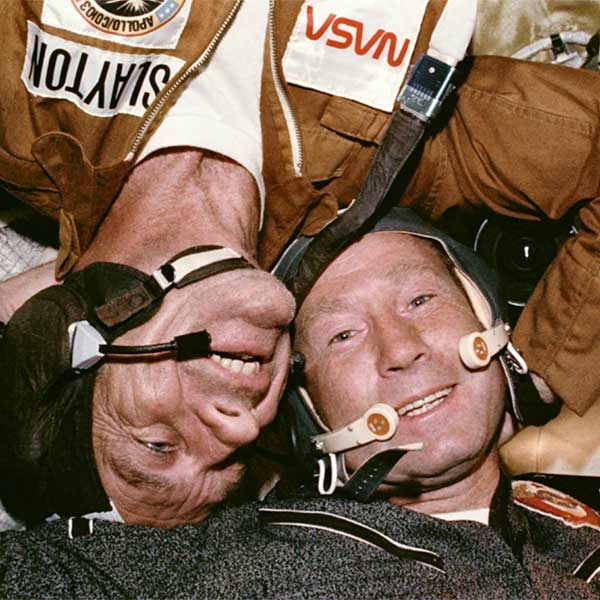
The crews trained together, learned each other’s languages, and ate each other’s food — or at least tried to. When Leonov was diplomatically asked what he thought of American space food, he said he liked “the freshness of its preparation.” On 15 July 1975, Soyuz 19 launched from Baikonur with Alexei Leonov — the first spacewalker — and Valery Kubasov aboard. Seven and a half hours later, Apollo lifted off from Kennedy Space Center carrying Tom Stafford, Deke Slayton, and Vance Brand.
Slayton deserves a moment. He had been one of the original Mercury Seven astronauts, selected in 1959. An irregular heartbeat had grounded him immediately, before he could fly. He had spent sixteen years managing the astronaut office, overseeing everyone else’s flights, and fighting the medical system to get back into space. In 1972, after a lengthy programme of monitoring and evaluation, he had been cleared to fly. He was 51 years old when Apollo lifted off. He had waited longer than any astronaut in history for his first flight.
On 17 July, the two spacecraft docked 138 miles above the Atlantic. Leonov floated through the hatch. Stafford reached out his hand. “Glad to see you,” Stafford said in Russian. “Glad to see you. Very, very happy to see you,” Leonov replied in English. Both crews rotated through each other’s spacecraft, shared meals, conducted experiments, and addressed a press conference from orbit. Slayton photographed ocean currents over the Yucatan Peninsula. Leonov had brought along painting materials and sketched his crewmates in zero gravity. After 44 hours docked together, the two spacecraft separated and went their separate ways — Soyuz home first, Apollo remaining in orbit for another six days.
Then, on 24 July, Apollo began its final descent.
The reentry was routine until it wasn’t. The Earth Landing System failed to jettison its drogue parachutes at the correct moment and had to be triggered manually — but the reaction control thrusters hadn’t been shut down first. The RCS was inadvertently left on during descent, and toxic fumes were sucked into the spacecraft as it drew in outside air. The cabin filled with yellow gas. Brand, who was coughing the most because he was closest to the steam duct opening, was hanging unconscious in his harness. Stafford later recalled crawling across the inverted cabin — the spacecraft had landed upside down — through the yellow atmosphere, grunting to keep pressure in his lungs to maintain consciousness, reaching Brand and securing an oxygen mask over his face. Brand came around. All three were hospitalised for several weeks with chemical pneumonia. A quick-thinking crew had averted what could have been the first American in-flight fatalities.
The mission was declared a complete success. It had been, by any measure, exactly that — the near-disaster at the end notwithstanding.
What It Left Behind
The Apollo-Soyuz Test Project was the last Apollo flight and the last American splashdown. It ended an era that had begun with Alan Shepard’s fifteen-minute hop in 1961 and had placed twelve men on the Moon in the intervening fourteen years. The hardware was retired. The infrastructure was dismantled. The next American crewed spacecraft would land on a runway.
But ASTP left something more durable than hardware. It established that the two spacefaring nations could work together in orbit — that the Cold War, for all its hostility, did not have to extend into space. The docking system developed for the mission, refined and adapted, became the basis for the mechanism that Shuttles would later use to dock with Mir, and that the ISS modules would use to connect with each other. The trust built between flight controllers, engineers, and crew members during three years of joint preparation proved, when it was needed again twenty years later, that the relationship could be rebuilt.
Leonov and Stafford remained friends for the rest of their lives. When Stafford delivered the eulogy at Leonov’s funeral in 2019, he spoke about the handshake in space as the beginning of something, not the end. In the history of the Space Age, he was right.