

The story of Chinese spaceflight after 1999 is, in a structural sense, the story of a pattern repeating. Each time the United States denied China access to technology, expertise, or cooperation — from Qian Xuesen’s deportation in 1955, to the Soviet withdrawal in 1960, to the ITAR satellite restrictions in 1999 — China responded not by abandoning its ambitions but by accelerating them. The sanctions meant to contain Chinese spaceflight have, historically, tended to produce Chinese spaceflight. The twenty-first century has continued the pattern with remarkable consistency.
The Third Nation
In the early hours of 15 October 2003, a Long March 2F rocket stood on the pad at Jiuquan Satellite Launch Center in the Gobi Desert. Inside the Shenzhou 5 capsule sat Yang Liwei, a 38-year-old People’s Liberation Army pilot who had been selected for astronaut training in 1998 and had spent the intervening five years preparing for a mission that the Chinese government had officially kept secret until its first uncrewed test in 1999. Project 921 — formally the China Manned Space Program, approved by the CCP Politburo Standing Committee on 21 September 1992 — had been working toward this moment for eleven years.
The rocket lifted off at dawn. Yang Liwei reached orbit ten minutes later. He spent 21 hours and 14 revolutions above the Earth before his capsule landed in Inner Mongolia on 16 October. He walked out of the capsule unaided. The Chinese government announced that the mission was the second milestone of the space programme — after the 1970 Dong Fang Hong 1 satellite — and a moment of national affirmation that the state media covered with an intensity that Americans might recognise from July 1969.
China had become the third nation to achieve independent human spaceflight. The Soviet Union had been first in 1961. The United States second in 1962. Nobody else had done it in the 41 years since. The achievement ended what Yang Liwei, in his post-flight statement, called “the duopoly.” United Nations Secretary-General Kofi Annan sent his congratulations.
The programme that produced Shenzhou 5 had been built on a foundation of methodical, sequential capability development that reflected the “three steps” approach embedded in Project 921 since 1992: crewed spacecraft launch and return; short-term space laboratory; long-term modular space station. Each step would be validated before the next began. The schedule would be driven by engineering readiness, not political cycles. The contrast with American human spaceflight policy — cancelled, resurrected, renamed, restructured across successive administrations — was structural rather than accidental.
The Programme Accelerates
With the first step proven, China moved to the second. Shenzhou 6 in 2005 carried two taikonauts, Fei Junlong and Nie Haisheng, for five days — the first Chinese multi-person, multi-day spaceflight. Shenzhou 7 in September 2008 carried three, and during the mission Zhai Zhigang performed China’s first spacewalk, waving a small Chinese flag he had brought with him while floating outside the capsule in a domestically-developed Feitian suit. The spacewalk lasted 22 minutes. Liu Boming briefly appeared at the hatch wearing a Russian Orlan suit — China was hedging its suit technology — before retreating inside. The imagery was carefully staged and widely broadcast. China had demonstrated the three capabilities required for station operations: multi-person crews, extended duration, and extravehicular activity.
In parallel, the Chinese Lunar Exploration Programme was beginning its own sequential march. Chang’e 1, launched on a Long March 3A from Xichang in October 2007, became China’s first spacecraft to leave Earth orbit, entered lunar orbit in November, and spent fifteen months producing a comprehensive three-dimensional map of the entire lunar surface before being intentionally crashed on 1 March 2009. Its launch carried 32 Chinese songs broadcast back to Earth upon orbital insertion — an echo of Dong Fang Hong 1’s transmission of a revolutionary anthem thirty-seven years earlier, the same instinct for space as cultural broadcast.
The Wall Goes Up
In April 2011, United States Representative Frank Wolf of Virginia inserted a clause into the federal appropriations bill that prohibited NASA from using government funds to engage in any direct bilateral cooperation with the Chinese government or Chinese-affiliated organisations without explicit authorisation from the FBI and Congress. The Wolf Amendment, as it became known, was motivated by a combination of the Cox Report’s 1999 technology-transfer allegations, concerns about Chinese military space capabilities — China had destroyed one of its own weather satellites with a ballistic missile in January 2007, creating the largest debris cloud in the history of orbital spaceflight — and, in Wolf’s own stated words, “grave concerns about the nature and goals of China’s space program.”
The practical consequence was absolute. Chinese scientists could not board the International Space Station. Chinese researchers were barred from attending a NASA-hosted Kepler science conference in 2013 — a multilateral gathering of astronomers — because the venue was a NASA facility. American scientists boycotted the conference in protest; NASA eventually reversed the ban and admitted it had misapplied the law, but the incident illustrated how comprehensively the amendment’s chilling effect exceeded its literal text. A joke circulated in the Washington space community: if a NASA employee found themselves on the Metro with an Asian passenger, they had better switch cars.
Being left out of US-led international missions had not deterred China in space, but instead pushed China to develop parallel capabilities on its own. This observation, made by analysts who opposed the Wolf Amendment, was not a prediction. By 2011 it was already a description of what had happened. China had been effectively excluded from the ISS from the programme’s inception in the 1990s — the Wolf Amendment codified an exclusion that had been informal policy for a decade. The response had been Project 921 and the Tiangong programme. China, as it had done after 1955 and again after 1960, built its own.
The Heavenly Palaces
Tiangong-1 — Heavenly Palace 1 — launched on a Long March 2F on 29 September 2011, the same year the Wolf Amendment passed, into a low Earth orbit where it would serve as a docking target for the next phase of capability development. Shenzhou 8, uncrewed, docked with it automatically in November 2011 — China’s first orbital docking. Shenzhou 9 brought the first crewed docking in June 2012, with Liu Yang becoming China’s first female taikonaut. Shenzhou 10 followed in 2013 with Wang Yaping, who conducted China’s first space lecture — a live broadcast to 60 million schoolchildren across the country — from inside the module. Tiangong-1 served its purpose and eventually exceeded its design life before contact was lost in March 2016. It reentered the atmosphere uncontrolled in April 2018, scattering debris over the South Pacific. A fisherman on the island of Maupiti in French Polynesia watched it burn overhead.
Tiangong-2, launched September 2016, was more capable: a full-scale habitation module with a Shenzhou 11 crew of two who spent 30 days aboard — the longest Chinese spaceflight to that date — and received China’s first automated cargo vehicle, Tianzhou-1, in April 2017. Tiangong-2 was deorbited controlled over the Pacific in July 2019, having validated everything needed for the permanent station that would follow.
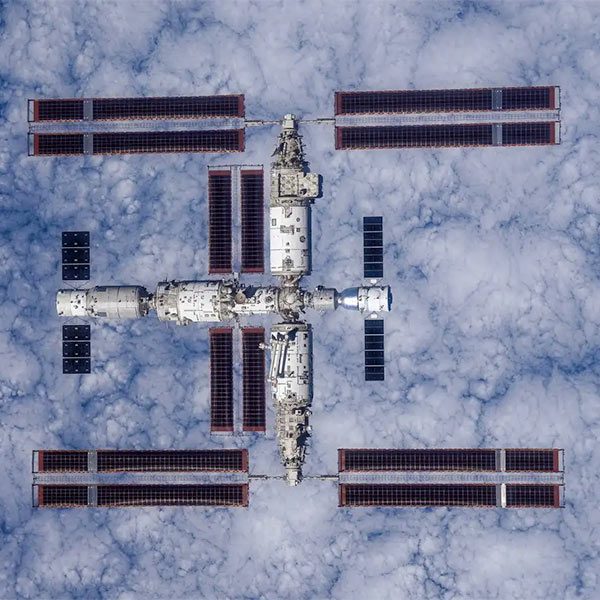
The Chinese Space Station — Tiangong, dropping the number — began assembly with the launch of the Tianhe core module on a Long March 5B from Wenchang on 29 April 2021. The Long March 5B’s large core stage reached low Earth orbit with insufficient velocity to maintain it, and the 21-tonne booster made an uncontrolled reentry in May 2021, with debris falling on the Ivory Coast. NASA administrator Bill Nelson publicly criticised China for failing to meet responsible standards for managing space debris — a criticism with some validity, though Nelson’s own agency was at that moment preparing to fly a rocket that burned its engines and discarded them in the ocean. The Wentian laboratory module followed in July 2022, the Mengtian module in October. Construction was completed on 5 November 2022, and China became the third entity to operate a permanently crewed space station, after the Soviet Union and the United States — and the only one to have built it entirely without foreign partnership, because no foreign partnership had been available.
Tiangong modules are self-contained and pre-assembled, in contrast to the US Orbital Segment of the ISS, which required spacewalking to interconnect cables, piping, and structural elements manually. The station is smaller than the ISS — three 22-tonne modules against the ISS’s 16 modules and 420 tonnes — but its design philosophy reflects a different set of constraints and ambitions. It was built to be operated by China alone, maintained by China alone, and expanded on China’s schedule. Multiple countries have expressed interest in sending astronauts to Tiangong. In 2025, China and Pakistan signed an agreement to send a Pakistani astronaut on a short-duration mission. As the ISS approaches retirement in 2030, Tiangong may become, for a period, the only crewed station in orbit.
The Moon in Sequence
While the station was being assembled, the Chang’e programme had been advancing through its phases with the same sequential discipline. Chang’e 3 achieved lunar orbit on 6 December 2013 and landed on 14 December 2013, becoming the first spacecraft to soft-land on the Moon since the Soviet Union’s Luna 24 in 1976, and the third country to successfully achieve the feat. It deployed the Yutu rover — Jade Rabbit — named in an online public vote. Yutu’s right front wheel jammed after two weeks, trapping it in a fixed position. Before it fell silent, it transmitted a message that the Chinese government released and that circulated worldwide: “I am the Jade Rabbit. I had some problems and my masters are on their way to fix me. Good night, humans.” Engineers found the lander itself still transmitting in December 2015, two years after landing, having survived conditions it was not designed to endure.
Chang’e 4 went further than anyone had gone before. On 3 January 2019, after months of preparation that included launching a dedicated relay satellite — Queqiao, the Magpie Bridge — into a halo orbit around the Earth-Moon L2 point to maintain communications with the permanently radio-shadowed surface, Chang’e 4 landed in the Von Kármán crater within the South Pole-Aitken basin on the lunar far side. No spacecraft had ever landed there. The far side never faces Earth; without the relay satellite, direct communication was impossible. The landing required the relay satellite to be placed precisely, the descent to be fully autonomous, and the landing site to have been mapped to sufficient resolution from orbit — all three of which China had spent the previous decade developing the capability to achieve. Su Yan, responsible for data reception at the Miyun ground station, later recalled: “When the signals were clearly visible, everyone cheered enthusiastically. Years of hard work had paid off in the most sweet way.”
Chang’e 5 launched on 23 November 2020, landed on the Moon on 1 December, and returned a sample of about 1.7 kilograms of lunar rocks and soil to Earth from the plains of Oceanus Procellarum. It was the first sample return from the Moon since the Soviet Union’s Luna 24 in 1976 — a 44-year gap. The mission’s four-component architecture — lander, ascent vehicle, orbiter, and return capsule — required autonomous rendezvous and docking in lunar orbit, a capability no Chinese mission had previously attempted at lunar distance. It worked on the first try. Analysis of the returned samples showed they were approximately 2 billion years old — significantly younger than the 3-to-4.5-billion-year-old samples collected during the Apollo missions — indicating that volcanic activity on the Moon had continued far longer than previous models predicted. China had not merely retrieved lunar material; it had revised the geological history of the Moon.
Chang’e 6, launched on a Long March 5 in May 2024, collected the first samples ever retrieved from the lunar far side — landing in the southern portion of the Apollo crater within the vast South Pole-Aitken basin on 1 June 2024 and returning nearly two kilograms of material to Earth on 25 June. The sampling drill left a hole in the shape of the character 中 — the first character of China’s name in Chinese, Zhōngguó. The symbolism, noticed immediately by Chinese social media, went viral. China had, in the space of four years, returned samples from both the near side and far side of the Moon. The United States has not returned lunar samples since Apollo 17 in December 1972.
The Race That Isn’t, and the Race That Is
The comparison between the American and Chinese lunar programmes reveals less about competition than about different relationships between ambition and institutional continuity. NASA’s Artemis programme, has been building toward a lunar landing since Bush announced Constellation in 2004. The programme was cancelled in 2010, reconstituted in 2011, renamed in 2017, flew its first uncrewed mission in 2022, and as of early 2026 has its crewed circumlunar mission on Pad 39B awaiting launch. China’s lunar programme was approved in January 2004 — the same month as Bush’s announcement — and has since orbited the Moon twice, mapped it completely, landed on it twice on the near side and once on the far side, returned samples from both hemispheres, and is building toward a crewed landing before 2030 using the Long March 10 rocket, the Mengzhou crewed spacecraft, and the Lanyue lander, all of which had completed primary hardware development by October 2025.
All development and construction work for China’s crewed lunar mission is proceeding as planned, China’s space agency announced at a press conference in October 2025, listing a sequence of completed milestones including captive firing tests for the Long March 10, a zero-altitude escape test for the Mengzhou spacecraft, and a comprehensive landing and takeoff verification test for the Lanyue lander. The Long March 10 is designed to lift 70 tonnes to low Earth orbit and 27 tonnes to trans-lunar injection. Two rockets will launch per crewed lunar mission: one carrying the crew in Mengzhou, one carrying the Lanyue landing stack; they rendezvous in lunar orbit before descent. The architecture is directly analogous to Apollo’s lunar orbit rendezvous approach — the same solution Houbolt argued for in 1961, vindicated by the same engineering logic sixty years later.
Beyond the first lunar landing, China’s fourth phase of lunar exploration targets a permanent robotic research station at the lunar south pole, with Chang’e 7 launching in 2026 to explore polar resources and Chang’e 8 in 2028 to test in-situ resource utilisation — extracting water ice, generating oxygen, 3D-printing structures from lunar regolith. The Long March 9 super-heavy rocket, with a planned payload capacity of 150 tonnes to low Earth orbit — comparable to the fully expendable Starship — targets a first flight around 2030 to support the construction of what China calls the International Lunar Research Station: a permanently inhabited base, open to international partners, targeted for the mid-2030s. Russia has signed an agreement to participate. A number of other nations have expressed interest. The United States, under the Wolf Amendment’s prohibition on bilateral NASA-China cooperation, is not among them.
The Mirror Image
The structural parallel between the two nations’ space programmes is almost too neat to be coincidental. Both have a crewed lunar programme targeting the late 2020s/early 2030s. Both have a super-heavy rocket in development. Both have a space station in orbit. Both have returned or plan to return samples from the Moon. Both are building toward a permanent lunar presence. Neither can formally cooperate with the other.
The difference is institutional pace. The American programme has crossed administrations, survived cancellations, been reconstituted by Congress for reasons that had as much to do with Alabama aerospace employment as lunar science, and is now flying hardware that traces its lineage to the Space Shuttle era on a per-launch cost that would fund the entire Chinese space programme for several years. The Chinese programme has had a single strategic plan — three steps, clearly defined — maintained across the same period without interruption, executed at a cost per mission that American analysts find difficult to assess because Chinese accounting is not transparent but that is universally agreed to be substantially lower than American equivalents.
The old space race was about ideology made visible in orbital mechanics — democracy versus communism, measured in who reached which altitude first. The new one is quieter, less televised, driven more by strategic interest in cislunar space as the next domain of geopolitical competition than by the kind of pure prestige calculation that motivated Sputnik. The Moon’s south pole contains water ice. Water ice, electrolysed, produces hydrogen and oxygen — rocket propellant. Whoever establishes a permanent presence in the permanently shadowed craters of the lunar poles, and whoever develops the technology to extract and use what’s there, will have a logistical advantage in the cislunar economy that could compound for decades. NASA administrator Bill Nelson has said publicly that he worries China will reach the Moon’s south pole first and claim the best resources. Chinese officials have said publicly that they worry the United States is trying to become “the overlord of space.” Both sides are worried about the other. Both sides are right to notice that the other is serious.
The pattern that began when Qian Xuesen was put under house arrest in 1955 and chose to spend the next forty years building China’s space programme has not changed in its fundamental character: external pressure has not slowed Chinese spaceflight, but redirected and intensified it. The Wolf Amendment that was passed to restrict Chinese access to American space technology in 2011 produced an independent Chinese space station that, when the ISS retires in 2030, may briefly be the only crewed station in orbit. The ITAR sanctions that ended American satellites on Chinese rockets in 1999 accelerated China’s development of indigenous satellite technology and commercial launch services that now compete globally for the contracts those sanctions were meant to protect. History suggests the competition will continue. History also suggests that the United States has been, on balance, a less effective architect of Chinese space policy than China has been.