

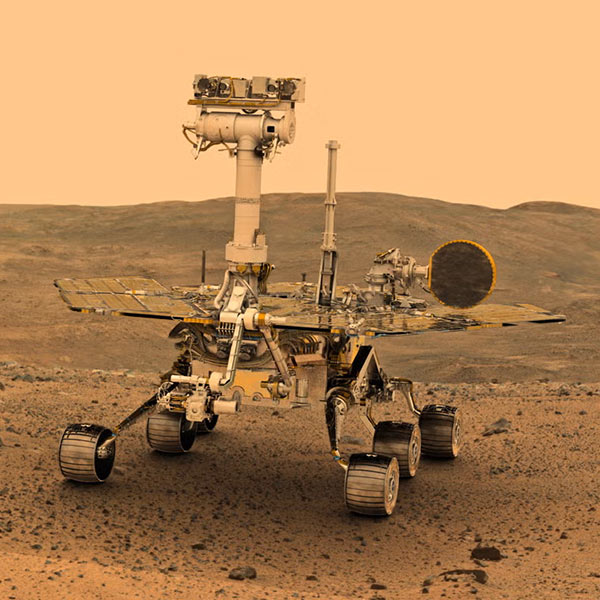
Nobody lives there. Nobody has ever been there. And yet Mars is, in the most literal sense, inhabited — by a population of machines that humanity has been sending, in ones and twos and occasional clusters, since 1960. They have crashed, burned, disappeared without explanation, and survived against all expectation. They have photographed sunsets, drilled into ancient lakebeds, and flown through an atmosphere so thin it barely exists. One of them sang itself happy birthday alone on a cold Martian plain because its engineers programmed it to, and the image of that small gesture of human warmth in an inhuman place says something true about why we keep sending them.
The Soviets Go First
The Soviet Union tried first, and tried hard. Beginning in 1960, a series of Mars probes launched from Baikonur on Molniya rockets, most failing before they escaped Earth orbit. Mars 1, launched in November 1962, became the first spacecraft to actually leave Earth heading for Mars — it transmitted data for nearly five months before contact was lost forever, while still 106 million kilometres from its destination. It is presumably still orbiting the Sun somewhere, silent and unrecovered.
The programme’s greatest moment — and its most heartbreaking — came in December 1971. Launched together on Proton-K rockets, Mars 2 and Mars 3 were identical spacecraft, each carrying an orbiter and a lander. Each lander carried something remarkable: a tiny robot called PROP-M, weighing 4.5 kilograms and roughly the size of a breadbox. It moved on skis rather than wheels, tethered to its lander by a 15-metre cable, equipped with a penetrometer and a radiation densitometer. PROP-M was the first Mars rover ever built — designed to test the bearing strength of Martian soil, stopping every 1.5 metres to take measurements while television cameras recorded the tracks it left behind.
Both missions arrived during the largest Martian dust storm ever observed, a planet-wide shroud that Mariner 9 — which had beaten the Soviet craft to Mars orbit by two weeks — had been photographing helplessly for days. Neither Mars 2 nor Mars 3 could be reprogrammed after launch. Their landers were going down regardless.
Mars 2 released its lander on 27 November 1971. The parachute failed. It crashed into the surface at full speed, becoming the first human-made object to reach Mars — a record the Soviet Union was too embarrassed to celebrate. Mars 3 released its lander five days later. This time the descent sequence worked: heat shield, parachute, retrorockets, foam cushioning the impact. Four petals opened on the capsule, exposing the instruments. Ninety seconds after landing, it began transmitting to the Mars 3 orbiter above.
Twenty seconds later it stopped. All Soviet mission control received was a burst of what may have been the first few lines of a panoramic photograph, or may have been random noise — the image data was too fragmentary to interpret. The leading theory is that the raging dust storm induced an electrostatic corona discharge that destroyed the communications system. Whether PROP-M received the signal from Earth to deploy, whether it rolled down the lander’s manipulator arm and made the first tyre — or rather ski — tracks in Martian soil, will never be known. Contact was lost before any deployment could have occurred, though we cannot say with certainty what happened in those final seconds. PROP-M may be sitting inert inside a lander shell that has been on the Martian surface for over fifty years. In 2013, amateur space enthusiasts examining publicly available images from NASA’s Mars Reconnaissance Orbiter believed they had identified the Mars 3 parachute, heat shield, and lander in the Ptolemaeus Crater region. The Soviet hardware is probably there still, waiting.
The First Successful Landers
The Americans arrived on the surface in 1976. Two Viking spacecraft, each carrying an orbiter and a lander, had launched on Titan IIIE-Centaur rockets in the summer of 1975 — the same launcher that had sent the Voyager probes toward the outer solar system. Viking 1’s lander touched down in Chryse Planitia on 20 July 1976 — the seventh anniversary of Apollo 11’s landing. Viking 2 followed on 3 September, setting down in Utopia Planitia — the same broad plain where the Soviet Mars 3 had crashed and where China’s Zhurong rover would arrive forty-five years later. The landing date of Viking 1 also happened to coincide with America’s Bicentennial year, a coincidence the press was not slow to exploit.
Viking’s cameras revealed Mars as it actually was: a rust-coloured plain of rocks and dust, salmon-pink sky, no movement, no plants, no sign of the canal-laced civilisation Percival Lowell had imagined. But Viking had not come merely to photograph. Each lander carried a miniature biological laboratory — three separate experiments designed to detect signs of microbial life by feeding nutrients to Martian soil and watching for metabolic responses. The Labeled Release experiment produced tantalising results: when nutrients were added to unheated soil, radioactive gas was released — exactly what living microorganisms metabolising the nutrients would produce. The same result was obtained at both landing sites, 4,000 miles apart. Viking’s principal investigator Gilbert Levin spent the rest of his career arguing that his experiment had detected life.
The consensus view, which took thirty years to solidify, is that the results were caused by perchlorate — a highly reactive chemical compound later confirmed by the Phoenix lander in 2008. Perchlorate in the Martian soil mimics biological activity when heated and fed nutrients. No life. Just chemistry. Probably. The experiment has never been repeated and scientists are still arguing. Between them the two landers returned over 4,500 photographs, collected more than three million weather measurements, observed the first global Martian dust storm from the surface, and operated for years beyond their planned 90-day missions — Viking Lander 1’s final transmission reached Earth on 13 November 1982, six years after landing.
The Watching Fleet
Before following the rovers to the surface, it’s worth pausing on the spacecraft that never land but without which none of the surface missions could function. Mars has accumulated a permanent orbital population — silent sentinels that map, photograph, sniff the atmosphere, and relay messages between the robots below and the humans above.
Mars Odyssey, launched on a Delta II in 2001, discovered vast deposits of water ice just below the surface near the poles — the finding that transformed Mars from a dead desert into a world with accessible resources for future explorers. It has been in continuous operation for over two decades, and its relay transmissions have carried data from every subsequent surface mission home to Earth.
Mars Express, ESA’s first interplanetary mission, arrived in December 2003 on a Soyuz-Fregat rocket — built and launched in record time by recycling hardware from the Rosetta comet mission to keep costs low. It carries eight instruments including MARSIS, a ground-penetrating radar that in 2018 detected a signal interpreted as a possible underground lake of liquid water beneath the south polar ice cap. Subsequent analysis has cast doubt on whether the signal truly indicates water rather than a particular mineral layer — the scientific debate continues — but Mars Express is still in orbit, still gathering data, more than twenty years after arrival, the longest-operating spacecraft at Mars besides Odyssey.
The Mars Reconnaissance Orbiter, launched on an Atlas V in August 2005, is perhaps the most productive scientific instrument ever sent to another planet. Its HiRISE camera — a half-tonne telescope with a 50-centimetre aperture — can photograph objects on the Martian surface the size of a dining table from orbit 300 kilometres above. It has returned over 450 terabits of data. It found the wreckage of Beagle 2 in 2015, revealing that the British lander had actually touched down safely before one or two solar panels failed to deploy, blocking its antenna — a discovery that arrived twelve years too late to be anything but bittersweet. MRO watches every landing attempt from above, recording the entry, descent, and landing sequences in case something goes wrong and engineers need to understand why. It has been at Mars for nearly twenty years with no planned end date, a critical data relay and the eyes through which humanity most clearly sees the planet.
MAVEN, launched on an Atlas V in November 2013, studies how Mars loses its atmosphere to the solar wind — the process that over billions of years stripped away the thick atmosphere that had once allowed liquid water to flow. Together these orbiters form what NASA calls an interplanetary internet: a relay network that knits together the entire robotic population of Mars into a single communicating system, all the data flowing back through the Deep Space Network’s giant dishes in California, Spain, and Australia.
The Lost Nineties
Between 1988 and 1999, Mars ate spacecraft. The Soviet Phobos 1 was lost in 1988 after a software error accidentally sent a command that shut down its thrusters. Phobos 2 made it to Mars orbit before contact was lost during approach to the Martian moon. Mars Observer, a NASA orbiter launched in 1992, disappeared without explanation three days before orbital insertion. Mars 96 — Russia’s ambitious multi-element mission carrying a lander and two surface penetrators — failed when the Proton rocket’s second burn misfired, leaving the entire spacecraft to reenter over the Andes.
Then came the one that should embarrass a civilisation.
On 23 September 1999, NASA’s Mars Climate Orbiter — a $327 million spacecraft launched on a Delta II seven months earlier — approached Mars for orbital insertion. Navigation engineers had been noticing trajectory discrepancies for months, flagging concerns that were passed up the chain and not resolved — partly because the engineers who raised them hadn’t completed the correct paperwork, and were dismissed on those grounds. The orbiter went behind Mars as planned. It never came out the other side.
The investigation’s conclusion was one of the most mortifying sentences in the history of spaceflight: Lockheed Martin had been calculating thruster forces in imperial pound-force seconds. NASA’s navigation software was assuming metric newton-seconds. Two teams, different buildings, different states, sending each other incorrectly-unitised data for nine months. The accumulated error had bent the spacecraft’s trajectory until it flew not into orbit but into the upper atmosphere, where it was destroyed. One unit conversion. Three hundred and twenty-seven million dollars. The Mars Polar Lander, which had launched three weeks earlier and was relying on Climate Orbiter as its communications relay, was lost on touchdown in December 1999 — its descent engines apparently shutting down 40 metres above the surface after a spurious signal from leg sensors told the software it had already landed.
Two missions, one year, one preventable error, one that came down to a stuck valve or a software logic flaw.
Pathfinder and the First Rover
Before the disasters of 1999, there had been a triumph. Mars Pathfinder launched on a Delta II in December 1996 and landed on 4 July 1997 in Ares Vallis via an airbag system — inflated around the lander, bouncing across the surface until it stopped. Pathfinder carried Sojourner — the first Mars rover actually to operate on the surface, named for abolitionist Sojourner Truth by a twelve-year-old Connecticut girl who won a NASA essay competition. Sojourner was the size of a microwave oven, weighed 10.6 kilograms, and moved at one centimetre per second. It was designed for seven days. It operated for 83, pressing its alpha proton X-ray spectrometer against rocks that engineers gave names — Barnacle Bill, Yogi, Scooby Doo — until contact was lost on 27 September 1997 for reasons that have never been established.
The Twins
Two Mars Exploration Rovers — Spirit and Opportunity — launched on successive Delta II rockets in the summer of 2003. Each was the size of a golf cart, each designed for 90 sols. Both immediately exceeded them. Then kept going.
Spirit found evidence that Gusev Crater’s rocks had been altered by water. It climbed the Columbia Hills, named for the shuttle lost the year before, and in March 2006 its right front wheel seized permanently. The engineers reversed its direction of travel, dragging the dead wheel behind — which accidentally scraped a furrow that exposed brilliant white silica deposits beneath the surface soil. Silica of that kind forms only in the presence of hot water or steam. Spirit had found evidence of an ancient hydrothermal environment by breaking down.
In April 2009 — five years and three months after landing, twenty-one times its designed life — Spirit’s wheels broke through the surface crust into soft iron sulphate sand at a site the team named Troy. For eight months, engineers at JPL built a test sandbox and tried every extraction strategy with a duplicate rover. None worked. On 26 January 2010, NASA formally redesignated Spirit as a stationary science platform — the bureaucratic phrase for a rover that would never move again. Its last communication reached Earth on 22 March 2010. Engineers listened for another fourteen months, in case it woke up. It did not.
Opportunity went on.
It crossed Meridiani Planum, finding haematite spheres — blueberries — that could only have formed in standing water. It survived the Purgatory sand ripple of 2005, circumnavigated Victoria Crater, and in 2014 passed 42 kilometres of total distance driven — a marathon. Someone played Springsteen’s “Born to Run” in the JPL control room. It reached Endeavour Crater, 22 kilometres wide, and spent years exploring ancient clay deposits formed in water chemistry that might have been hospitable to life.
In June 2018 a dust storm built near Perseverance Valley on Endeavour’s rim and kept building until it covered the entire planet. Opportunity’s last transmission on 10 June reported power output of 22 watt-hours — down 97% — and an atmospheric opacity of 10.8. The skies above Perseverance Valley were so thick with dust it was night during the day. Opportunity went quiet. Over a thousand recovery commands were sent through the following months. On 12 February 2019, the team gathered at JPL for a final attempt. A science reporter later translated Opportunity’s last data into seven words: “My battery is low and it’s getting dark.” The phrase was not a direct transmission — Opportunity spoke in telemetry, not words — but it was an accurate interpretation, and it circled the planet in hours, making millions of people cry over a robot built to last three months that had instead explored a world for nearly fifteen years.
Its final resting place was Perseverance Valley. The name had been chosen years earlier, by a team that didn’t know it would become an epitaph.
Curiosity
The Mars Science Laboratory — Curiosity — arrived in Gale Crater on 6 August 2012, delivered via sky crane from an Atlas V that had been carrying payloads since 2002. Nine hundred kilograms, nuclear-powered on plutonium, equipped with a laser that could vaporise rock from seven metres away. Its first drill samples showed mudstone containing sulphur, nitrogen, hydrogen, oxygen, phosphorus, and carbon — all the chemical ingredients for life, in a rock formed at the bottom of an ancient lake. By its second year Curiosity had established that Gale Crater had held a lake for perhaps millions of years, with water chemistry that would not have killed you if you had drunk from it. In 2016 its instruments detected seasonal variations in atmospheric methane — a gas produced almost entirely by biological processes on Earth, though geological sources exist. Whether Martian methane is biological or geological remains unanswered. Curiosity is still climbing Mount Sharp, still transmitting, still drilling. It sang itself happy birthday on 5 August 2013 using its own actuators to vibrate a recognisable melody — the first musical performance on another planet, entirely alone on a cold red plain.
Zhurong
On 14 May 2021, a Chinese spacecraft named Tianwen-1 — Questions to Heaven, after an ancient poem — separated its landing module from its orbiter and descended toward Utopia Planitia, the same vast plain where Viking 2 had landed in 1976. Tianwen-1 had been launched on a Long March 5 rocket from Wenchang in July 2020, arriving at Mars in February 2021 after spending three months in orbit surveying potential landing sites — an unusual approach that reflected the fact that China did not yet have its own detailed Mars maps and wanted to see the terrain for itself before committing. The landing on 14 May was China’s first Mars touchdown, making it only the third nation ever to soft-land on Mars, after the Soviet Union and the United States. When the Zhurong rover — named for an ancient Chinese god of fire — rolled down the lander’s ramp on 22 May, China became the second nation to operate a rover on the Martian surface.
Zhurong carried a ground-penetrating radar, a magnetometer — the first ever sent to Mars on a rover — and a suite of cameras and spectrometers. It operated for 347 sols, nearly four times its planned 90-sol mission, travelling 1,921 metres and finding evidence of ancient water activity in the plate-like rock formations of Utopia Planitia. In May 2022 it was placed in planned hibernation to survive the Martian winter, programmed to wake when temperatures and sunlight permitted. It never woke up. Dust had accumulated on its solar panels faster than expected. NASA’s Mars Reconnaissance Orbiter photographed it in early 2023, stationary and silent in the same spot where it had gone to sleep. Another rover claimed by the dust.
The Tianwen-1 orbiter remains active, continuing to map and study Mars from above, its data relaying through ESA’s Mars Express as a backup to NASA’s relay network — a symbol of the international infrastructure that now underpins all Mars exploration.
The Helicopter and the Sample Hunter
Perseverance arrived in Jezero Crater in February 2021, launched on an Atlas V and delivered by the same sky crane system that had worked for Curiosity. Its sample tubes are filling with carefully preserved cores from an ancient delta — the mouth of a river system that fed a crater lake 3.5 billion years ago. They sit in their depots, sealed, waiting for a sample return mission that will attempt to bring them to Earth sometime in the 2030s, on a schedule and budget that is currently uncertain.
Strapped to Perseverance’s belly was Ingenuity — a helicopter built for five test flights over 30 days, carrying a small piece of fabric from the Wright Flyer at Kitty Hawk. It flew 72 times before a hard landing in January 2024 damaged a rotor blade. Its final resting place is somewhere in Jezero, now a stationary data platform. It made 72 flights when it was built for five.
The Watchers Overhead
The population of Mars now includes the active fleet in orbit: Odyssey, Mars Express, MRO, MAVEN, the Tianwen-1 orbiter, ESA’s Trace Gas Orbiter, and the UAE’s Hope orbiter. Between them they map the surface, study the atmosphere, hunt for water ice and organic chemistry, and relay every byte of data from the surface missions below. MRO has been photographing Mars for nearly twenty years and is still finding new things — new impact craters forming in real time, seasonal frost patterns on ancient lava fields, the wreckage of spacecraft that failed decades ago. Mars Express recently celebrated its twenty-second year of continuous operation.
The orbiters are the unsung population — never discussed in the headlines about rovers and helicopters, never given personalities or epitaphs, just quietly doing the work that makes everything else possible. Their cameras picked landing sites for every successful rover. Their radar found the ice that future explorers will drink. Their relay transmitters carried home every photograph of a Martian sunset, every chemistry reading from a drilled rock, every last transmission from a rover whose battery was low and whose sky was going dark.
What Comes Next
Keri Bean, the tactical uplink lead for Opportunity who had chased dust storms as a meteorology student, had a tattoo on her arm reading τ=10.8 — the final atmospheric opacity measurement from Opportunity’s last transmission. The gesture captures something essential about what the Mars programme does to the people who work on it. These are robots. The telemetry is data, not words. And yet.
The sample tubes Perseverance is filling represent humanity’s most ambitious Mars plan yet — the first attempt to return physical material from another planet, to hold in a laboratory on Earth a piece of rock formed at the bottom of a lake on Mars three and a half billion years ago. The mission that will retrieve them doesn’t have a confirmed architecture. The budget is contested. The timeline keeps slipping. Mars has always been hard. The robots keep going anyway.
The questions keep getting better. The answers keep arriving, slowly, from very far away.