

The history of rocketry has always been the story of the next vehicle — the one that will do more, cost less, fly more often, go further. What distinguishes the current moment is that several of those next vehicles have arrived simultaneously, from different directions, built on different philosophies, with different answers to the same fundamental question: what does a rocket need to be in the era after SpaceX proved the economics wrong?
The answers on offer are: a rocket that serves European sovereign independence regardless of economics; a rocket that inherits the legacy of American national security launch and kills its Russian dependency; a rocket built by a company that took twenty-five years to reach orbit and names its boosters after Jim Carrey movies; and something that, if it works as designed, will make the other three look like footnotes.
Ariane 6: The Sovereign Option
In July 2023, the last Ariane 5 lifted off from Kourou and delivered its payload to orbit. It was the rocket’s 117th flight, a magnificent record of reliability that had made Europe the dominant commercial launch provider of the 1990s and 2000s. When it disappeared into the sky above French Guiana, Europe had no replacement ready. The Ariane 6 took so long that Europe lost its cherished independent access to space. For an entire year, the European Space Agency, the agency that had coined the phrase “independent access to space” as a foundational principle of European space policy, was buying launches from SpaceX.ESA director general Josef Aschbacher called it publicly what it was: a “launcher crisis.”
The crisis had been building for a decade. Ariane 6 had been approved in 2014, initially planned for a 2020 debut, and had then proceeded through a procession of delays caused by technical challenges, COVID-19, software problems, hydraulic system failures, and the accumulated difficulty of building an all-new rocket in an industrial ecosystem that hadn’t done a major new development since Ariane 5 entered service in 1996. Industry had not faced a major development ever since the beginning of the Ariane 5. The skills, the tooling, the organisational muscle memory for building something new from scratch — all of it had to be rebuilt alongside the rocket itself.
The vehicle that eventually emerged is genuinely capable. Ariane 6 comes in two configurations: the A62 with two solid P120C strap-on boosters, suited for medium payloads and government missions, and the A64 with four, intended for the heavy commercial dual-launch market that Ariane 5 had dominated. Its Vulcain 2.1 main engine burns liquid hydrogen and liquid oxygen on the first stage. Its Vinci upper stage — the genuinely new capability that Ariane 5 had never possessed — can reignite up to four times in space, allowing it to deliver payloads to multiple different orbits on a single mission and to deorbit itself cleanly at the end, rather than leaving debris in space. The ability to serve multiple customers with different orbital requirements on a single flight was designed to make Ariane 6 genuinely competitive in the multi-payload market that SpaceX had been capturing with Falcon 9.
On 9 July 2024, Ariane 6 lifted off for the first time. Cheers rang out in the control room as Ariane 6 strolled through milestones, including deploying its first satellites. ESA’s director general declared it “a historic day for Europe.” The head of ArianeGroup said “Ariane is back.” The president of France’s space agency declared “Europe is back in space.”
Their excitement turned out to be premature. Analysis shows that one temperature measurement exceeded a pre-defined limit and that the flight software correctly triggered a shutdown, entering the long coasting phase without the APU thrust and so degrading the proceeding of the demo phase. As a consequence, the third ignition sequence of the Vinci engine was not ordered by the flight software. The deorbit burn that should have sent the upper stage to a controlled reentry in the Pacific Ocean never happened. Two experimental reentry capsules, which couldn’t deorbit under their own power and depended on the stage to bring them down, were left stranded with it. The upper stage remains in low orbit, slowly decaying, having created the debris it was specifically designed to avoid.
The fault, when investigated, was as specific as it was frustrating: a temperature sensor on the Auxiliary Propulsion Unit used to pressurise the tanks between engine restarts read too high during the coast phase, triggering a safety shutdown designed for precisely this scenario. The shutdown was correct according to the software’s logic. The software’s logic was based on ground-test data that hadn’t fully captured the thermal environment of actual spaceflight. A single sensor reading, a single safety threshold, a single line of flight software standing between a successful demonstration and a stranded upper stage leaving debris in orbit above a planet whose space agencies have spent decades arguing for debris mitigation standards.
The second launch was therefore postponed to 6 March 2025, successfully delivering its first commercial payload to orbit — the CSO-3 French military reconnaissance satellite. The second launch had also slipped from its promised late-2024 date, because incorporating the software fix, completing the anomaly investigation, and preparing the launch site had taken longer than Arianespace’s post-anomaly press conference had suggested it would. The CEO’s assurance that the anomaly would have “no consequence on the next launches” had been technically accurate and practically misleading simultaneously.
As of 2026, the targeted launch rate has not yet been achieved, although when measured by cost per kilogram to orbit, costs have been reduced by 40%. The A64 variant, with four boosters, finally flew in February 2026. A backlog of approximately 30 missions awaits, 18 of which will deploy Amazon’s Project Kuiper internet constellation — a contract that gives Arianespace financial stability while it builds toward the cadence it needs to be commercially viable. A Block 2 version with upgraded P160C solid boosters and enhanced Vinci engine is due to enter service in 2026, adding approximately two tonnes of payload capacity.
The deeper question Ariane 6 faces has nothing to do with temperature sensors or launch cadence. It faces it because of the rocket this chapter ends with. The programme has faced criticism over its development costs and lack of reusability compared with competing vehicles such as SpaceX’s Falcon 9. Ariane 6’s projected launch price exceeds €100 million per mission — comparable to a reused Falcon 9, but without the reusability that allows SpaceX to amortise its costs across dozens of flights per vehicle. Europe made a deliberate decision in 2014 not to pursue reusability, judging the technology too uncertain and the investment too large. By 2024 that decision looked, in retrospect, like the wrong call at the worst possible time. Officials have noted that the vehicle’s long-term viability in the commercial market will depend on its ability to remain price-competitive against SpaceX’s Falcon 9.
The rocket components, to their credit, travel from European factories to Kourou aboard the Canopée — a cargo vessel that uses sails to assist its propulsion and reduce fuel use. It is an elegant detail: a rocket built in the era of reusability, transported by a ship that uses the wind.
Vulcan: The American Inheritance
United Launch Alliance had a problem, and the problem had a name: RD-180. The Russian-built engine that had powered the Atlas V since 2000 was extraordinarily capable — Energomash had designed it as a two-chamber derivative of the four-chamber RD-170 that powered Energia’s boosters, and it was by most measures the finest liquid oxygen/kerosene engine in operational service. It was also Russian. After Russia’s 2014 annexation of Crimea, a bipartisan congressional consensus emerged that the United States government should stop paying a Russian state enterprise tens of millions of dollars per year to launch national security satellites. A 2015 law directed ULA to phase out the RD-180 by 2022.
The replacement was Vulcan Centaur — a new rocket built around a first stage powered by two BE-4 engines from Blue Origin, burning liquid methane and liquid oxygen, mated to the proven Centaur upper stage that had been flying since 1962. ULA began development of the new launch vehicle in 2014, primarily to compete with SpaceX’s Falcon 9 and to comply with a Congressional mandate to phase out the use of the Russian-made RD-180 engine. The BE-4 was an engine that Blue Origin had been developing since 2011 — three years before Vulcan was announced — and whose development delays would substantially drive Vulcan’s own timeline. The first launch of the Vulcan Centaur was initially scheduled for 2019 but faced multiple delays due to developmental challenges with its new BE-4 first-stage engine and the Centaur second-stage.
On 8 January 2024, Vulcan lifted off from Space Launch Complex 41 at Cape Canaveral carrying Astrobotic’s Peregrine lunar lander — the first mission of NASA’s Commercial Lunar Payload Services programme, intended to be the first American lunar landing since Apollo 17. The rocket performed flawlessly. The payload did not. A propulsion system failure on Peregrine shortly after separation — a propellant leak that could not be stopped — prevented any lunar landing. Astrobotic turned the spacecraft around and directed it back toward Earth, where it reentered the atmosphere over the South Pacific on 18 January in a controlled reentry that Astrobotic described, with admirable restraint, as an “unplanned fiery end.” The robot that was supposed to land on the Moon burned up over the ocean while its controllers watched the telemetry.
Vulcan’s first launch was, from a rocket perspective, completely successful — ULA’s CEO Tory Bruno issued a joyful “yee-haw” at payload separation. The rocket had done its job. The mission hadn’t done its job. It was the kind of distinction that matters enormously in engineering and very little in headlines. What Vulcan’s first flight also carried, attached to its Centaur upper stage in a secondary payload, was the Celestis Enterprise Flight — cremated remains of the creator and beloved stars of the original Star Trek television series, including Gene Roddenberry, his wife Majel Barrett, Nichelle Nichols, and James Doohan. The Centaur, after completing its mission, was placed in a heliocentric orbit. The remains of the man who created Star Trek and the people who brought it to life are now orbiting the Sun, a permanent memorial in the solar neighbourhood that Roddenberry imagined humanity one day reaching. There is something fitting about that.
Vulcan Centaur lifted off on the second of two flights needed to certify the rocket for future NSSL missions at 11:25 UTC on October 4, 2024. Approximately 37 seconds into the launch, the nozzle on one of the solid rocket boosters fell off, resulting in a shower of debris in the exhaust plume. The rocket flew anyway, compensating for the asymmetric thrust, and achieved its target orbit. The Space Force certified Vulcan for national security launches. Its third flight, in August 2025, was Vulcan’s first classified national security mission — the culmination of a decade-long programme to end American dependence on Russian engines for its most sensitive payloads.
The architecture question that hangs over Vulcan is the same one that hangs over Ariane 6: it is an expendable rocket in the era of reusability. ULA has studied recovering Vulcan’s first stage engines — a programme called SMART reuse, in which the engine section separates after staging, deploys an inflatable heat shield, descends through the atmosphere, and is recovered by helicopter — but this has not been implemented. Whether Vulcan evolves toward meaningful reusability or remains a high-reliability expendable serving the national security market that tolerates the cost is a question its first decade of operations will answer.
New Glenn: Step by Step, Eventually
New Glenn is a serious machine, and its arrival in January 2025 changed the orbital launch landscape in ways that its years of delay had made easy to forget were coming. New Glenn is a heavy-lift vehicle standing 98 metres tall with a first stage powered by seven BE-4 engines producing 3.85 million pounds of thrust — more than twice a Falcon 9’s liftoff thrust — and a second stage burning liquid hydrogen and liquid oxygen. Its fairing is nearly seven metres in diameter, the largest commercial fairing in operation, offering more than twice the internal volume of a Falcon 9 fairing. For payloads that are large, heavy, or simply benefit from volume — certain military satellites, large commercial telecommunications platforms, Blue Origin’s own Blue Moon lunar lander — New Glenn has capabilities that Falcon 9 cannot match.
Blue Origin reached orbit on its first attempt on 16 January 2025, injecting its payload into medium Earth orbit after a clean ascent from Cape Canaveral’s Launch Complex 36 — the same pad that had launched Pioneer, Surveyor, and the Mars Observer. The booster, named “So You’re Telling Me There’s a Chance” — after a line from the 1994 Jim Carrey film Dumb and Dumber, a name chosen in acknowledgement of how difficult it would be to land a booster on the first attempt — descended toward the recovery ship Jacklyn and was lost. The ship was named after Bezos’s mother. The booster lost data contact during descent and was not recovered.
The second flight, carrying NASA’s twin ESCAPADE Mars probes in November 2025, successfully landed its first stage — named “Never Tell Me the Odds” — making Blue Origin the second company in history to recover an orbital-class rocket booster. SpaceX had been first in December 2015. A decade had passed.
On November 20, 2025, Blue Origin announced the development of a new super heavy-lift version of New Glenn, designated New Glenn 9×4. The variant will use nine BE-4 engines on its first stage and four BE-3U engines on its second stage. According to the company, it will be capable of launching more than 70,000 kilograms to low Earth orbit — a capacity that would make it the second most capable operational rocket after Starship. The announcement came five weeks after the first successful booster landing. Blue Origin is moving quickly now, which is a sentence that has not often been written.
Starship: A Different Category of Thing
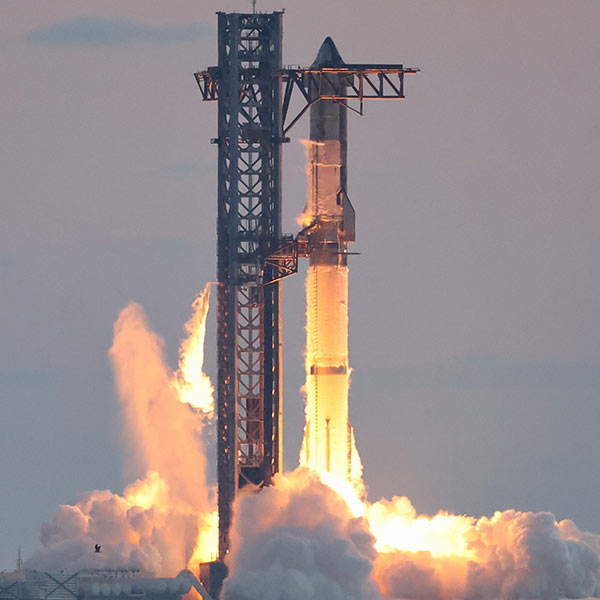
The three vehicles above are new rockets. Starship is something else. The numbers establish the category difference immediately. Super Heavy, Starship’s first stage, produces 16.7 million pounds of thrust at liftoff from 33 Raptor engines burning liquid methane and liquid oxygen — nearly twice the Saturn V’s 7.6 million pounds, making it the most powerful rocket ever built. The Starship upper stage is itself a 50-metre spacecraft designed to carry 100 tonnes to low Earth orbit, or 100 passengers to orbit, or any combination of cargo and crew to the Moon and Mars. Both stages are designed to be fully reusable. The target cost per launch, once reusability is mature, is in the order of a few million dollars — an order of magnitude below Falcon 9 and two orders of magnitude below SLS.
The development programme has been conducted by the standards of SpaceX’s iterative philosophy applied to the most ambitious engineering project in the history of private spaceflight. Vehicles have been built, tested to failure or near-failure, and the lessons applied to the next one. The process has been public, loud, and occasionally pyrotechnic.
Flight 1, April 2023: The most powerful rocket ever built left its pad at Boca Chica and immediately revealed that no flame diverter had been built beneath it. Debris scattered across 400 acres. The rocket flew for approximately four minutes before the flight termination system was commanded. The launch pad was destroyed. SpaceX rebuilt it with a steel plate water deluge system they called the “Steel Thunder” that could pour 40,000 gallons of water per minute beneath the engines at ignition.
Flights 2 and 3, November 2023 and March 2024: Successive improvements. The second reaching space before an anomaly destroyed it. The third reaching near-orbital velocity, the upper stage surviving reentry before contact was lost. Each flight further than the last, each failure teaching something the previous failure hadn’t.
Flight 4, June 2024: Both vehicles survived complete flight profiles and were recovered in controlled splashdowns — the first time the full system had demonstrated it could survive a complete mission.
Flight 5, October 2024: The booster catch. Super Heavy descended toward the launch tower and was grappled by the mechanical arms — Mechazilla — out of mid-air, a catch that took a fraction of a second for a vehicle that had been in the air for seven minutes. The crowd watching from the beach at Boca Chica screamed.
Flight 6, November 2024: A second booster splashdown — the catch was aborted when sensors on the tower chopstick arms were damaged at launch.
Flight 7, January 2025: A second successful booster catch, but the Block 2 upper stage — the new generation vehicle with 25% more propellant capacity and thousands of design changes — was lost on ascent.
Flight 8, March 2025: Another booster catch, another upper stage lost. Two consecutive Block 2 upper stages destroyed before reaching space, both from failures in the redesigned aft section around the engine bay, requiring investigation and redesign.
Flights 9, 10, and 11 progressively resolved the aft section issues and demonstrated the upper stage surviving reentry and splashing down successfully in the Indian Ocean. On October 13, 2025, Starship completed its eleventh flight test. Every major objective of the flight test was achieved. It was the final flight of the second-generation vehicle, as SpaceX prepares a version 3 that will be the first to reach orbit, carry operational payloads, and demonstrate propellant transfer — the critical technology that must work before Starship can refuel in orbit and proceed to the Moon.
The banana bears a mention. Flight 6 carried, as its first payload, a toy banana — a reference to the internet meme in which a banana is used as a scale reference in photographs, and which SpaceX had been using to illustrate Starship’s size in their own presentations. Someone at Boca Chica had put an actual banana in the payload bay of the world’s most powerful rocket. It flew to space. It came back down. The banana was recovered, technically intact. Musk posted a photograph of it.
The path from banana to Moon landing runs through a set of requirements that have not yet been demonstrated. Because the rocket is fully reusable, the Moon lander will use all of its propellant just reaching low Earth orbit. To send it to the Moon, SpaceX will need to launch 10 to 20 Super Heavy tanker flights to refill the lander’s tanks with the needed propellant. It also will need to somehow counteract the natural warming of the liquid oxygen and methane fuel that otherwise will cause the propellants to boil off. No orbital-class rocket has ever demonstrated in-orbit propellant transfer. Starship must demonstrate this, then demonstrate an uncrewed lunar landing, before it can carry Artemis astronauts to the surface. NASA’s Aerospace Safety Advisory Panel noted that the Artemis III lunar landing mission could be “years late” because of Starship delays.
The timeline is uncertain. The physics is not. If propellant transfer works and the upper stage catch works and the heat shield survives lunar reentry and the landing legs deploy reliably and all the other things that must happen do happen — Starship will be able to deliver payloads to low Earth orbit for a per-launch cost that collapses the economics of everything above it in this chapter. A Falcon 9, at a few hundred dollars per kilogram to LEO with a reused stage, was a revolution. Starship, at its target economics, is a multiplication of that revolution by an order of magnitude.
The Ariane 6 team knows this. The Vulcan team knows this. Blue Origin, whose New Glenn is competitive with Falcon 9 in a market that Starship may eventually restructure entirely, knows this. The question everyone in the launch industry is trying to answer is not whether Starship works — eleven flights of increasingly successful testing have made that question obsolete — but when, and at what cadence, and whether the operational reliability required for the national security and commercial markets can be achieved before the funding cycles that sustain the other vehicles run dry.
These are not engineering questions. They are business questions, political questions, questions about whether the institutions that have sustained human spaceflight for sixty years can adapt quickly enough to survive what is coming next. The launchpad for everything that comes next is, at the moment, in Boca Chica, Texas. It is currently being rebuilt for the version 3 vehicle. It will be ready before the end of 2026.