

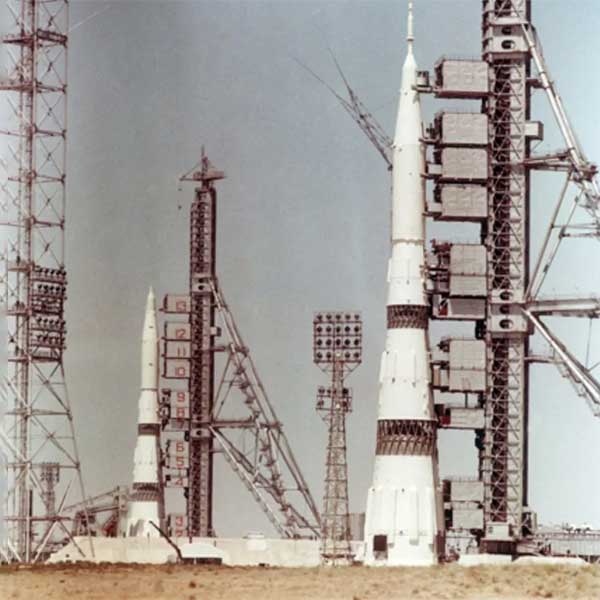
To understand why the Soviet lunar programme failed, you have to understand the peculiar structure of Soviet rocket development — and the men who ran it.
The Soviet space programme was not a single organisation with a unified chain of command. It was a collection of competing design bureaus, each led by a powerful chief designer, each fighting for funding, missions, and political favour from a leadership that understood prestige but not necessarily engineering. Where NASA had von Braun and a clear hierarchical structure answering ultimately to the administrator and the President, the Soviets had Korolev, Chelomei, Glushko, Yangel, and others — brilliant men who despised each other and competed as ferociously internally as they competed with the Americans externally.
Sergei Korolev’s vision for the Moon was Mars. Not metaphorically — he genuinely wanted to go to Mars, and saw the N1 rocket he had begun developing as a vehicle for interplanetary missions. Korolev was more interested in launching a heavy orbital station and sending crewed flights to Mars and Venus. The Moon was, in his thinking, a stepping stone. It was only after Kennedy’s 1961 announcement — and the political pressure that followed — that the Moon became the immediate objective.
The engine question nearly broke everything before it started. Korolev needed powerful first-stage engines for the N1, and the obvious man to build them was Valentin Glushko — the Soviet Union’s premier rocket engine designer, who had built the engines for virtually every significant Soviet rocket. But Korolev and Glushko had a history. Glushko had informed on Korolev to the NKVD during the purges, contributing to the arrest that had sent Korolev to the gulags. The two men were already personal adversaries, and they disagreed on the proper fuel for the N1. Glushko wanted hypergolic propellants — storable, reliable, the kind he knew. Korolev wanted liquid oxygen and kerosene, cleaner and higher-performing. Neither would yield.
They finally decided they could no longer work together. Korolev turned instead to Nikolai Kuznetsov — an aircraft engine designer with almost no rocket experience — to build the N1’s first stage engines. It was a decision born of personal animosity, and it would haunt the programme for the rest of its life.
Meanwhile, Vladimir Chelomei — who had Khrushchev’s son working in his bureau and thus enjoyed considerable political protection — was pursuing a parallel lunar programme, proposing a circumlunar flight using his Proton rocket and his own spacecraft. Between 1961 and 1964, with Khrushchev still in power, Chelomei’s approach received priority over Korolev’s. It was only after Khrushchev’s overthrow in October 1964 that the balance shifted. Korolev won the lunar landing assignment. Chelomei was given responsibility for planning a circumlunar flight to be carried out before the 50th anniversary of the Bolshevik Revolution in October 1967.
Two parallel lunar programmes. Two competing design bureaus. One country’s budget.
Building the Monster
The N1 that Korolev designed was a genuine titan. Standing 105 metres tall — slightly shorter than the Saturn V’s 110 metres — the complete N1-L3 system was composed of five stages. The first three formed the N1 itself, carrying the payload to low Earth orbit. Two additional upper stages would push the spacecraft toward the Moon. At its base, the first stage Block A was powered by thirty NK-15 engines arranged in two concentric rings — the outer ring of twenty-four and an inner ring of six, producing a combined thrust that on paper exceeded the Saturn V.
Thirty engines was an extraordinary number, born of necessity. The Soviet Union’s industrial capacity simply couldn’t produce engines large enough to do the job in fewer units. The decision to use thirty smaller engines instead of fewer larger ones was driven by the fact that the Soviet Union did not have the industrial capacity to build bigger engines at the time. To manage potential failures, engineers developed the KORD system — an automated engine monitoring network that would shut down a failing engine and its diametrically opposite counterpart simultaneously, keeping the thrust balanced. It was elegant in theory. In practice, the thirty-engine cluster created a plumbing system of nightmarish complexity, with fuel and oxidiser lines intertwining in ways that were almost impossible to inspect or test comprehensively.
And there was the testing problem. The Saturn V’s F-1 engines had been ground-tested exhaustively — individually, in clusters, on full-duration burns. NASA had built the infrastructure to do it. The N1 stages had to be transported by rail thousands of kilometres from their manufacturing plants to Baikonur. Static test facilities for the full first stage cluster were never built — Korolev, in a characteristic gamble, decided that single-engine tests adapted from existing rigs would be sufficient, and that the first full firing of all thirty engines together would happen in flight. The adverse characteristics of the large cluster of thirty engines and its complex fuel and oxidiser feeder systems were not discovered earlier in development because static test firings had not been conducted.
It was the single most consequential decision in the history of the programme.
Korolev’s Death and the Unravelling
On 5 January 1966, Korolev entered hospital in Moscow for what was described as routine surgery to remove intestinal polyps. The operation revealed colorectal cancer more advanced than the pre-operative assessment had shown. During surgery, complications arose — his jaw had been broken in the gulags and could not be fully opened, making intubation for anaesthesia difficult. Korolev’s heart stopped on the operating table. He was 59. His identity was revealed to the Soviet public only in his obituary.
The N1 programme lost the one person who had the authority, the political connections, and the sheer force of personality to hold it together. Vasily Mishin inherited a program already plagued with technical problems and delays. Mishin was a capable engineer — he had been Korolev’s deputy for years — but he was not Korolev. He was described by those who worked with him as cautious, indecisive, poor at managing people, and over-reluctant to take risks. Khrushchev had described him as not having “the slightest idea how to cope with the many thousands of people” that the programme required. Mishin also reportedly drank heavily under the pressure. He was trying to fill a space that nobody could have filled, in a programme that was already running behind and underfunded, with a rocket that had never been properly tested.
The Soyuz 1 disaster in April 1967 — Vladimir Komarov’s death during reentry, the first in-flight fatality in spaceflight history — consumed eighteen months of crewed programme time and shattered institutional confidence at the worst possible moment. The Zond circumlunar programme, which was supposed to have a cosmonaut looping around the Moon by the 50th anniversary of the Revolution in October 1967, suffered failure after failure. In September 1968, Zond 5 carried a biological payload including two tortoises around the Moon and safely back to Earth. But two months later Zond 6 depressurised and then crashed on landing, ending any hope for a quick crewed follow-on flight.
That Zond 6 failure was particularly bitter. Had it succeeded, a cosmonaut could plausibly have circled the Moon before Christmas 1968. Instead, NASA — reacting in part to CIA intelligence suggesting an imminent Soviet circumlunar attempt — made the extraordinary decision to send Apollo 8 to lunar orbit in December 1968. Speculation that the Soviet vehicle was manned prompted Apollo programme directors to move the launch of Apollo 8 from spring 1969 to winter 1968. Frank Borman, Jim Lovell, and Bill Anders became the first humans to orbit the Moon on Christmas Eve. The Soviets had inadvertently triggered the mission by simply rolling a mockup to the pad.
Four Attempts, Four Disasters
The first N1 reached its launch pad in January 1969. Apollo 9 was still weeks away. Apollo 10 hadn’t flown. If the N1 worked, if a crewed mission could be mounted quickly enough, the Moon landing race was still technically open. On 21 February 1969, the first N1 — designated 3L — launched from Baikonur.
About 70 seconds into the flight, telemetry indicated a fire had broken out in the Block A first stage. The fire spread rapidly, burning through wiring and control lines. At 106 seconds, all telemetry ceased as the rocket exploded, scattering debris across the Kazakh steppe. The KORD system’s electrical interference — triggered by the fire — had shut down all 28 remaining engines simultaneously. The failure was traced to a loose bolt that had rattled into a fuel line. A loose bolt.
The escape system fired and saved the unmanned payload. The programme pushed immediately to the next vehicle.
The second launch, on 3 July 1969, was the last possible moment at which a Soviet success could have complicated the Apollo 11 mission. It was, by any measure, the worst rocket disaster in history. At the very point of liftoff, debris in the LOX tank was sucked into one of the first-stage engines, causing its turbopump to explode. This led to a second engine failure, which triggered a chain reaction destroying several neighbouring engines and damaging the KORD control system. The N1 crashed back onto the launch pad and exploded 18 seconds after liftoff. The massive explosion destroyed Pad 110 East at Baikonur. The fireball was one of the largest non-nuclear explosions ever recorded on Earth. The launch pad was obliterated. It would take eighteen months to rebuild. The escape system fired and the payload landed safely about a kilometre away — small comfort given the magnitude of the catastrophe.
The explosion was filmed. The footage was classified. The Soviet Union denied that an N1 had ever existed.
Thirteen days later, Apollo 11 landed on the Moon.
The third N1 flew in June 1971, reaching higher than its predecessors before a ruptured propellant line caused it to crash 24-1 after 138 seconds. The fourth and final attempt came in November 1972 — by which point Apollo had already landed on the Moon five times. The rocket proceeded further than its predecessors, but shortly before first stage separation one engine caught fire, causing the entire structure to explode. The escape system saved the payload again. Nothing else had been saved.
Before that fourth flight, Mishin and his deputy had both been hospitalised due to exhaustion in the days before launch. They had approved the flight plan from their hospital beds.
What Might Have Been
The engineers who built the N1 were not incompetent. The NK-15 engines that Kuznetsov developed were, by some measures, extraordinarily advanced — their staged-combustion cycle achieved efficiencies that Western engineers didn’t match for decades. After the programme’s cancellation the engines were mothballed and hidden, their existence denied. When they were rediscovered in Russian warehouses after the Cold War, American rocket engineers bought them and were astonished by their performance. The NK-33 — an upgraded NK-15 — was sold to Aerojet and flew on American rockets in the 2010s. The engines that couldn’t save the Soviet lunar programme were good enough to power American launch vehicles forty years later.
The N1’s architecture could have succeeded given time, funding, and modern systems engineering. It didn’t get those conditions. The programme started four years after Saturn V. It was chronically underfunded. It lost its chief designer at the worst possible moment. It was run by competing bureaus that never fully cooperated. And it was never allowed to properly test the one component that mattered most.
Mishin was ousted in 1974, replaced by — of all people — Valentin Glushko, Korolev’s old enemy. Glushko had long been a rival of Korolev and Mishin, and now had his chance to lead the Soviet space programme in a new direction. One of his first decisions was to cancel the N1 entirely. The completed vehicles were scrapped. The launch pads were demolished. The programme was erased from official records so thoroughly that its existence wasn’t acknowledged until glasnost began lifting the curtain in 1989.
Alexei Leonov — the man who had walked in space, the man who had been selected to be the first Soviet cosmonaut on the Moon — spent decades watching the programme he had trained for simply not exist in the official history. He said, later, that he believed the Soviets could have beaten Apollo to a crewed lunar landing if Korolev had lived. Whether that’s true is unknowable. What is certain is that Korolev was the one person who might have forced the programme to be what it needed to be — properly funded, properly tested, properly managed — and that without him, it had no chance at all.