

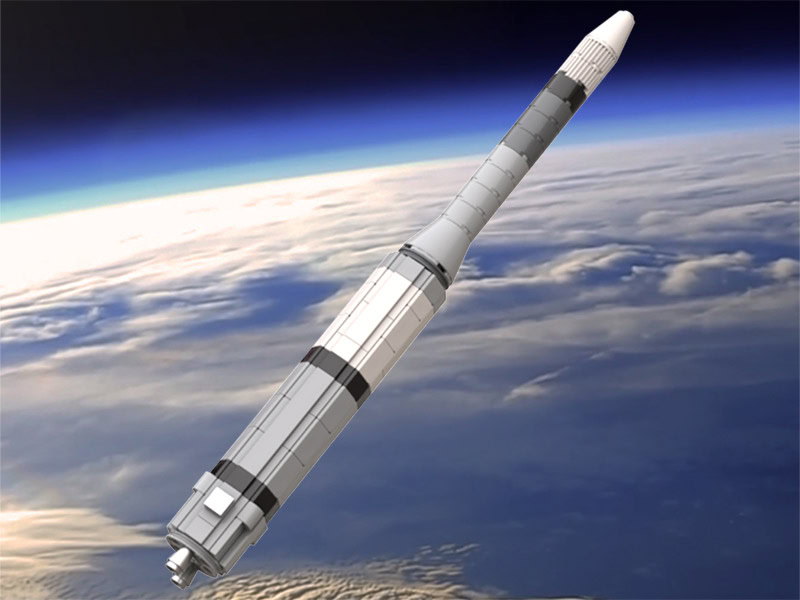
LEGO Designer:
Dan Fallon (phreaddee)
Designed:
June 2023
Categories:
unlisted
Launch Vehicle Details
Stages:
3
Length:
33m
Diameter:
3.05m
Mass at Launch:
230,750 lb
Low Earth Orbit Capacity:
200kg
Total Thrust:
337,200 lb
Apogee:
300km
Class:
Orbital
ELDO Europa program
The ELDO Europa program was a collaborative effort among several European countries to develop a launch vehicle capable of placing satellites into orbit. As part of this program, the European Space Research Organisation (ESRO) conducted a series of test launches of the Europa rockets, and some of these launches took place at the Woomera Rocket Range in Australia.
The choice to launch Europa rockets from Woomera was driven by a few factors. Firstly, Woomera offered a remote location with a large expanse of uninhabited land, providing ample space for testing and launching rockets. The vast area and clear range allowed for safe and controlled launches without endangering populated areas.
Furthermore, Woomera provided favourable launch conditions due to its proximity to the equator. Launching from a location closer to the equator can take advantage of the Earth’s rotational velocity, which aids in achieving greater payload capacity and efficiency for reaching orbit.
Between 1966 and 1971, a total of seven Europa rockets were launched from Woomera as part of the ELDO program. These launches aimed to test and refine the Europa rocket design, evaluate its performance, and gather valuable data for further improvements.
The launches at Woomera faced their share of challenges and setbacks, including some failures and anomalies. However, several successful launches occurred, with Europa rockets reaching orbit and deploying experimental payloads, including satellites developed by ESRO.
The collaboration between ELDO and Woomera allowed European scientists and engineers to benefit from the extensive facilities and expertise available at the Woomera Rocket Range. Woomera provided the necessary infrastructure, such as launch pads, tracking systems, and support facilities, to enable the Europa rocket tests and data collection.
The experience gained from launching Europa rockets from Woomera and the data gathered during those missions contributed to the development and improvement of the Europa rocket design. The knowledge gained from the Woomera launches helped refine the technology and later contributed to the development of the successful Ariane rocket family, which became Europe’s primary launch vehicle for commercial satellite launches.
Part count: bricks, lots.
| Unit | width | length | height |
|---|---|---|---|
| Studs | |||
| Inches | |||
| Centimetres |
No: TNo.: Serial Type Date LS Payload
 4      1    F-4      Europa-1 (1 stage)      23.05.1966    Wo LC-6A  * (R/D)
 5      2    F-5      Europa-1 (1 stage)      14.11.1966    Wo LC-6A  * (R/D)
 6      1    F-6/1    Europa-1 (2 stage)      04.08.1967 F  Wo LC-6A  * (R/D)
 7      2    F-6/2    Europa-1 (2 stage)      04.12.1967 F  Wo LC-6A  * (R/D)
 8      1    F-7      Europa-1                29.11.1968 F  Wo LC-6A    STV 1
 9      2    F-8      Europa-1                02.07.1969 F  Wo LC-6A    STV 2
10      3    F-9      Europa-1                12.06.1970 F  Wo LC-6A    STV 3
11      1    F-11     Europa-2                05.11.1971 F  Ko CECLES   STV 4


Failures:

Flight  6:      Stage 2 failed
Flight  7:      Stage 2 failed
Flight  8:      Stage 3 failed
Flight  9:      Stage 3 failed
Flight 10:      payload fairing failed to seperate
Flight 11:      structural failure of Stage 3


Launch sites:

Ko  =    Centre Spatial Guyanais (CSG), Kourou, French Guiana, France
Wo  =    Woomera Instrumented Range, Woomera, South Australia, Australia
Launch History information from space.skyrocket.de
Launch History information from space.skyrocket.de
Related Posts
None found